Google Ads: A Complete Guide to Growing Your Business Online
In today’s digital world, reaching the right customers at the right time is one of the biggest challenges for businesses. People are constantly searching for products, services, solutions, and information online. Google Ads gives businesses an opportunity to appear in front of these potential customers when they are actively looking for something related to what the business offers.
Whether you want more website visitors, phone calls, enquiries, leads, or sales, Google Ads can be an effective part of a digital marketing strategy when planned and managed correctly.
But how does Google Ads actually work? What types of campaigns are available? How much does it cost? And how can a business get better results from its advertising budget?
Let’s understand it step by step.
What Is Google Ads?
Google Ads is Google’s online advertising platform that allows businesses to promote their products and services across Google’s advertising network.
Businesses can create advertisements that may appear when people search for relevant terms on Google or interact with other Google properties and partner placements, depending on the campaign type.
For example, imagine a person searches for:
“website development company near me”
A company offering website development services could use Google Ads to potentially show an advertisement to that person.
This is one of the major advantages of Google Ads: businesses can reach people who are already showing interest in a particular product or service.
How Does Google Ads Work?
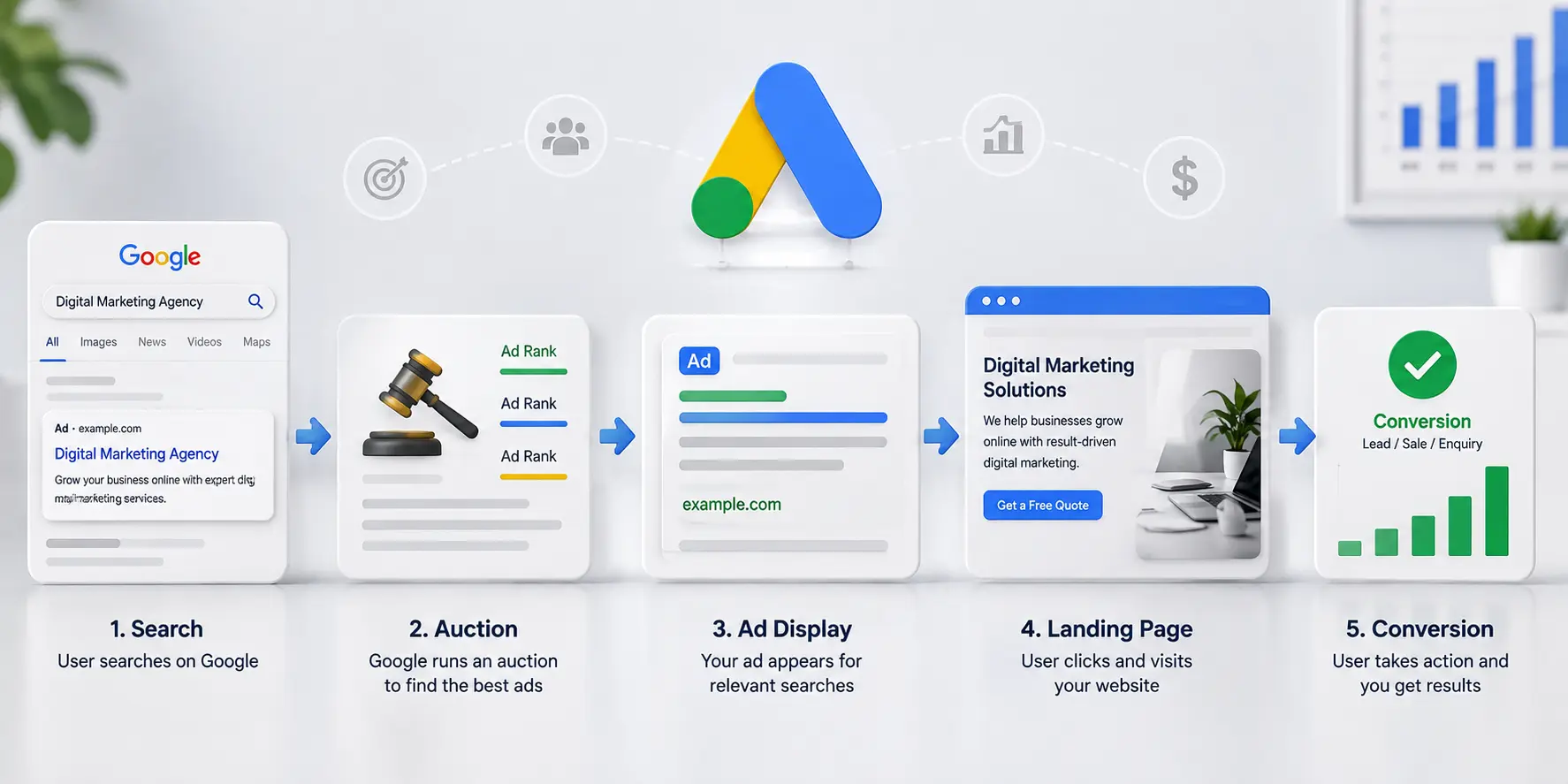
Google Ads operates through an advertising auction.
When someone performs a search that can trigger an advertisement, Google evaluates eligible ads and determines which ones can appear and in what position.
The result isn’t simply determined by which advertiser is willing to pay the most.
Google considers multiple factors, including the advertiser’s bid, the quality and relevance of the advertisement, the landing page experience, and other contextual signals.
This means that simply increasing your advertising budget doesn’t automatically guarantee the best results.
A well-structured campaign with relevant keywords, strong advertisements, appropriate targeting, and a useful landing page can make a significant difference.
Why Do Businesses Use Google Ads?
One of the biggest reasons businesses use Google Ads is the ability to reach people who are actively searching for relevant products and services.
Consider the difference between these two situations:
Situation 1:
Someone sees a random advertisement while browsing the internet.
Situation 2:
Someone searches for “digital marketing agency” and sees an advertisement from a digital marketing company.
The second situation can represent stronger purchase intent because the person has already expressed an interest through their search.
Google Ads allows businesses to take advantage of these moments of intent.
Major Types of Google Ads Campaigns
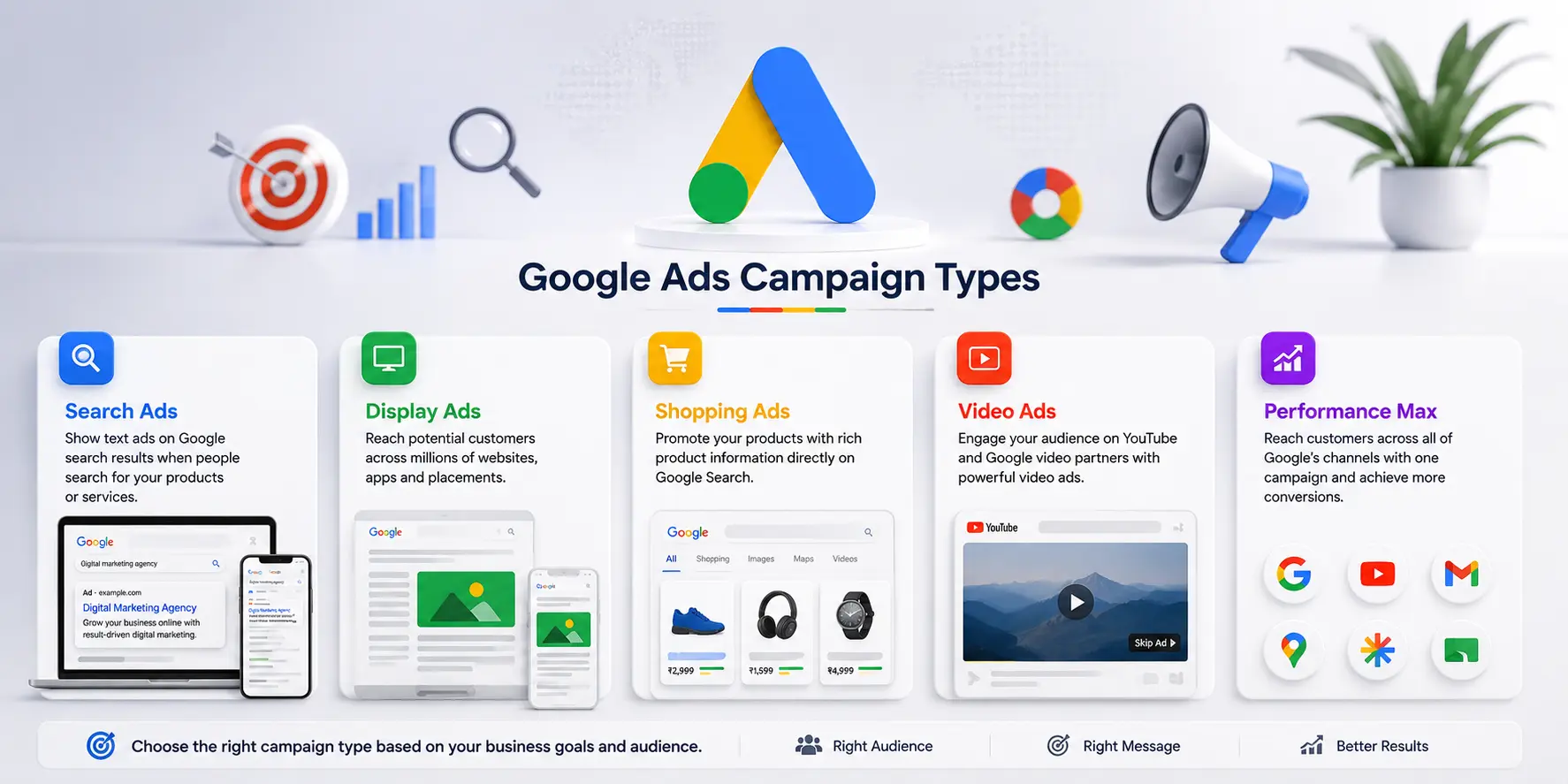
Google Ads offers different campaign types designed for different marketing objectives.
1. Search Ads
Search campaigns are among the most commonly used forms of Google advertising.
These advertisements can appear when users search for terms related to the products or services being advertised.
For example, a business providing graphic design services might target searches related to:
- Graphic design services
- Logo design company
- Branding agency
- Professional graphic designer
Search advertising can be particularly useful for businesses that want to generate enquiries, leads, website visits, or sales from people actively searching for their offerings.
2. Display Ads
Display advertising allows businesses to promote visual advertisements across websites, apps, and other placements within Google’s Display Network.
Unlike Search Ads, users don’t necessarily have to search for the business’s product or service at that moment.
Display campaigns can therefore be useful for objectives such as:
- Building brand awareness
- Reaching new audiences
- Remarketing
- Promoting products
- Supporting larger marketing campaigns
Strong visuals and clear messaging are especially important for Display advertising.
3. Shopping Ads
Google Shopping campaigns are designed primarily for businesses selling products online.
Shopping ads can display product information such as:
- Product image
- Product name
- Price
- Store information
This allows potential customers to see important product information before visiting a website.
For e-commerce businesses, Shopping advertising can be an important way to bring product-focused traffic to an online store.
4. Video Ads
Video advertising allows businesses to promote their products, services, or brand through video content.
These advertisements can appear across Google’s video advertising ecosystem, including YouTube.
Video can be particularly effective when a business wants to demonstrate:
- How a product works
- What a service looks like
- Customer experiences
- Brand stories
- Tutorials
- Product features
Good storytelling can make video advertising more memorable than relying only on static advertisements.
5. Performance Max
Performance Max campaigns allow advertisers to access multiple Google advertising channels through a single campaign.
Advertisers provide information such as campaign goals, creative assets, audience signals, and other inputs, while Google’s automated systems help optimize campaign delivery toward the selected objectives.
This approach can be useful for businesses that want to reach potential customers across multiple Google surfaces rather than managing each channel separately.
However, proper conversion tracking and high-quality campaign inputs are important for getting useful results.
What Are Keywords in Google Ads?
Keywords are words or phrases that help Google understand what searches are relevant to an advertisement.
For example, if you run a business offering website development services, you might consider keywords such as:
- Website development services
- Website design company
- Business website development
- Professional website designer
The goal isn’t simply to collect as many keywords as possible.
The goal is to identify keywords that are closely connected to your business and have meaningful customer intent.
Choosing irrelevant or overly broad keywords can result in wasted advertising spend.
Understanding Search Intent
Keyword selection becomes much more effective when you understand search intent.
Different searches can indicate different levels of interest.
For example:
Informational intent:
“What is website development?”
Research intent:
“Best website development companies”
Commercial intent:
“Website development company pricing”
Transactional intent:
“Hire website developer”
These searches don’t necessarily represent the same type of customer.
Understanding intent can help businesses create more relevant campaigns and advertisements.
How Much Does Google Ads Cost?
There isn’t one fixed price for Google Ads.
The cost depends on factors such as:
- Industry
- Competition
- Keywords
- Location
- Audience
- Campaign type
- Ad quality
- Bidding strategy
- Campaign objectives
- Market demand
Google Ads generally operates through an auction system, so the amount advertisers pay can vary depending on the circumstances of each advertising interaction.
This means there is no universal answer to the question:
“How much does Google Ads cost?”
A business can decide how much it wants to spend within its campaign settings, but controlling the budget alone isn’t enough. The campaign also needs to be optimized so that the budget is directed toward meaningful results.
Google Ads vs Organic Google Search
Google Ads and organic search engine optimization are two different approaches.
Google Ads
- Paid advertising
- Can generate visibility quickly after campaigns become eligible to serve
- Allows detailed campaign targeting and budget control
- Useful for promoting specific products and services
- Costs are associated with advertising interactions and campaign delivery
Organic SEO
- Focuses on improving unpaid search visibility
- Usually requires longer-term effort
- Relies on content, technical SEO, authority, relevance, and user experience
- Can generate ongoing traffic without paying for every organic click
For many businesses, Google Ads and SEO work best together.
Google Ads can support immediate campaign objectives while SEO builds long-term organic visibility.
How to Create an Effective Google Ads Campaign
Running a Google Ads campaign involves more than writing an advertisement and setting a budget.
Here is a practical process.
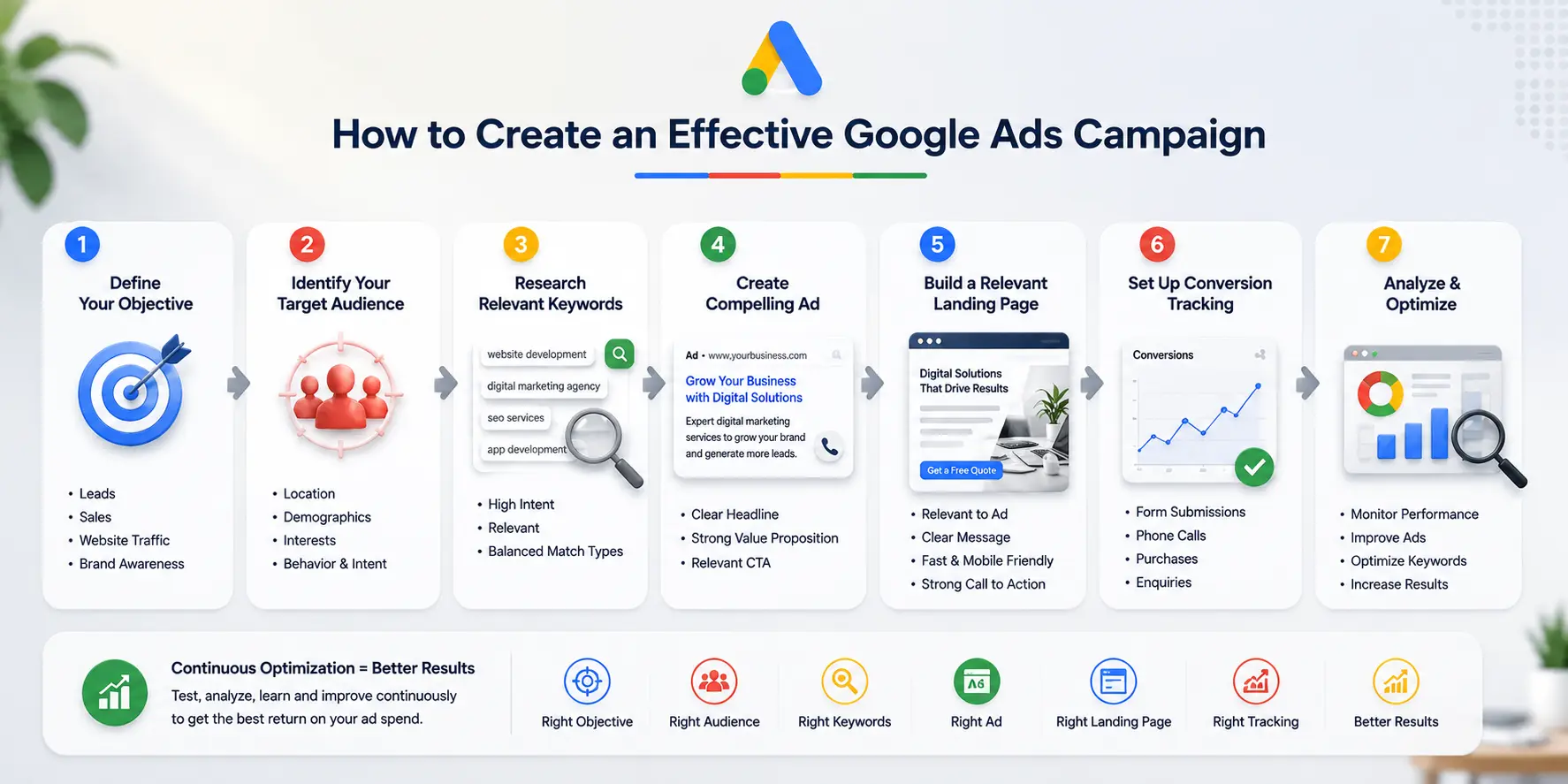
Step 1: Define Your Objective
Start by deciding what you want the campaign to accomplish.
For example:
- Generate leads
- Increase online sales
- Receive phone enquiries
- Drive website traffic
- Promote a product
- Increase bookings
A clear objective makes it easier to choose the right campaign structure and measure success.
Step 2: Identify Your Target Audience
Think about who you actually want to reach.
Consider factors such as:
- Location
- Customer needs
- Search behavior
- Interests
- Purchasing stage
- Demographics where relevant
The more clearly you understand your customer, the easier it becomes to create relevant advertising.
Step 3: Research Relevant Keywords
Choose keywords that are closely related to your products or services.
Don’t focus only on high search volume.
A keyword with lower search volume but stronger commercial intent may be more valuable than a popular keyword that attracts people who aren’t ready to buy.
Step 4: Write Relevant Ad Copy
Your advertisement should clearly communicate:
- What you offer
- Why customers should consider you
- What makes your business different
- What action the customer should take
For example, instead of a vague advertisement saying:
“Professional Digital Services”
a more specific message could communicate the actual service, benefit, and next step.
Clear messaging helps potential customers understand what they can expect when they click.
Step 5: Create a Relevant Landing Page
One of the most overlooked parts of Google Ads is the landing page.
Imagine someone searches for “logo design services” and clicks your advertisement, but the page they reach only talks about general digital marketing.
That creates a disconnect.
The landing page should closely match the advertisement and the user’s search intent.
A good landing page should be:
- Relevant
- Easy to navigate
- Mobile-friendly
- Fast-loading
- Clear about the offer
- Focused on a specific action
Step 6: Set Up Conversion Tracking
Clicks and impressions are useful, but they don’t necessarily tell you whether your advertising is producing business results.
Conversion tracking helps businesses understand actions that matter, such as:
- Form submissions
- Purchases
- Phone calls
- Sign-ups
- Bookings
- Other valuable customer actions
Without reliable conversion data, it can be difficult to understand which parts of a campaign are actually working.
Common Google Ads Mistakes
Even businesses that invest in Google Ads can make mistakes that reduce campaign performance.
Using Irrelevant Keywords
Targeting unrelated searches can consume budget without producing valuable results.
Sending Every Ad to the Homepage
The homepage isn’t always the best destination for every advertisement.
A dedicated service or product page can provide a more relevant experience.
Ignoring Negative Keywords
Negative keywords can help prevent advertisements from showing for searches that aren’t relevant to the business.
Focusing Only on Clicks
A campaign can generate many clicks without generating meaningful leads or sales.
Business outcomes should be considered alongside traffic metrics.
Not Testing Ad Variations
Testing different messaging, headlines, offers, and landing pages can reveal what resonates better with your audience.
Setting a Budget Without a Strategy
A larger budget doesn’t automatically fix a poorly structured campaign.
Campaign structure, targeting, relevance, conversion tracking, and optimization all matter.
How to Improve Google Ads Performance
Once a campaign is running, optimization becomes an ongoing process.
Businesses can review:
- Search terms
- Conversion rates
- Cost per conversion
- Click-through rates
- Ad performance
- Keyword performance
- Landing page performance
- Geographic performance
- Audience performance
The purpose of optimization isn’t simply to reduce advertising costs.
The bigger goal is to generate better business results from the available advertising budget.
For example, if one campaign generates many inexpensive clicks but very few enquiries, while another generates fewer clicks but more qualified leads, the second campaign may be more valuable to the business.
Is Google Ads Right for Every Business?
Google Ads can be useful for many types of businesses, but its effectiveness depends on the market, offer, competition, customer behavior, website quality, and campaign strategy.
It can be particularly useful when:
- People actively search for your products or services
- You have a clear business offer
- Your website can convert visitors
- You can track meaningful conversions
- You have a realistic advertising budget
- You are prepared to monitor and optimize campaigns
Before spending money on advertising, businesses should understand their customers and determine whether Google Ads aligns with their marketing objectives.
Google Ads and Digital Marketing Strategy
Google Ads should not always be treated as an isolated marketing activity.
It can work alongside other digital marketing channels such as:
- Search engine optimization
- Social media marketing
- Content marketing
- Email marketing
- Website development
- Local SEO
- Remarketing
- Online reputation management
For example, a customer might first discover a business through an advertisement, visit its website, leave without making an enquiry, and later return through organic search or another marketing channel.
A coordinated digital marketing strategy can help businesses stay connected with potential customers throughout their decision-making process.
The Future of Google Ads
Google Ads continues to evolve as search behavior, technology, automation, and consumer expectations change.
Automation and artificial intelligence are increasingly being integrated into campaign management, targeting, bidding, creative development, and optimization.
At the same time, the fundamentals of successful advertising remain important:
Understand your customer. Create a relevant offer. Deliver a useful experience. Measure the results. Improve continuously.
Technology can make advertising more sophisticated, but businesses still need a clear strategy behind the technology.
Conclusion
Google Ads can be a powerful tool for businesses that want to reach potential customers when they are actively searching for relevant products and services.
From Search and Display advertising to Shopping, Video, and Performance Max, Google provides different campaign options for different marketing objectives.
However, successful advertising isn’t simply about spending money to get clicks.
The strongest campaigns combine careful targeting, relevant keywords, compelling advertisements, high-quality landing pages, accurate conversion tracking, and continuous optimization.
When Google Ads is integrated with a broader digital marketing strategy, it can become more than just a source of website traffic. It can become a channel for generating meaningful leads, sales, enquiries, and long-term business growth.
The goal isn’t to get more clicks. The goal is to get the right clicks from the right people and turn those opportunities into real business results.
 Previous Post
 Next Post