AI in Marketing: How Artificial Intelligence Is Changing the Way Businesses Grow
Marketing is no longer just about creating advertisements and reaching as many people as possible. Customers expect relevant content, quick responses, personalized experiences, and brands that understand their needs. This is where AI in marketing is becoming increasingly important.
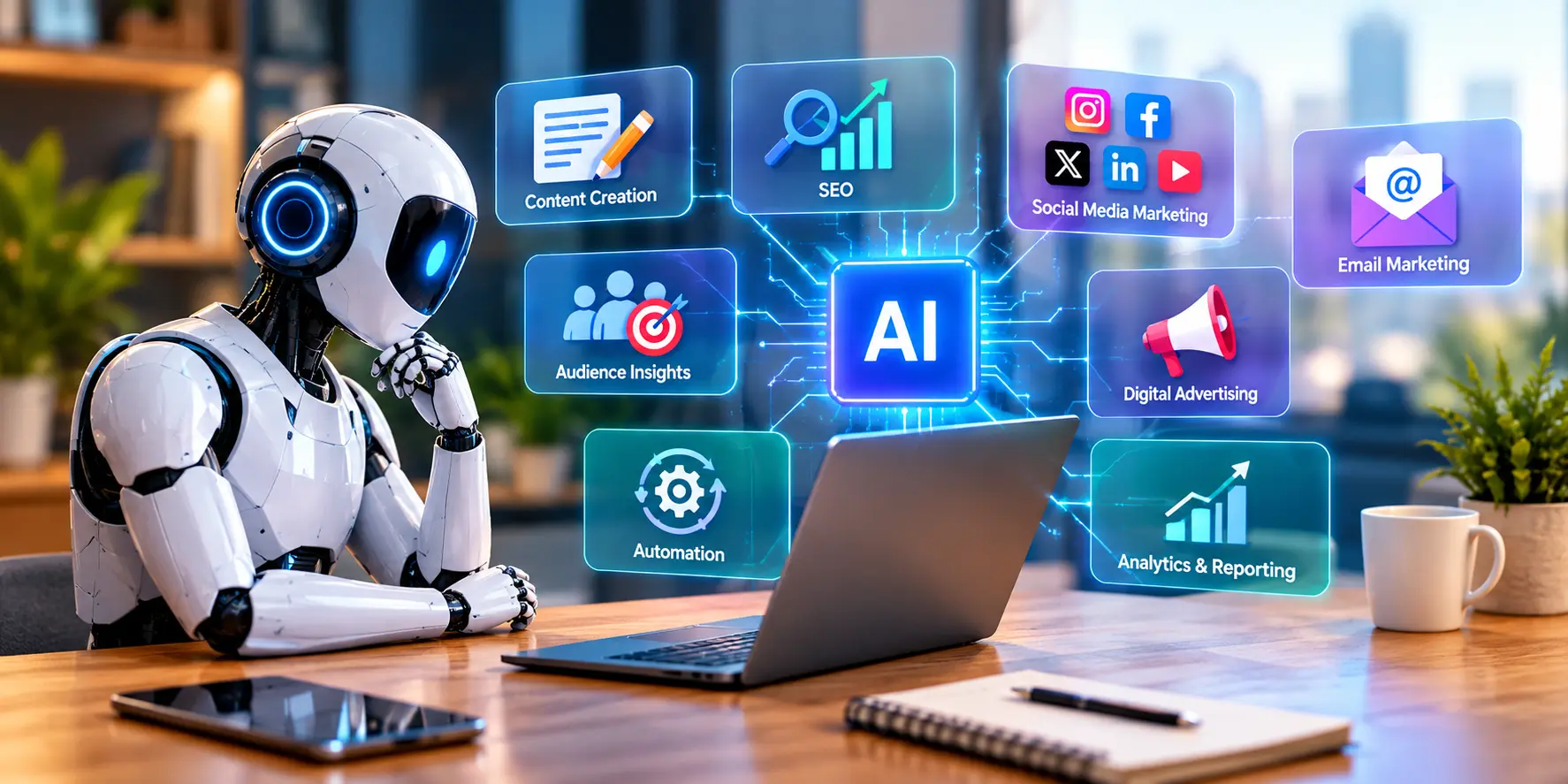
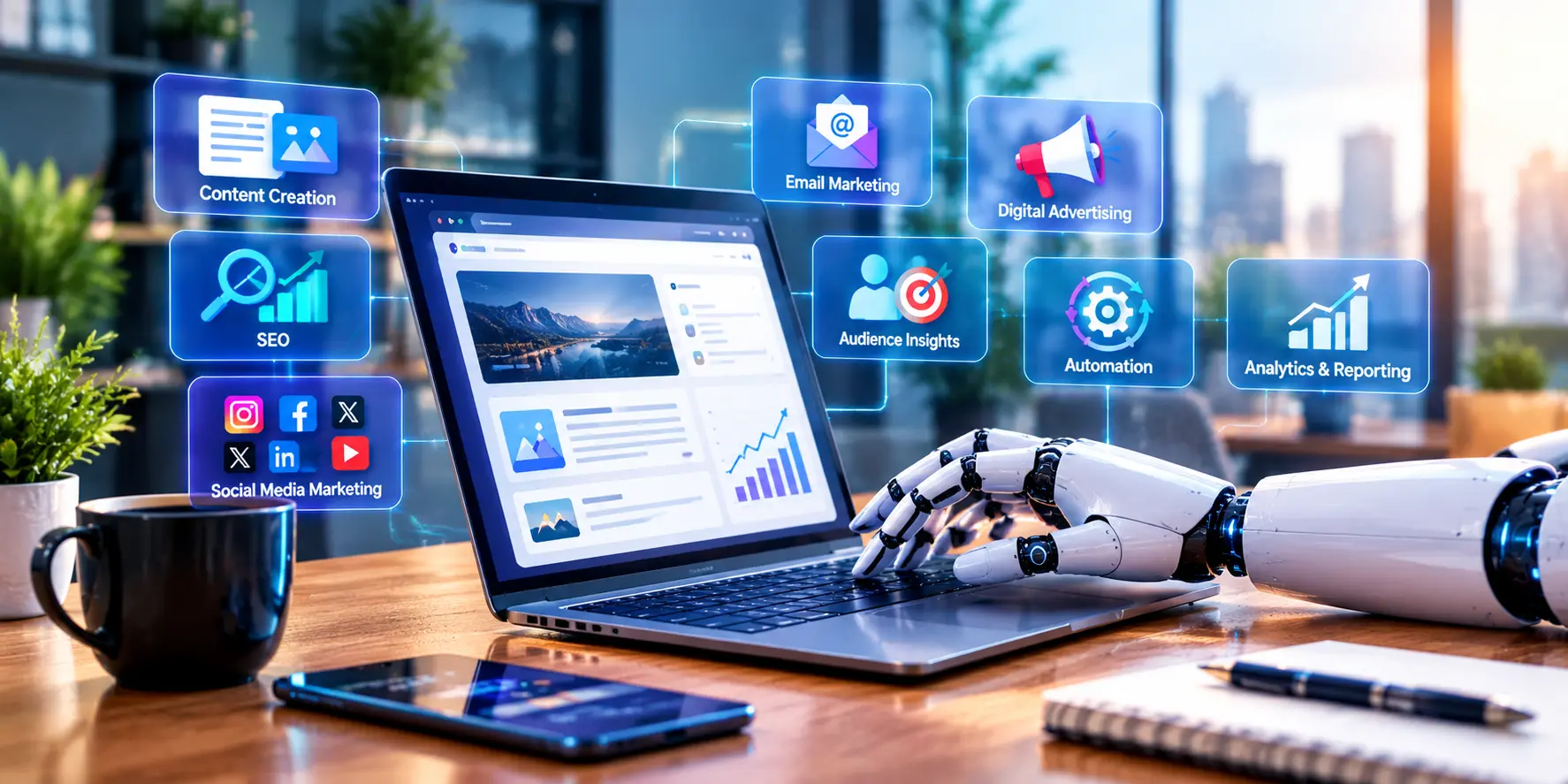
Artificial intelligence can help businesses analyze customer behavior, create content, automate repetitive tasks, improve advertising campaigns, and make better marketing decisions. Instead of replacing marketers, AI can work alongside marketing teams to help them save time and focus on strategy and creativity.
In this guide, we explore how AI is transforming marketing and how businesses can use it effectively.
What Is AI in Marketing?
AI in marketing refers to using artificial intelligence technologies to perform or improve marketing activities.
AI systems can process large amounts of information, identify patterns, generate content, predict customer behavior, and automate certain tasks. This allows marketers to make faster, more informed decisions.
Some common applications include:
- Content creation and ideation
- Customer behavior analysis
- Personalized marketing
- Search engine optimization
- Social media management
- Email marketing
- Advertising optimization
- Customer support
- Marketing analytics
- Lead generation
The goal is not simply to automate marketing. The real value comes from using AI to make marketing more relevant, efficient, and data-driven.
How AI Is Changing Marketing
1. Faster Content Creation
Creating marketing content can take significant time. Businesses need blog posts, social media content, advertisements, email campaigns, product descriptions, and other materials.
AI tools can help marketers generate ideas, create initial drafts, develop headlines, organize content, and adapt messages for different platforms.
However, AI-generated content should always be reviewed and improved by humans. Brand voice, accuracy, originality, and context still require human judgment.
2. Better Customer Understanding
Understanding customers is one of the most important parts of marketing.
AI can analyze information such as customer interactions, website behavior, search patterns, and engagement data to identify trends.
For example, AI may help a marketing team understand:
- Which products receive the most attention
- Which pages visitors spend time on
- What type of content generates engagement
- Which customers are likely to make a purchase
- Where potential customers leave the buying journey
These insights can help businesses make better marketing decisions.
3. Personalized Marketing Experiences
Customers are more likely to respond to messages that are relevant to their interests.
AI can help businesses personalize marketing campaigns by analyzing customer preferences and previous interactions.
For example, an online store could use AI to recommend products based on a customer’s browsing or purchasing behavior.
Personalization can also be used in:
- Email campaigns
- Product recommendations
- Website experiences
- Advertising
- Content suggestions
- Customer communication
When used responsibly, personalization can make marketing feel more useful rather than repetitive.
4. Smarter Social Media Marketing
Managing social media requires consistent content, planning, monitoring, and analysis.
AI can support social media marketing by helping teams:
- Generate content ideas
- Create captions
- Analyze engagement
- Identify content trends
- Organize publishing schedules
- Repurpose existing content
- Understand audience interests
A marketing team can take one long-form article and use AI to develop ideas for multiple social media posts, short-form videos, and email content.
This can make content production more efficient while maintaining a consistent brand message.
5. AI-Powered Advertising
Digital advertising depends heavily on data.
AI can analyze campaign performance and help identify patterns related to audiences, creative content, keywords, placements, and conversions.
Marketing teams can use these insights to improve campaigns and allocate advertising budgets more effectively.
AI can assist with:
- Audience segmentation
- Ad creative variations
- Campaign analysis
- Keyword research
- Performance forecasting
- Budget optimization
Human oversight remains important because marketing decisions involve business goals, brand positioning, and customer relationships that cannot always be understood from data alone.
6. AI and SEO
Search engine optimization involves understanding search intent, creating useful content, improving website structure, and monitoring performance.
AI can support SEO by helping marketers research topics, identify content gaps, organize keywords, generate content outlines, and analyze existing pages.
For example, instead of randomly publishing articles, a business can use AI-assisted research to identify questions customers are asking and create content that provides useful answers.
The important principle is simple:
Use AI to improve the quality and efficiency of SEO—not to produce large amounts of low-quality content.
7. Automated Customer Communication
Customers often expect quick answers.
AI-powered chatbots and virtual assistants can help businesses respond to common questions at any time. They can provide information about products, services, availability, basic policies, and frequently asked questions.
This can reduce the workload on customer support teams.
For more complicated questions, the conversation can be transferred to a human representative.
The best approach is to combine automation with human support rather than making every customer interaction completely automated.
8. Better Email Marketing
Email marketing becomes more effective when messages are relevant to the audience.
AI can help marketers analyze previous campaign performance and identify patterns in:
- Open rates
- Click-through rates
- Customer engagement
- Content preferences
- Sending patterns
AI can also assist with subject-line ideas, content variations, audience segmentation, and campaign analysis.
This allows marketers to spend more time developing strategy instead of manually analyzing every campaign.
9. Predictive Marketing
One of the most powerful applications of AI is its ability to identify patterns in historical data.
Predictive marketing uses these patterns to estimate what customers may do in the future.
Businesses can use predictive insights to identify:
- Potential high-value customers
- Customers who may stop engaging
- Products that could become more popular
- Likely purchasing behavior
- Campaign opportunities
These predictions are not guarantees, but they can help marketing teams make more informed decisions.
10. AI Can Save Marketing Teams Time
Marketing involves many repetitive activities.
AI can help automate parts of these workflows, including:
- Generating content ideas
- Summarizing campaign data
- Categorizing customer feedback
- Creating reports
- Repurposing content
- Organizing research
- Drafting routine communications
By reducing repetitive work, marketers can dedicate more time to creative thinking, strategy, branding, and customer relationships.
Benefits of Using AI in Marketing
When implemented properly, AI can provide several benefits.
Increased Efficiency
AI can complete certain repetitive tasks much faster than manual processes.
Data-Driven Decisions
AI can process large datasets and identify patterns that may be difficult to detect manually.
Improved Personalization
Businesses can create more relevant experiences based on customer behavior and preferences.
Faster Content Production
AI can help marketing teams move from an idea to a usable first draft more quickly.
Better Campaign Optimization
AI-assisted analysis can help marketers understand what is working and where improvements are needed.
Scalable Marketing
Businesses can manage larger amounts of content, data, and customer interactions without increasing every manual workload.
Challenges of AI in Marketing
AI offers significant opportunities, but it also comes with challenges.
Maintaining Authenticity
If businesses depend too heavily on AI-generated content, their communication can become generic.
A strong brand still needs a distinct personality, human creativity, and authentic storytelling.
Accuracy and Quality
AI can sometimes produce incorrect or misleading information. Every important piece of marketing content should be reviewed before publication.
Data Privacy
Businesses must handle customer information responsibly and follow applicable privacy requirements when using AI systems.
Over-Automation
Not every marketing activity should be automated.
Customers still value genuine human interaction, especially when dealing with complex questions or important purchasing decisions.
Lack of Strategy
AI cannot fix a marketing strategy that does not have clear goals.
Before introducing AI, businesses should understand what they are trying to achieve.
How to Start Using AI in Marketing
Businesses do not need to transform their entire marketing operation overnight.
A better approach is to start with specific tasks.
Step 1: Identify Repetitive Tasks
Find marketing activities that consume time but do not require constant human decision-making.
Step 2: Choose the Right AI Tools
Select tools based on your actual marketing requirements rather than simply choosing the most popular AI platform.
Step 3: Start With One Workflow
For example, begin with content research, social media planning, email analysis, or customer-support automation.
Step 4: Keep Human Review
Make sure people review AI-generated content, recommendations, and important customer communications.
Step 5: Measure Results
Track whether AI is actually improving productivity, engagement, conversions, or marketing performance.
Step 6: Expand Gradually
Once one workflow works successfully, introduce AI into other suitable areas.
The Future of AI in Marketing
AI is becoming an important part of modern marketing, but successful marketing will continue to depend on a combination of technology and human creativity.
AI can analyze information, automate processes, identify patterns, and assist with content creation. Humans provide strategy, empathy, creativity, judgment, and brand vision.
The businesses that benefit most from AI will not necessarily be those that automate everything. They will be the ones that understand where AI can create value and where human involvement matters most.
Final Thoughts
AI in marketing is changing how businesses create content, understand customers, optimize campaigns, and build digital experiences.
From content creation and SEO to advertising, personalization, analytics, and customer communication, AI can make marketing processes faster and more efficient.
But AI should be treated as a powerful marketing assistant—not a complete replacement for human expertise.
The strongest approach is to combine AI-powered efficiency with human creativity and strategic thinking. When used responsibly, AI can help businesses build smarter marketing systems, connect with customers more effectively, and create sustainable digital growth.
- AI Content Marketing
- AI digital marketing
- AI email marketing
- AI in Marketing
- AI Marketing
- AI marketing automation
- AI marketing tools
- AI SEO
- AI social media marketing
- AI tools
- AI-powered marketing
- Artificial Intelligence
- artificial intelligence in marketing
- Content Marketing
- Customer Personalization
- Digital Marketing
- Digital StrategyAI in marketing
- Email Marketing
- Marketing Automation
- SEO
- Social Media Marketing
 Previous Post
 Next Post