
How Mobile App Development Can Transform the Way Businesses Connect With Customers
Mobile devices have become an important part of how people communicate, shop, work, access services, and interact with brands. For businesses, this creates an opportunity to build more direct and convenient digital experiences through mobile applications.
A well-designed mobile app is more than a digital version of a website. It can provide personalized experiences, faster access to services, convenient communication, loyalty features, notifications, and tools designed specifically around customer needs.
When developed strategically, mobile applications can help businesses strengthen customer relationships, improve engagement, streamline operations, and create new digital opportunities.
What Is Mobile App Development?
Mobile app development is the process of designing, building, testing, deploying, and maintaining applications for mobile devices such as smartphones and tablets.
Mobile applications can be developed for platforms such as:
- Android
- iOS
- Cross-platform environments
Depending on the purpose of the application, businesses may build:
- E-commerce apps
- Banking and financial apps
- Booking applications
- Educational apps
- Healthcare platforms
- Food delivery apps
- Business productivity apps
- Social networking applications
- Customer service apps
- On-demand service platforms
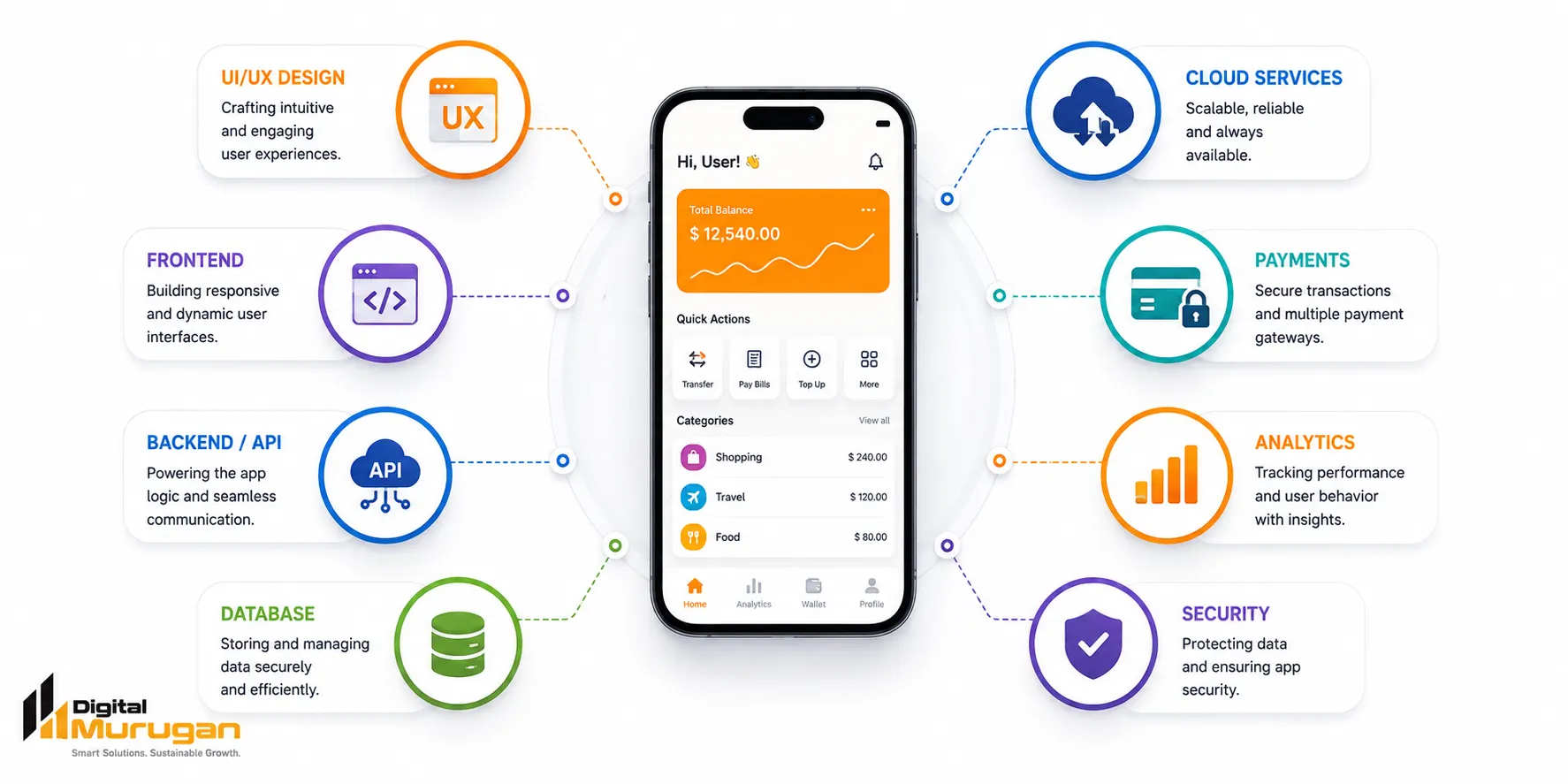
The development process typically combines user experience design, interface development, programming, backend systems, databases, APIs, security, testing, and ongoing maintenance.
Why Mobile Apps Matter for Modern Businesses
A mobile app can provide customers with a direct digital channel for interacting with a business.
Instead of requiring users to repeatedly search for a website or remember a web address, an application can place the business experience directly on their device.
Mobile apps can help businesses:
- Improve accessibility
- Increase customer engagement
- Provide personalized experiences
- Simplify transactions
- Strengthen customer loyalty
- Send timely notifications
- Collect useful behavioral insights
- Support business operations
However, an app should not be created simply because mobile apps are popular.
The application should solve a genuine customer or business problem.
1. Improving Customer Experience
Customer experience is one of the strongest reasons businesses develop mobile applications.
An app can make common actions faster and more convenient.
For example, customers might be able to:
- Browse products
- Book appointments
- Track orders
- Manage accounts
- Make payments
- Access support
- Receive updates
- Save preferences
Instead of navigating through multiple systems, customers can access relevant features from one centralized interface.
A good mobile experience should feel simple, fast, intuitive, and useful.
2. Building Direct Customer Relationships
Websites are important, but mobile applications can create a more direct relationship between a business and its customers.
Once a user installs an application, the business can provide an ongoing experience through features such as:
- Personalized dashboards
- Notifications
- Loyalty programs
- Saved preferences
- Exclusive content
- Order updates
- Customer support
This can create more opportunities for meaningful interactions.
The goal should not be to send users constant promotional messages. Notifications should provide useful information at the right time.
3. Mobile Apps and Personalization
Modern customers increasingly expect digital experiences to feel relevant to their needs.
Mobile applications can support personalization through features such as:
- Recommended products
- Personalized content
- Saved preferences
- Customized offers
- Location-based experiences
- Personalized dashboards
- Purchase history
For example, an e-commerce application could recommend products based on previous interactions while a learning application could suggest lessons based on a user’s progress.
Personalization should provide genuine value rather than simply collecting information.
4. Mobile Apps for E-commerce
Mobile commerce has created significant opportunities for businesses selling products and services online.
An e-commerce application can provide features such as:
- Product browsing
- Search and filtering
- Shopping carts
- Secure payments
- Order tracking
- Wishlist functionality
- Personalized recommendations
- Customer reviews
- Loyalty rewards
A well-designed app can reduce friction throughout the purchasing process.
For example:
Discover → Explore → Add to Cart → Pay → Track → Reorder
Making this journey simple can improve the overall shopping experience.
5. Supporting Business Operations
Mobile applications are not only useful for customers.
Businesses can also use mobile apps internally to improve operations.
Examples include:
- Employee management
- Field service applications
- Inventory management
- Sales tracking
- Delivery coordination
- Appointment management
- Communication tools
- Reporting dashboards
For businesses with employees working outside traditional offices, mobile applications can provide access to important systems from almost anywhere.
6. Choosing Between Native and Cross-Platform Development
One important decision in mobile app development is choosing the development approach.
Native App Development
Native applications are developed specifically for a particular platform, such as Android or iOS.
Advantages can include:
- Strong platform integration
- High performance
- Access to native device features
- Platform-specific user experiences
However, building separate applications for different platforms can require additional development resources.
Cross-Platform Development
Cross-platform technologies allow developers to create applications that can operate across multiple platforms using a shared development approach.
Potential benefits include:
- Faster development
- Shared code
- Lower development complexity
- Easier maintenance across platforms
The right approach depends on the application’s requirements, performance needs, budget, features, and long-term strategy.
7. Essential Features of a Successful Mobile App
Not every application needs dozens of features.
A successful app should prioritize features that provide genuine value.
Depending on the business, important features may include:
Simple Navigation
Users should be able to find important functions quickly.
Secure Authentication
Account access should be convenient while maintaining appropriate security.
Fast Performance
Slow applications can create frustration and increase abandonment.
Search and Filtering
Useful for applications containing large amounts of products, content, or information.
Push Notifications
Useful for important updates, reminders, order information, or relevant communication.
Secure Payments
Essential for applications handling transactions.
Customer Support
Providing convenient support can improve the overall customer experience.
The best feature set is determined by user needs rather than simply adding every available technology.
8. Security and Data Protection
Security should be considered from the beginning of the development process.
Mobile applications can potentially handle sensitive information such as:
- Account details
- Payment information
- Personal data
- Location information
- Customer activity
Developers should therefore consider appropriate security practices including:
- Secure authentication
- Data encryption
- Secure APIs
- Access controls
- Regular security testing
- Secure data storage
- Software updates
Businesses should also understand their applicable privacy and data-protection requirements.
Security is not a feature that should be added at the end of development. It should be part of the application’s architecture from the beginning.
9. App Performance and User Experience
Users expect mobile applications to respond quickly.
Performance problems can include:
- Slow loading
- Crashes
- Unresponsive buttons
- Excessive battery usage
- Complicated navigation
- Poor mobile layouts
A successful application should be tested across different devices and network conditions.
User experience should also be continuously evaluated.
Small improvements to navigation, onboarding, checkout, or search can make a significant difference to how users interact with an application.
10. Common Mobile App Development Mistakes
Building an App Without a Clear Purpose
If the app does not solve a meaningful problem, users may have little reason to keep it.
Overloading the App With Features
Too many unnecessary features can make an application complicated.
Ignoring User Experience
Technical functionality alone does not guarantee a good product.
Poor Performance
Slow loading and frequent crashes can damage user trust.
Weak Security
Security weaknesses can create serious risks for both businesses and customers.
Neglecting Updates
Mobile applications need ongoing maintenance as operating systems, devices, security requirements, and user expectations evolve.
Skipping Real-World Testing
Testing only in a controlled development environment may fail to reveal problems users encounter in everyday conditions.
11. The Role of AI in Mobile App Development
Artificial intelligence is becoming increasingly useful throughout the mobile app development lifecycle.
AI can assist with:
- Code generation
- Debugging
- User experience research
- Personalization
- Recommendation systems
- Chatbots
- Predictive analytics
- Testing
- Content generation
- Workflow automation
For example, an application could use AI to recommend products, answer customer questions, analyze user behavior, or personalize content.
However, AI should support the application’s objectives rather than become a feature simply because it is technologically interesting.
Human oversight remains important for security, accuracy, user experience, and responsible implementation.
12. How to Plan a Mobile App Development Project
A successful application usually starts with careful planning.
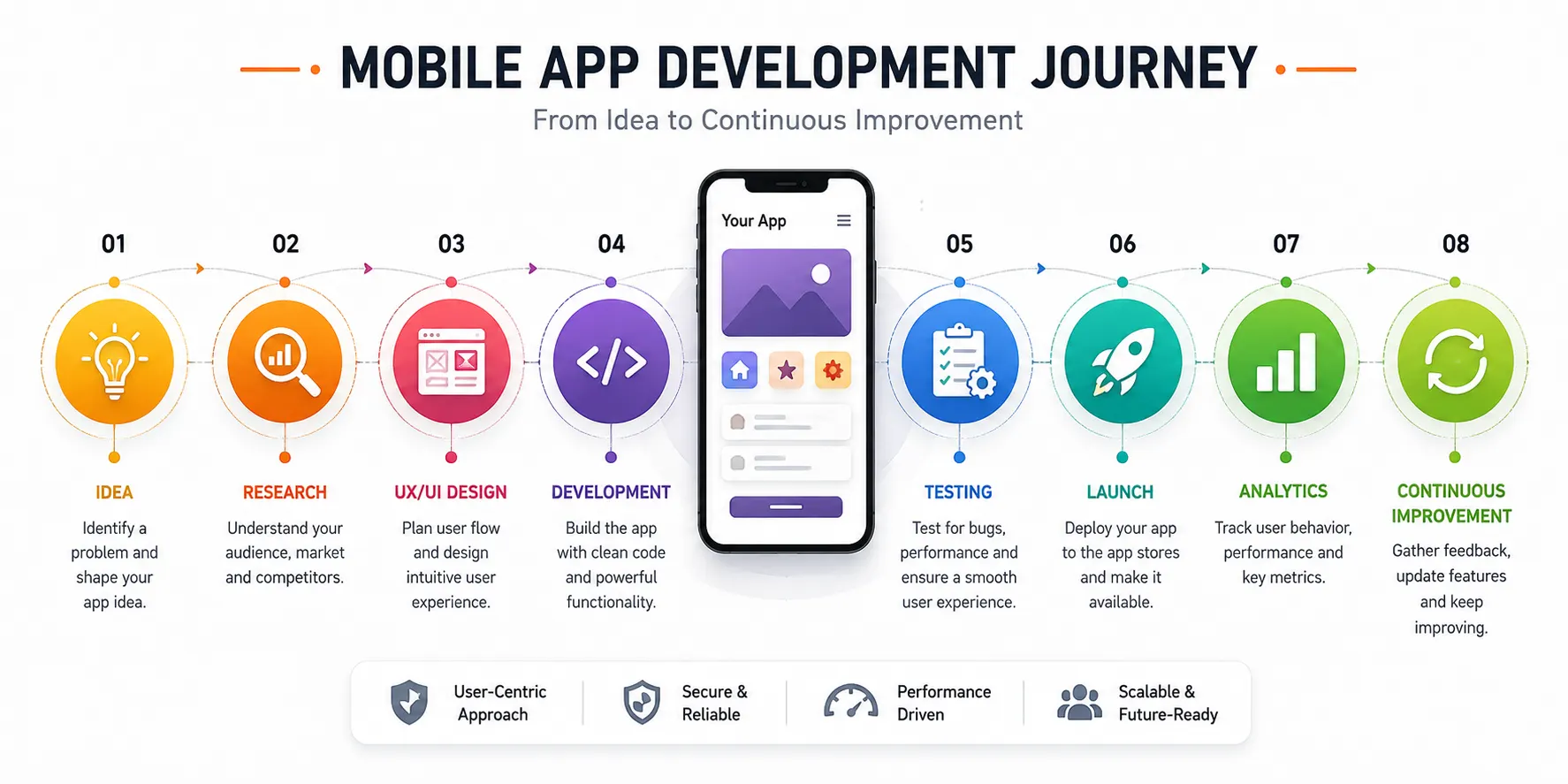
Step 1: Define the Problem
Identify what problem the application will solve.
Step 2: Understand the Audience
Research who will use the application and what they expect from it.
Step 3: Define Core Features
Prioritize the features that directly support the application’s main purpose.
Step 4: Plan the User Experience
Design the user journey before development begins.
Step 5: Choose the Technology
Select the appropriate platform and development approach.
Step 6: Build an MVP
A minimum viable product can help businesses test the core concept before investing in a larger feature set.
Step 7: Test Thoroughly
Test functionality, performance, security, compatibility, and usability.
Step 8: Launch
Deploy the application through the appropriate distribution channels.
Step 9: Monitor Performance
Track user behavior, crashes, engagement, retention, and other relevant metrics.
Step 10: Improve Continuously
Use feedback and data to improve future versions.
13. Measuring Mobile App Success
Launching an application is not the final step.
Businesses should monitor how users actually interact with it.
Useful metrics can include:
Downloads
How many people install the application?
Active Users
How many users regularly return to the app?
Retention
How many users continue using the app over time?
Engagement
How frequently and deeply do users interact with key features?
Conversion Rate
How many users complete important actions?
Revenue
How much revenue does the application generate or influence?
App Store Ratings
What are users saying about their experience?
These metrics can reveal which parts of the application are working and where improvements may be required.
14. Mobile Apps as Part of a Larger Digital Strategy
A mobile application should not operate in isolation.
It can become part of a broader digital ecosystem that includes:
Website + Mobile App + Social Media + Email + CRM + Analytics + Customer Support
For example, a customer might discover a brand through social media, visit its website, download the mobile application, make a purchase, receive an order notification, and later interact with the brand through email.
When these systems work together, the customer experience becomes more connected.
Mobile App Development Is an Ongoing Process
A common misconception is that mobile app development ends when an application is launched.
In reality, successful applications require continuous improvement.
Operating systems change. New devices appear. Security threats evolve. Customer expectations increase. New technologies become available.
Businesses may therefore need to:
- Release updates
- Fix bugs
- Improve performance
- Add useful features
- Update security
- Analyze user feedback
- Improve accessibility
- Optimize user journeys
Continuous development helps an application remain useful over time.
Conclusion
Mobile app development can provide businesses with a powerful way to create direct, convenient, and personalized digital experiences.
From e-commerce and customer service to internal operations and personalized engagement, mobile applications can support many different business objectives.
However, the success of an app depends on more than technology.
The strongest applications begin with a clear problem, understand their users, prioritize meaningful features, provide excellent user experiences, protect customer data, and continue improving after launch.
As AI, cloud technologies, mobile platforms, and digital services continue to evolve, mobile applications will remain an important part of how businesses connect with their customers.
The goal should not simply be to build an app.
The goal should be to build a useful digital experience that people have a reason to keep using.
Frequently Asked Questions
What is mobile app development?
Mobile app development is the process of designing, developing, testing, launching, and maintaining applications for smartphones and tablets.
Why should a business develop a mobile app?
A mobile app can provide customers with convenient access to products, services, support, personalized experiences, notifications, and other digital features.
Should businesses choose native or cross-platform development?
The right choice depends on the application’s requirements, performance expectations, target platforms, budget, features, and long-term maintenance strategy.
What makes a successful mobile app?
A successful mobile app should solve a genuine problem, provide a simple user experience, perform reliably, protect user data, and offer features that customers actually need.
How important is mobile app security?
Security is extremely important for applications that handle personal, financial, or business information. Security should be considered throughout the development lifecycle.
Can AI be used in mobile applications?
Yes. AI can support features such as personalization, recommendations, chatbots, predictive analytics, automation, and intelligent search.
Does a mobile app need regular updates?
Yes. Regular updates can help address bugs, security issues, operating-system changes, performance improvements, and evolving user expectations.
How can businesses measure app performance?
Businesses can track metrics such as downloads, active users, retention, engagement, conversions, revenue, crashes, and app-store ratings.
 Previous Post