
How to Choose the Right E-commerce Solution for Your Business
E-commerce has transformed the way people discover, compare, and purchase products. Today, having an online store is no longer simply about displaying products on a website. A successful e-commerce operation needs to provide a smooth shopping experience, secure payments, reliable performance, mobile accessibility, effective marketing capabilities, and room for future growth.
This is why choosing the right e-commerce solution is an important business decision.
Whether you are launching a new online store, moving an existing business online, or improving an underperforming e-commerce website, the technology behind your store can significantly influence your customers’ experience and your ability to grow.
But with so many platforms, technologies, integrations, and development options available, how do you know which solution is right for you?
Let’s explore the key factors you should consider.
What Is an E-commerce Solution?
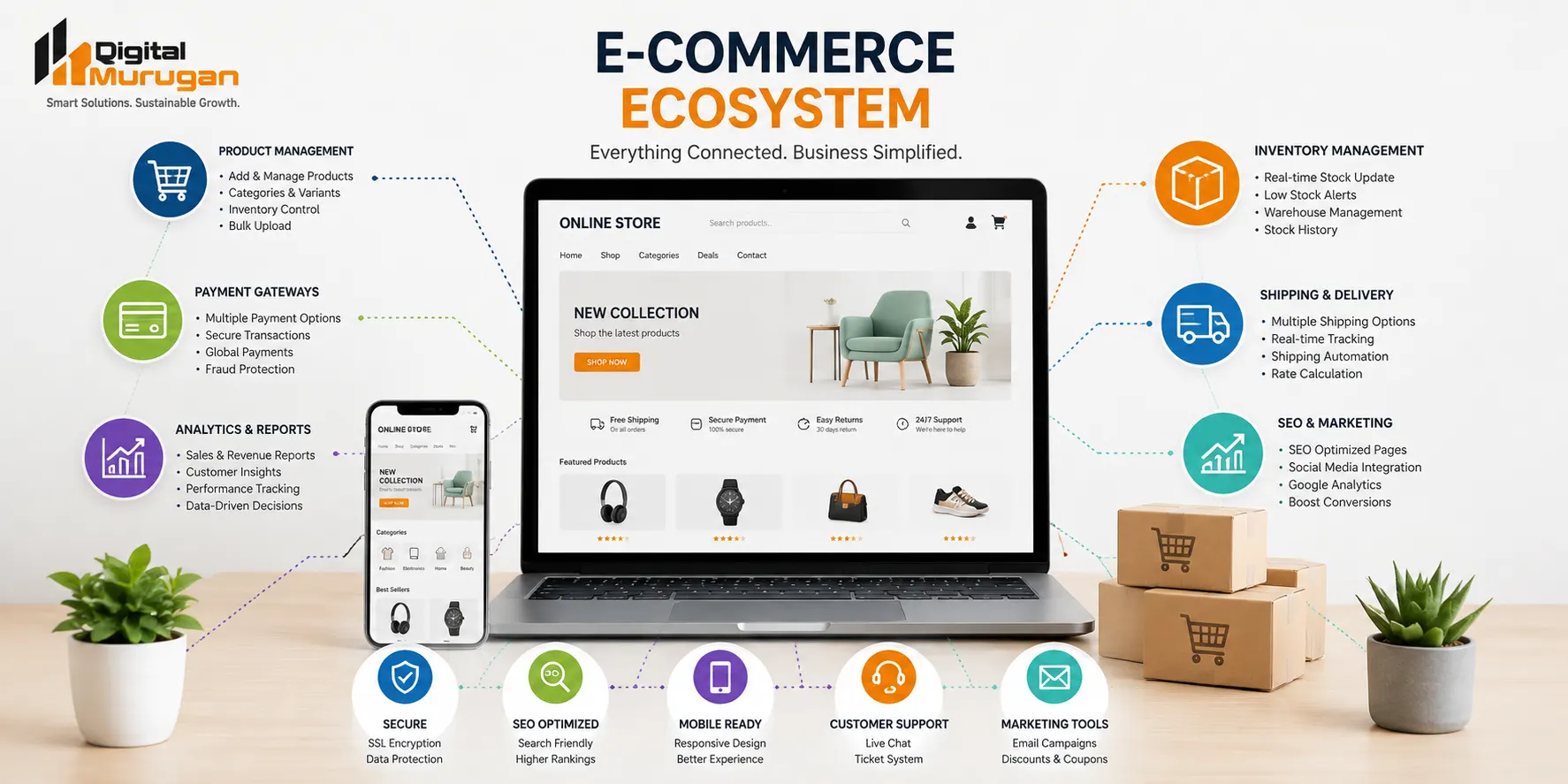
An e-commerce solution is a combination of technologies, tools, and services that enables a business to sell products or services online.
Depending on the business, an e-commerce solution may include:
- E-commerce website development
- Product and inventory management
- Shopping cart functionality
- Online payment integration
- Order management
- Customer account management
- Shipping and delivery integration
- Tax and invoice management
- Search engine optimization
- Analytics and reporting
- Marketing integrations
- Security and performance tools
The right combination depends on the size, goals, products, customers, and operational requirements of the business.
Why Choosing the Right E-commerce Solution Matters
An online store is more than a digital catalogue.
Customers expect websites to load quickly, work smoothly on smartphones, provide clear product information, offer convenient payment options, and make the entire purchasing process simple.
A poorly selected or poorly implemented solution can create problems such as:
- Slow website performance
- Complicated checkout processes
- Poor mobile experiences
- Limited payment options
- Difficult inventory management
- Security vulnerabilities
- Weak SEO performance
- Limited integration capabilities
- Expensive future upgrades
Choosing the right technology from the beginning can help create a stronger foundation for long-term growth
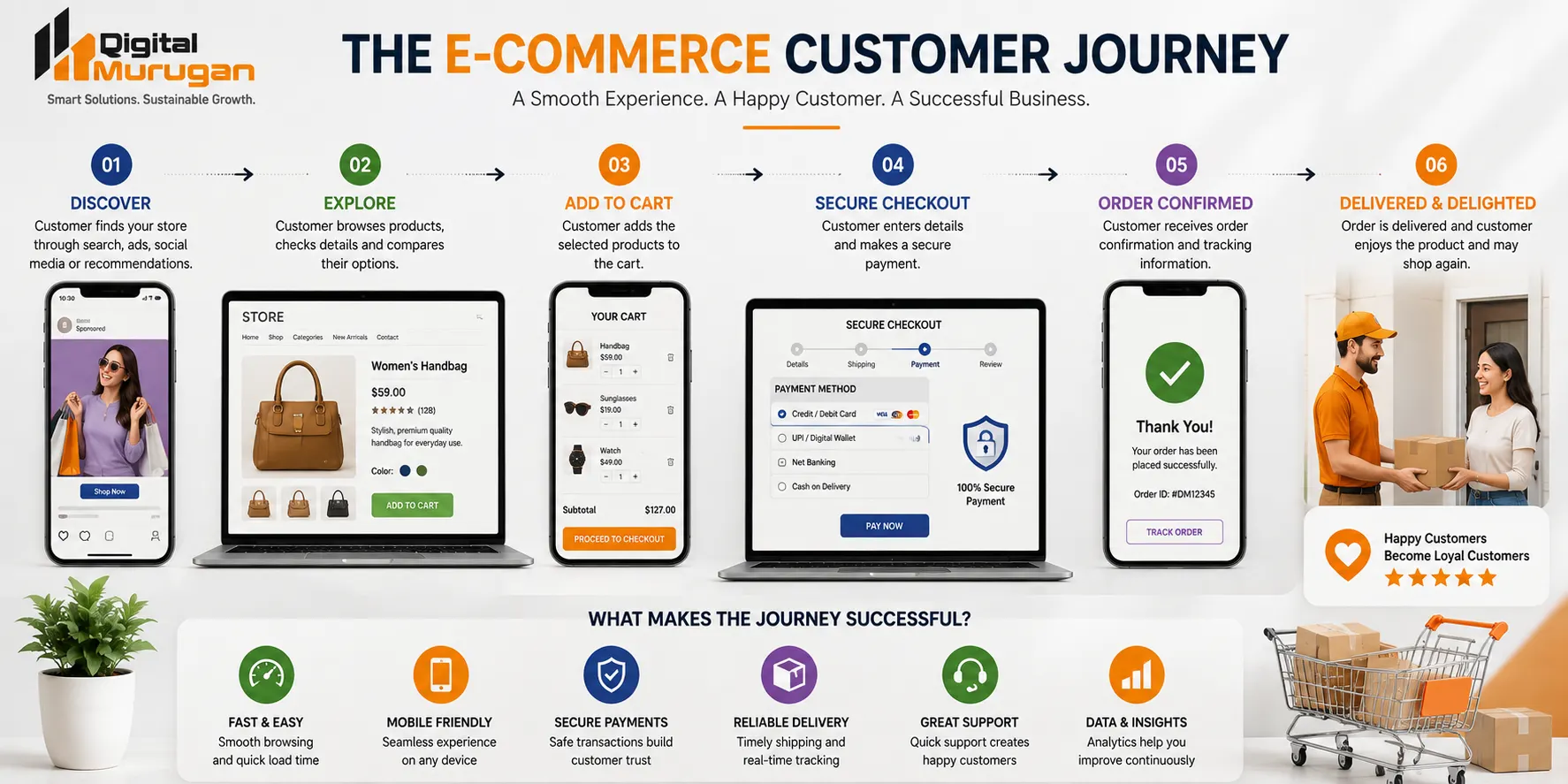
1. Start With Your Business Requirements
Before comparing e-commerce platforms or development technologies, identify what your business actually needs.
Consider questions such as:
- What products or services will you sell?
- How many products will you manage?
- Will you sell locally, nationally, or internationally?
- Do you need multiple currencies?
- Which payment methods should customers be able to use?
- Do you require shipping integrations?
- Will you need multiple languages?
- Do you need customer accounts?
- Will you sell subscriptions or digital products?
- Do you need integration with accounting, CRM, ERP, or marketing systems?
The answers will help determine which type of e-commerce solution is appropriate.
2. Consider the Customer Experience
A technically powerful e-commerce website can still fail if customers find it difficult to use.
Your store should make it easy for visitors to:
- Discover products
- Understand product details
- Compare options
- Add products to their cart
- Complete payment
- Track their orders
- Contact support when necessary
Navigation, product filtering, search functionality, checkout design, and mobile responsiveness all contribute to the overall shopping experience.
The goal should be simple: remove unnecessary friction from the buying journey.
3. Make Mobile Commerce a Priority
A significant portion of online shopping activity takes place through smartphones.
Therefore, an e-commerce website should not simply be a desktop website that has been resized for mobile devices.
The mobile experience should be designed intentionally.
Important considerations include:
- Responsive layouts
- Easy-to-use navigation
- Fast loading times
- Mobile-friendly product galleries
- Simple checkout
- Touch-friendly buttons
- Convenient payment options
- Readable product information
A smooth mobile experience can make a major difference in how visitors interact with an online store.
4. Look for Secure Payment Options
Payment functionality is one of the most important components of an e-commerce solution.
Customers need confidence that their payment information and personal details are handled securely.
Depending on the target market, your store may need to support options such as:
- Credit and debit cards
- Digital wallets
- Bank transfers
- Buy-now-pay-later services
- Local payment methods
- Cash on delivery
The exact payment options should be selected according to your customers and target markets.
Security should also be treated as a fundamental requirement rather than an optional feature.
5. Check Integration Capabilities
Modern e-commerce operations rarely work in isolation.
An online store may need to communicate with several other systems, including:
- Accounting software
- Customer relationship management systems
- Inventory platforms
- Shipping services
- Payment gateways
- Email marketing platforms
- Analytics tools
- Social media platforms
- Enterprise resource planning systems
Therefore, when evaluating an e-commerce solution, consider not only what it can do today but also how easily it can connect with the tools you may need tomorrow.
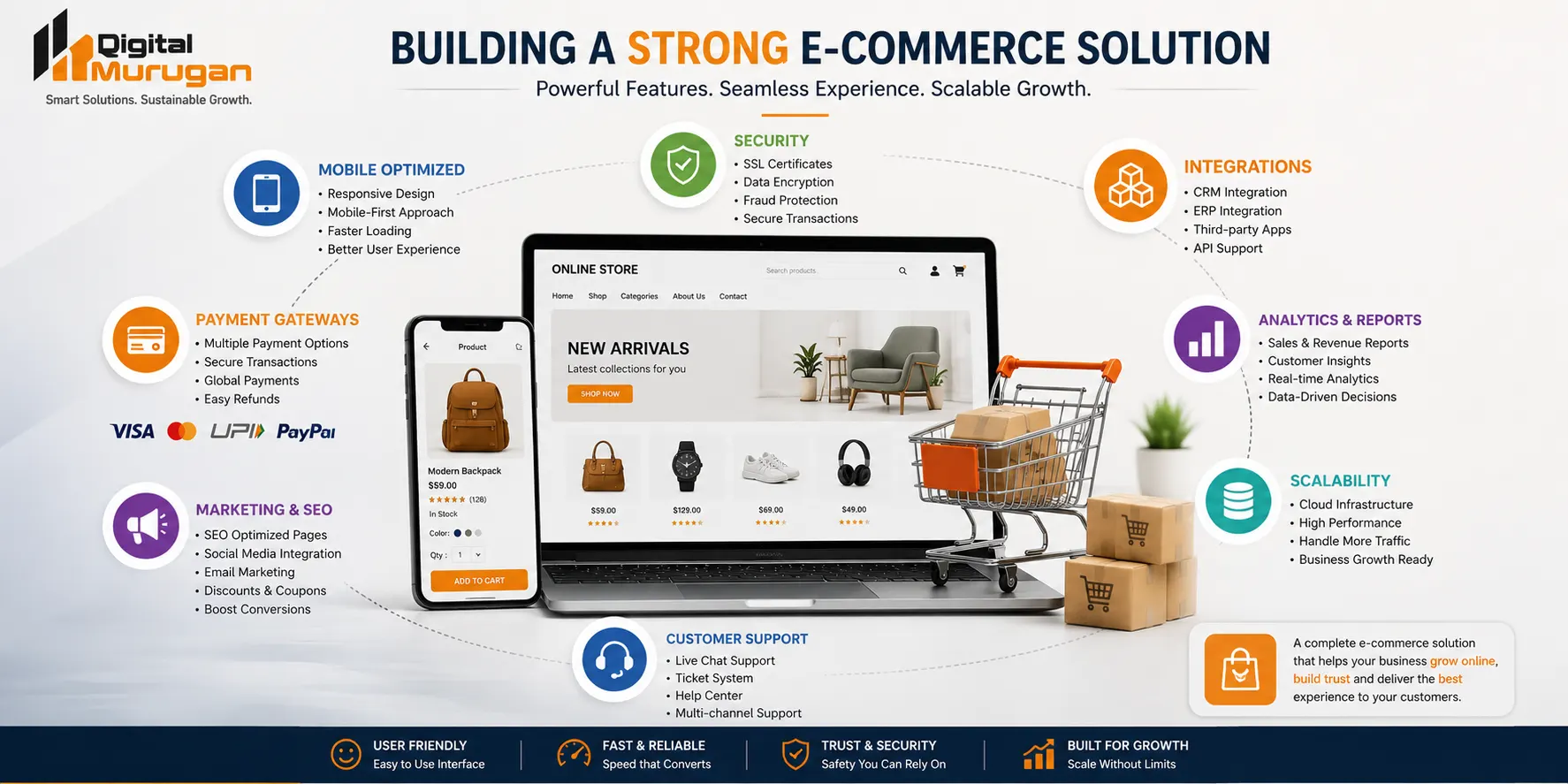
6. Think About SEO From the Beginning
A beautiful online store is not enough if potential customers cannot discover it through search engines.
SEO should be considered during the development of an e-commerce website rather than added as an afterthought.
Important areas include:
- Search-friendly URLs
- Product page optimization
- Category page optimization
- Page speed
- Mobile usability
- Structured data
- Internal linking
- Image optimization
- Helpful product content
- Technical SEO
A strong e-commerce solution should give you sufficient control over these elements.
7. Evaluate Scalability
Your e-commerce solution should be capable of growing with your business.
A store that works perfectly with 50 products may face different challenges when it has thousands of products, significantly higher traffic, multiple warehouses, or international customers.
Before selecting a solution, consider future requirements such as:
- Larger product catalogues
- Higher website traffic
- More customers
- Multiple locations
- International expansion
- Additional sales channels
- Advanced automation
- More complex integrations
Planning for scalability can prevent expensive technology changes later.
8. Pay Attention to Website Performance
Performance affects both user experience and business outcomes.
Slow pages can frustrate visitors and make it harder for customers to complete purchases.
An e-commerce website should be optimized for:
- Fast page loading
- Efficient images
- Lightweight code
- Reliable hosting
- Efficient databases
- Caching
- Content delivery
- Mobile performance
Performance optimization should continue after launch rather than being treated as a one-time development task.
9. Don’t Ignore Security
E-commerce websites handle valuable information, including customer accounts, contact details, addresses, and payment-related data.
Security should therefore be built into the overall architecture of the store.
Important practices include:
- HTTPS
- Secure authentication
- Strong password policies
- Regular software updates
- Secure payment processing
- Access controls
- Reliable backups
- Security monitoring
- Protection against common web vulnerabilities
Businesses should also ensure that their e-commerce operations follow applicable privacy and data-protection requirements in the markets they serve.
10. Consider the Total Cost, Not Just the Initial Price
One of the most common mistakes is choosing an e-commerce solution solely because it has a low initial development cost.
The actual cost of an online store can include:
- Development
- Hosting
- Domain
- Premium plugins or extensions
- Payment processing
- Maintenance
- Security
- Marketing tools
- Third-party integrations
- Support
- Future development
A cheaper solution may become expensive if it requires frequent workarounds or major redevelopment as the business grows.
Instead of asking only, “How much does this website cost?”, ask:
“What value and capabilities will this solution provide over the long term?”
11. Think Beyond the Website
An e-commerce business is not just a website.
Customers may discover products through:
- Search engines
- Social media
- Online advertisements
- Email campaigns
- Marketplaces
- Influencer content
- Direct traffic
- Repeat purchases
A good e-commerce solution should therefore fit into your broader digital strategy.
The website should work as part of a connected ecosystem rather than operating as an isolated platform.
12. Choose a Solution That Can Be Managed
The people responsible for running the store should be able to manage everyday tasks efficiently.
Depending on the business, administrators may need to:
- Add products
- Update prices
- Manage inventory
- Process orders
- Create discount codes
- Update product images
- Manage customers
- Review analytics
- Publish content
A complicated system can create unnecessary dependency on developers for routine operations.
The ideal solution should provide the right balance between flexibility and ease of management.
Common Mistakes to Avoid
When selecting an e-commerce solution, avoid making the decision based on a single factor.
Some common mistakes include:
Choosing Only Based on Price
The cheapest solution is not always the most cost-effective solution.
Ignoring Mobile Users
A store that performs poorly on smartphones can lose valuable customers.
Adding Too Many Features
More features do not automatically mean a better website. Unnecessary complexity can make a store harder to use and maintain.
Neglecting SEO
SEO should be considered during architecture and development, not only after launch.
Forgetting Future Growth
A solution that cannot scale can become a serious limitation as the business expands.
Treating Security as an Afterthought
Security should be part of the foundation of an e-commerce website.
How to Select the Right E-commerce Solution
A practical selection process can look like this:
Step 1: Define your business requirements.
Step 2: Understand your target customers and markets.
Step 3: Determine your product, payment, shipping, and inventory requirements.
Step 4: Identify required integrations.
Step 5: Compare available technologies and platforms.
Step 6: Evaluate performance, security, SEO, scalability, and usability.
Step 7: Calculate the total cost of ownership.
Step 8: Consider ongoing maintenance and support.
Step 9: Test the customer experience before launch.
Step 10: Choose the solution that provides the strongest long-term fit.
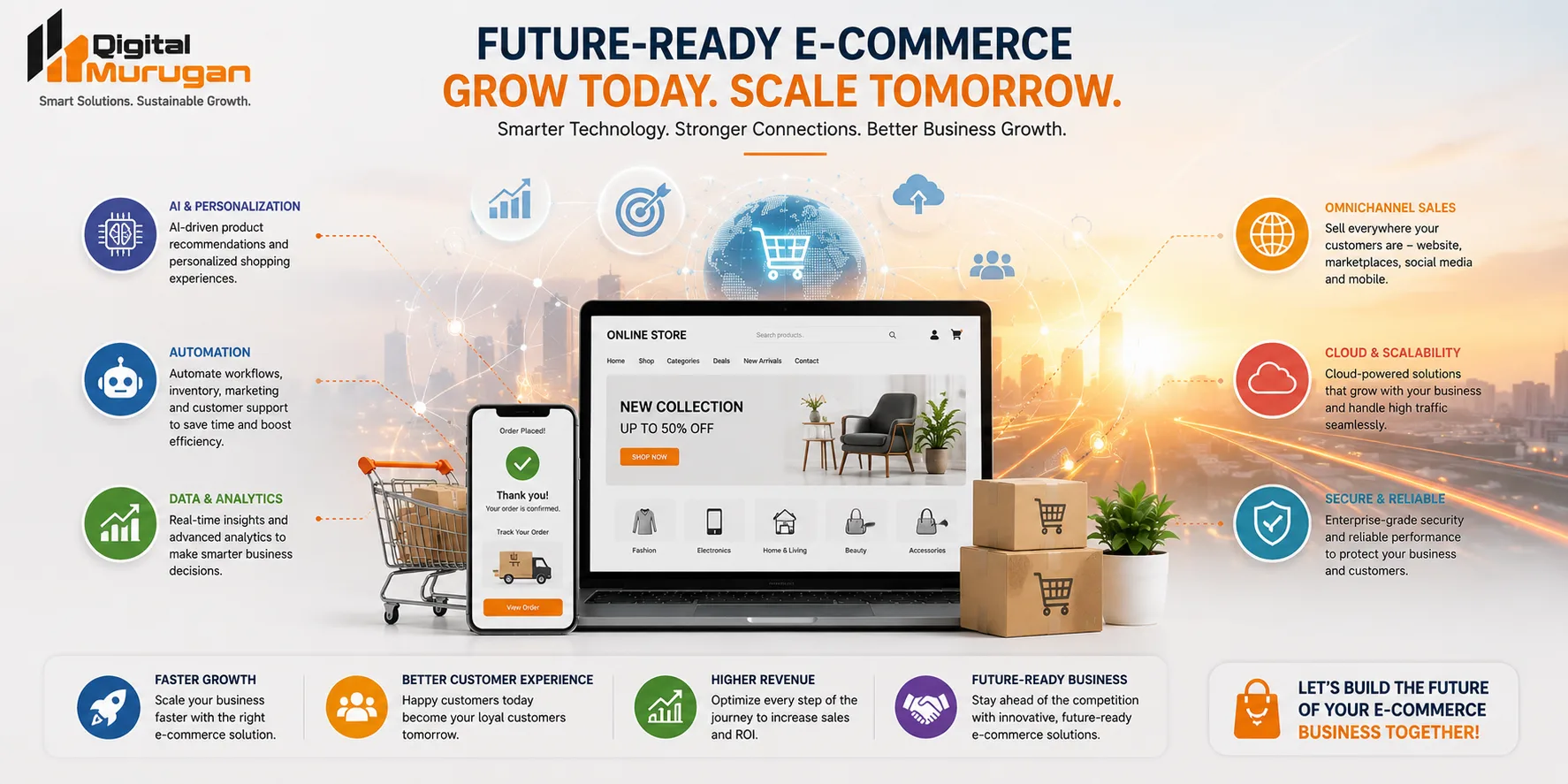
The Future of E-commerce Is More Connected
E-commerce continues to evolve beyond traditional online stores.
Businesses are increasingly combining websites with automation, analytics, personalized experiences, social commerce, mobile shopping, artificial intelligence, and multiple digital channels.
This makes flexibility increasingly important.
The best e-commerce solution is not necessarily the one with the longest feature list. It is the one that provides the right capabilities for your business today while leaving enough room to adapt tomorrow.
Conclusion
Choosing the right e-commerce solution is an important step toward building a sustainable online business.
The right solution should provide more than product listings and a shopping cart. It should create a secure, fast, mobile-friendly, search-optimized, scalable, and customer-focused digital shopping experience.
Before making a decision, look beyond the initial price and consider the complete picture: business requirements, customer experience, technology, integrations, security, SEO, performance, scalability, and long-term management.
When these elements work together, your e-commerce website can become much more than an online storefront—it can become a powerful part of your overall digital business.
Frequently Asked Questions
What is an e-commerce solution?
An e-commerce solution is a combination of technologies, tools, and services used to operate an online store, including product management, payments, orders, customers, shipping, security, and other business functions.
How do I choose the right e-commerce solution?
Start by understanding your business requirements, customers, products, markets, payment needs, integrations, budget, scalability requirements, and long-term goals. Then compare solutions based on functionality, security, performance, SEO, usability, and total cost.
Is mobile optimization important for e-commerce?
Yes. Customers increasingly use smartphones to discover products, research purchases, and complete transactions. A mobile-friendly experience is therefore an essential part of modern e-commerce.
Should SEO be included in e-commerce development?
Yes. SEO should be considered from the beginning of the website architecture and development process so that product pages, categories, URLs, performance, internal linking, and other technical elements can be optimized effectively.
Can an e-commerce website grow with a business?
Yes, provided the underlying solution is scalable. Businesses should evaluate future requirements such as larger product catalogues, increased traffic, additional integrations, international markets, and new sales channels before selecting a platform or technology.
 Previous Post
 Next Post