
From Idea to Impact: How AI Can Transform Your Content Strategy
Content marketing has changed dramatically. Creating a blog post, publishing it, and waiting for people to discover it is no longer enough. Businesses need a clear content strategy that connects ideas with audience needs, search visibility, brand goals, and measurable results.
This is where Artificial Intelligence (AI) is becoming a valuable part of modern content marketing.
AI can help businesses discover content opportunities, organize ideas, understand audiences, speed up content production, improve SEO, and repurpose existing content across multiple platforms. When combined with human creativity and strategic thinking, it can turn a basic content idea into a complete content ecosystem.
But the real value of AI isn’t simply creating content faster. It’s helping businesses build a smarter and more efficient content strategy.
Let’s explore how.
What Is an AI-Powered Content Strategy?
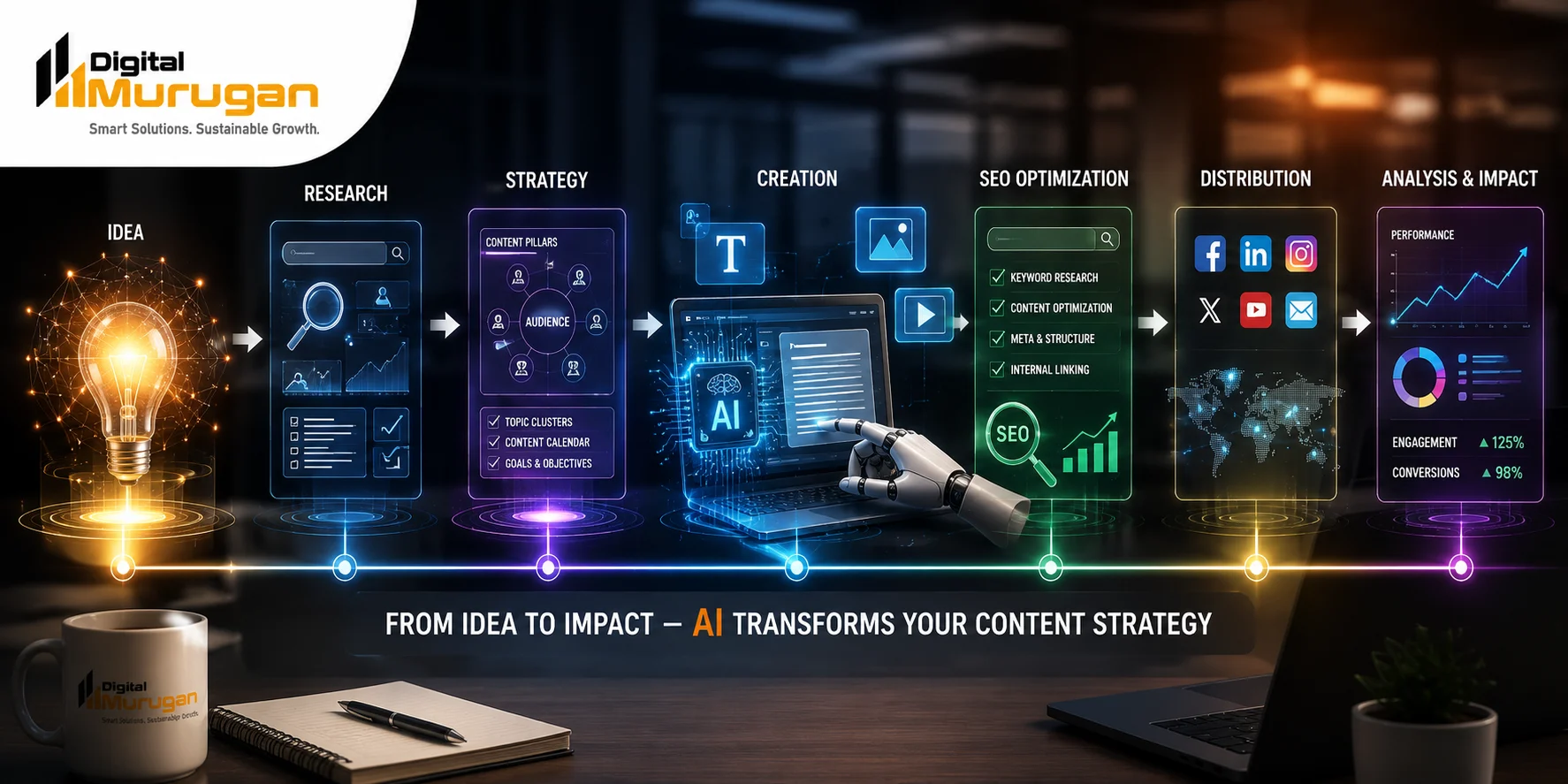
An AI-powered content strategy uses artificial intelligence to support different stages of the content marketing process, from research and planning to creation, optimization, distribution, and performance analysis.
Instead of treating every content task as a separate activity, businesses can use AI to connect the entire workflow.
For example:
Audience research → Content ideas → Planning → Creation → SEO → Distribution → Performance analysis → Improvement
AI can assist throughout this journey while human expertise remains responsible for creativity, accuracy, brand voice, and strategic decisions.
The result is a content process that is more organized, scalable, and data-informed.
1. Discover Better Content Ideas
One of the biggest challenges in content marketing is consistently finding topics that people actually want to read.
AI can help analyze audience questions, industry discussions, existing content, search-related information, and common customer problems to uncover potential topics.
Instead of starting with a broad subject such as “digital marketing,” businesses can develop more focused ideas around specific audience needs.
For example:
- How AI can improve content marketing
- Ways to create a consistent content calendar
- Common SEO mistakes businesses should avoid
- How to repurpose one blog into multiple content formats
- How AI can improve social media content planning
This makes the ideation process more structured.
However, AI-generated ideas should always be evaluated by people who understand the brand and its audience. A topic is valuable only when it provides genuine relevance to the people you want to reach.
2. Understand What Your Audience Wants
Great content begins with understanding the audience.
AI can help businesses identify patterns in customer questions, feedback, online interactions, and content engagement. These insights can reveal what people are interested in, what problems they are trying to solve, and what information they may still be looking for.
This allows businesses to move away from creating content based purely on assumptions.
Instead of asking:
“What can we publish?”
the better question becomes:
“What does our audience need from us?”
That shift can make a major difference in content quality.
When content is built around genuine audience needs, it becomes more useful, relevant, and meaningful.
3. Build a More Organized Content Plan
Having good ideas is only the beginning.
Without proper planning, content can become inconsistent. Businesses may publish several articles about one subject while completely ignoring other important topics.
AI can help organize ideas into content categories and content pillars.
For example, a digital marketing brand could organize its content around:
- SEO
- Content Marketing
- Social Media Marketing
- Branding
- AI Solutions
- Website Development
- Digital Business Growth
These categories can then be connected to different stages of the customer journey.
Awareness: Educational content that introduces a problem or opportunity.
Consideration: Content that explains possible solutions.
Decision: Content that demonstrates expertise and builds confidence.
Retention: Content that helps existing customers get more value.
This creates a more balanced and purposeful content strategy.
4. Create Content More Efficiently
Content creation requires research, writing, editing, design, optimization, and distribution.
AI can help reduce the amount of time spent on repetitive tasks.
It can assist with:
- Article outlines
- Draft development
- Headline ideas
- Social media captions
- Email concepts
- Video script ideas
- FAQs
- Content summaries
- Meta descriptions
This doesn’t mean businesses should simply generate content and publish it without review.
AI-generated content still needs human editing and refinement.
Your team should add real experience, original opinions, examples, brand personality, and accurate information.
The objective isn’t to remove humans from content creation.
The objective is to help humans spend more time on the parts of content creation that matter most.
5. Improve SEO Without Losing the Human Element
Search engine optimization is another area where AI can support content teams.
AI can help identify related topics, understand search intent, organize keywords, suggest content structures, and identify opportunities for improving existing pages.
For example, when creating an article around “AI content strategy,” AI can help identify related concepts that readers may expect to see.
But SEO shouldn’t become keyword stuffing.
A page filled with keywords but lacking useful information won’t provide a good experience for readers.
The better approach is to create content that answers questions clearly, demonstrates expertise, and naturally covers the subject in depth.
AI can support the optimization process.
Human judgment should determine the final content.
6. Transform One Piece of Content Into Many
One of the biggest opportunities AI provides is content repurposing.
A single high-quality blog post doesn’t have to remain a single blog post.
It can become the foundation for multiple content formats.
For example:
One detailed blog article
↓
LinkedIn post
↓
Instagram carousel
↓
Short-form video
↓
Email newsletter
↓
FAQ content
↓
Infographic
↓
Video script
This approach allows businesses to extend the lifespan of their content while maintaining a consistent message across different platforms.
Instead of constantly starting from zero, businesses can build new content from ideas and information they have already developed.
7. Personalize Content for Different Audiences
Not every visitor has the same needs.
Someone discovering a brand for the first time may need educational information. Someone already researching a service may want detailed comparisons or practical information.
AI can help businesses create different versions of messaging based on audience segments, interests, and stages of the customer journey.
For example, the same core subject can be presented differently for:
First-time visitors:
An introduction to the topic.
Interested prospects:
A deeper explanation of available solutions.
Existing customers:
Advanced tips and practical guidance.
This can make communication more relevant while reducing the amount of manual work required to create variations.
8. Use AI to Improve Existing Content
Content strategy isn’t only about creating new articles.
Sometimes the biggest opportunity is improving content that already exists.
AI can help identify areas that may need attention, such as:
- Outdated information
- Weak introductions
- Missing sections
- Poor content structure
- Repetitive information
- Unclear explanations
- SEO opportunities
- Internal linking opportunities
Updating useful existing content can help businesses get more value from the work they’ve already invested in.
Instead of constantly asking, “What should we create next?”, businesses should also ask:
“What can we improve?”
9. Measure Content Performance More Effectively
Publishing content without measuring its performance is like running a campaign without checking the results.
AI can help analyze content-related data and identify patterns across different performance indicators.
Businesses can look at metrics such as:
- Website traffic
- Engagement
- Click-through rates
- Conversions
- Search visibility
- Time spent on pages
- Content interactions
The goal isn’t simply to find the content with the most views.
A successful content strategy should identify which content contributes to meaningful business outcomes.
For example, one article might generate thousands of visitors but very few enquiries, while another article may attract fewer visitors but generate highly relevant leads.
Understanding this difference can help businesses make smarter decisions about future content.

10. Create a Continuous Content Improvement Cycle
AI becomes even more useful when content creation is treated as a continuous process.
A strong workflow can follow this cycle:
Research → Plan → Create → Optimize → Publish → Measure → Improve
The information collected from one content cycle can influence the next.
If a particular topic performs well, the business can explore related subjects.
If certain content receives little engagement, the team can investigate why.
If an article generates enquiries, similar content can be developed around the same audience need.
This creates a feedback loop where every piece of content contributes to improving the overall strategy.
AI Doesn’t Replace Human Creativity
AI can process information quickly, generate ideas, recognize patterns, and automate repetitive tasks.
But content still needs something AI cannot provide on its own: human perspective.
People understand brand identity, customer emotions, real-world experiences, cultural context, and business priorities.
That’s why the strongest content strategy isn’t:
AI instead of humans.
It’s:
AI + Human Creativity + Strategy + Expertise
AI handles repetitive and time-consuming tasks.
Humans provide direction, originality, judgment, and authenticity.
Together, they can create a more effective content process.
How to Build an AI-Assisted Content Strategy
Businesses looking to introduce AI into their content workflow can start with a simple approach.
Step 1: Define Your Audience
Understand who you’re creating content for and what problems they want to solve.
Step 2: Establish Your Content Pillars
Choose the key subjects that align with your audience and business objectives.
Step 3: Research Content Opportunities
Use AI-assisted research to identify questions, topics, trends, and gaps.
Step 4: Create a Content Calendar
Organize topics and maintain a consistent publishing schedule.
Step 5: Use AI During Production
Use AI to assist with research, outlines, drafts, variations, and repetitive tasks.
Step 6: Add Human Expertise
Review every piece of content and add original insights, examples, experience, and brand voice.
Step 7: Optimize and Publish
Improve readability, SEO, structure, visuals, and distribution.
Step 8: Measure Results
Track performance and identify which content is producing meaningful outcomes.
Step 9: Improve the Strategy
Use those insights to refine future topics and content formats.
The Future of Content Is Intelligent, Not Automated
AI is changing content marketing, but the biggest opportunity isn’t simply producing more content.
It’s producing better content with a smarter process.
Businesses can use AI to move from:
Random ideas → Strategic content planning
Manual repetition → Efficient workflows
One article → Multiple content assets
Guesswork → Data-informed decisions
Inconsistent publishing → A structured content system
The businesses that use AI effectively will not necessarily be those producing the largest volume of content.
They will be the ones that understand when to use AI, when to use human creativity, and how to combine both effectively.
Conclusion
From the first idea to measurable impact, AI can transform almost every stage of a modern content strategy.
It can help businesses discover better topics, understand their audiences, organize content plans, accelerate production, support SEO, repurpose existing content, personalize communication, and analyze performance.
But technology alone doesn’t create meaningful content.
Strategy gives content direction.
Creativity gives it personality.
Human expertise gives it credibility.
AI gives the process greater efficiency.
When these elements work together, a simple idea can become a powerful content strategy that attracts the right audience, builds trust, strengthens a brand, and contributes to business growth.
The future of content isn’t about choosing between AI and people. It’s about using AI to help people turn better ideas into greater impact.
A better approach to content starts with a better strategy.
At Digital Murugan, we believe technology should support creativity—not replace it. By combining AI solutions with digital strategy and creative thinking, businesses can build content that is not only easier to create, but more meaningful to the people they want to reach.
 Previous Post
 Next Post