
Search Engine Optimization (SEO): A Complete Beginner’s Guide for Small Businesses
If you run a small business, having a website is only the beginning. The bigger challenge is making sure potential customers can actually find you when they search online for the products, services, or information you provide.
This is where Search Engine Optimization (SEO) becomes important.
SEO is the process of improving your website and its content so that search engines can better understand your pages and users can discover them through relevant search results. Google describes SEO as helping search engines understand your content while helping users find your website and decide whether it is worth visiting.
Unlike paid advertising, SEO focuses primarily on organic search visibility. It can take time to build, but a well-planned SEO strategy can become a valuable long-term part of a small business’s digital marketing efforts.
In this guide, we’ll explain how SEO works, the main areas of SEO, common mistakes to avoid, and a practical strategy that small businesses can start using.
What Is Search Engine Optimization?
Search Engine Optimization (SEO) is the practice of improving a website so search engines can crawl, understand, index, and potentially rank its content for relevant searches.
Imagine someone searches for:
“best accounting services for small businesses”
If your company provides that service, you want your website to have a chance of appearing when that person searches.
SEO helps search engines understand:
- What your business offers
- What each page on your website is about
- Which questions your content answers
- Where your business operates, when location matters
- How useful and trustworthy your content appears to be
However, SEO does not guarantee a particular position in Google’s search results. Google explicitly states that there are no secrets that automatically make a website rank first.
The goal should therefore be to create a website that is genuinely useful to your audience while making it easy for search engines to understand.
Why Is SEO Important for Small Businesses?
Large companies often have significant marketing budgets and established brand recognition. Small businesses may not have the same advantages.
SEO can help level the playing field by allowing a smaller company to compete for searches that are closely related to its products, services, location, or expertise.
A strong SEO strategy can help a small business:
Increase Online Visibility
When your pages appear for relevant searches, more potential customers can discover your business.
Attract Relevant Visitors
SEO is not simply about getting more traffic. The better goal is to attract people who are actually interested in what you offer.
For example, a local web design company does not necessarily need millions of visitors. It needs the right visitors—business owners looking for web design services.
Build Long-Term Visibility
Paid advertising can produce visibility while campaigns are running. SEO works differently. A useful page can continue attracting search visibility after it has been published, although rankings and traffic can change over time.
Establish Trust and Authority
A website that consistently publishes useful, accurate, and well-organized information can become a valuable resource for its audience.
Google’s current guidance emphasizes helpful, reliable, people-first content rather than content created primarily to manipulate search rankings.
How Does SEO Work?
Search engines need to discover web pages, understand their content, and decide which results may be most relevant to a search.
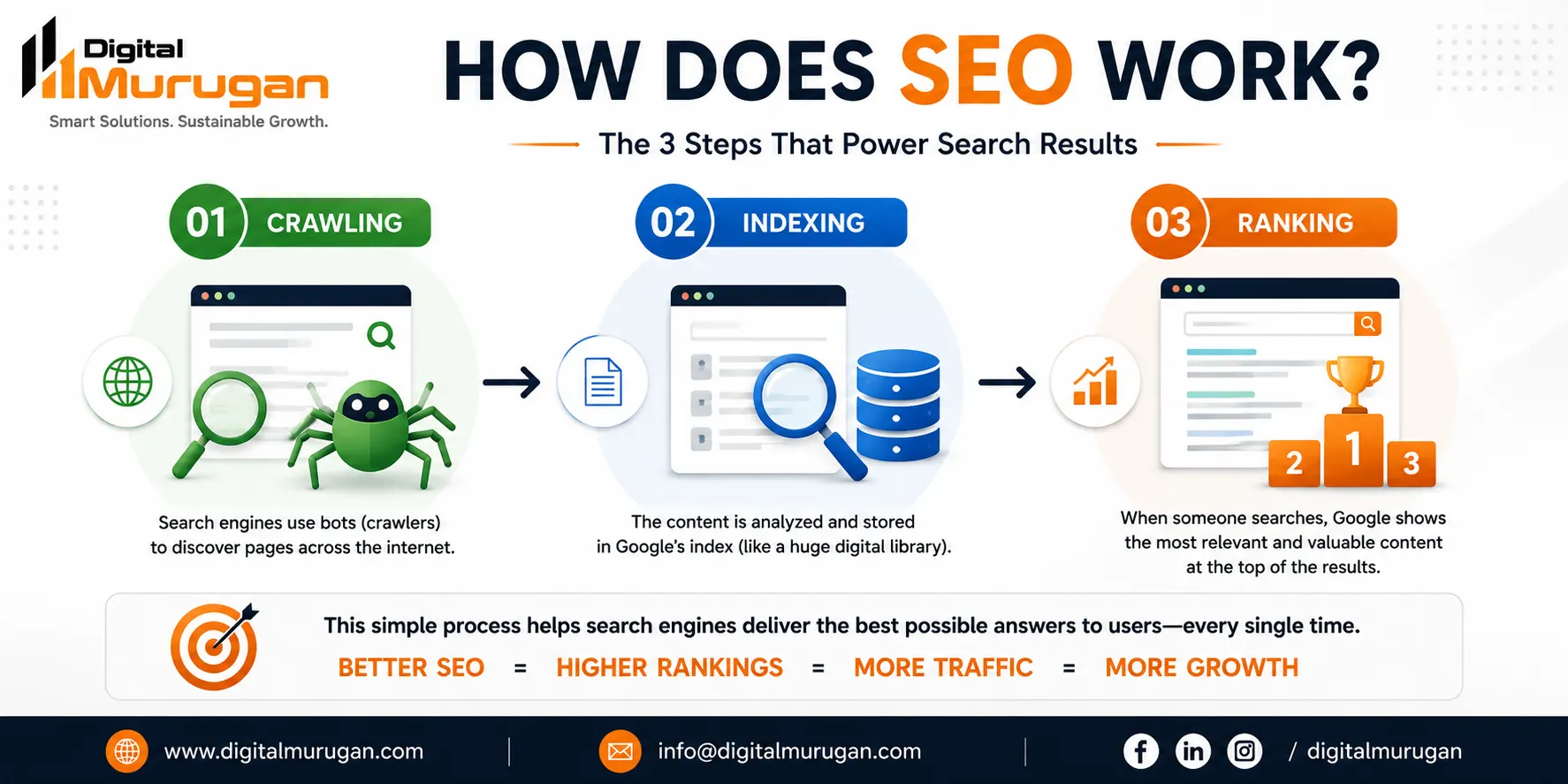
A simplified way to understand the process is:
Crawling → Indexing → Ranking
1. Crawling
Search engines use automated systems, often called crawlers or bots, to discover pages across the web.
Crawlers can follow links and discover new or updated content. Google explains that its systems automatically look for websites to add to its index, although some pages may still be missed.
2. Indexing
After discovering a page, a search engine can analyze and store information about it in its index.
Think of an index as a huge digital library. If a page is not indexed, it generally cannot appear in Google’s organic search results.
That is why technical accessibility and clear website structure matter.
3. Ranking
When someone performs a search, the search engine determines which available results are most relevant and useful for that query.
Many different signals and systems can influence search results, so there is no single SEO trick that guarantees a top position.
The practical takeaway is simple:
Make your website easy to discover, easy to understand, and genuinely useful to the people you want to reach.
The 4 Main Types of SEO
SEO is often divided into four broad areas: on-page SEO, technical SEO, off-page SEO, and local SEO.
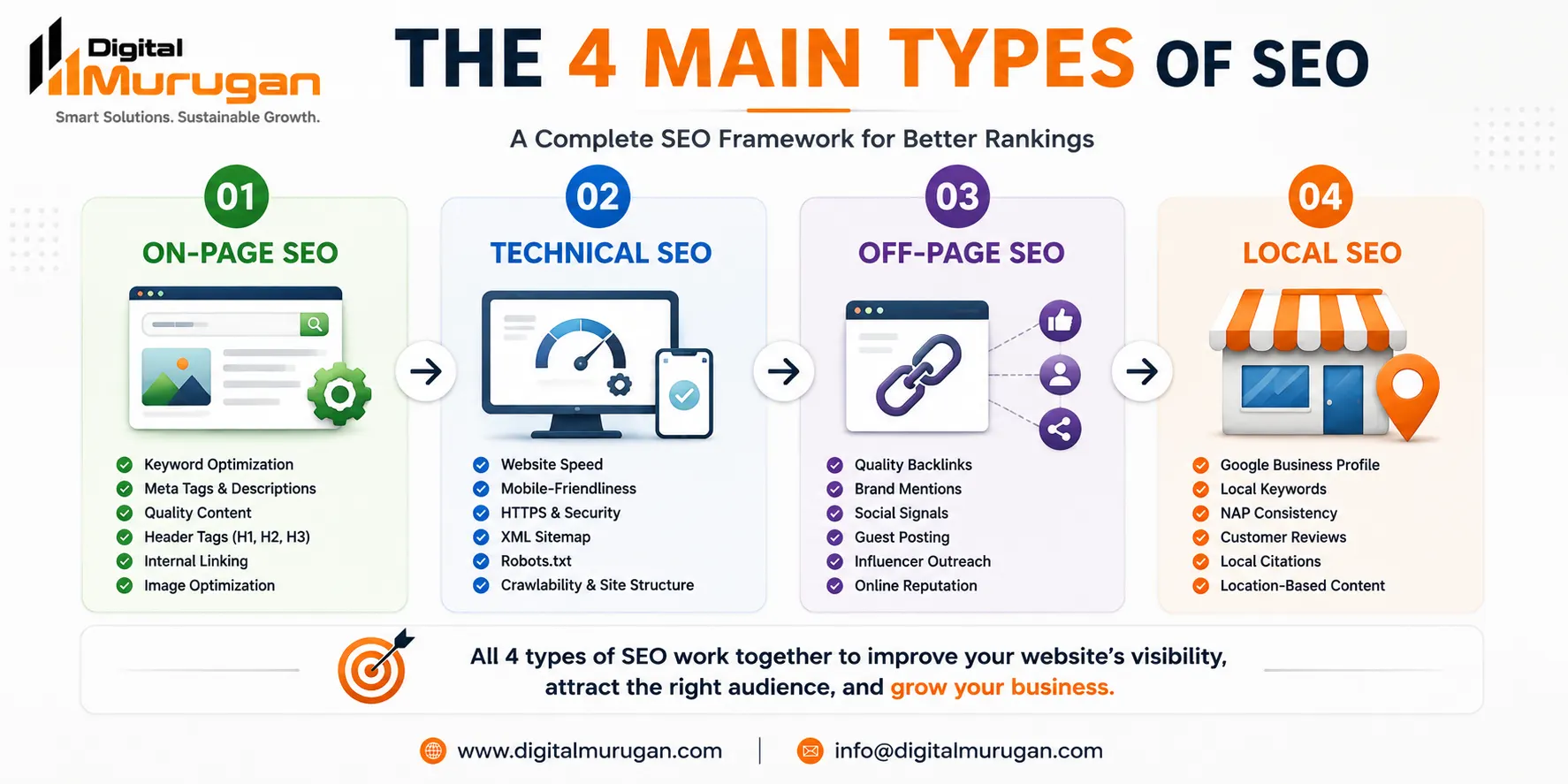
On-Page SEO
On-page SEO focuses on elements you can improve directly on your website pages.
This can include:
- Clear page titles
- Useful headings
- Relevant keywords and phrases
- Helpful original content
- Internal links
- Descriptive image alt text
- Logical page structure
- Useful meta descriptions
The important point is not to insert a keyword repeatedly just because you want to rank for it.
Google considers keyword stuffing a spam practice. Repeating keywords unnaturally can make content difficult to read and can violate Google’s spam policies.
Instead, write naturally and use terminology that helps readers understand the topic.
Technical SEO
Technical SEO focuses on aspects that help search engines access, understand, and process your website.
Examples include:
- Website crawlability
- Logical URL structure
- XML sitemaps
- Mobile usability
- HTTPS
- Website performance
- Internal linking
- Proper redirects
- Indexing controls
Google’s Search Central documentation specifically covers crawling, indexing, sitemaps, URL structure, and crawler management as important areas of website management.
Technical SEO does not mean every small business needs a highly complicated setup. In many cases, the fundamentals are enough to create a strong foundation.
Off-Page SEO
Off-page SEO refers to activities and signals that occur outside your own website.
One important area is links from other websites.
A relevant, editorially earned link can help users discover your content and can provide useful context about your website. However, trying to manipulate rankings by buying links, creating excessive link exchanges, or generating low-quality links can fall under Google’s link spam policies.
Instead of thinking:
“How many backlinks can I get?”
Think:
“What can I create that other people would genuinely find useful enough to reference?”
That change in mindset leads to better long-term SEO.
Local SEO
Local SEO is particularly important for businesses that serve customers in a specific geographic area.
Examples include:
- Restaurants
- Dentists
- Accountants
- Salons
- Repair services
- Real estate businesses
- Local retailers
- Professional service providers
Local SEO can involve maintaining accurate business information, creating useful location-related content, earning genuine reviews, and managing your presence on relevant local platforms.
For a small business, being visible when someone nearby searches for a relevant service can be far more valuable than attracting unrelated visitors from around the world.
Keyword Research: Find What Your Customers Are Searching For
Keywords are the words and phrases people use when searching for information.
For example, a small business selling handmade furniture might discover searches such as:
- handmade furniture
- custom wooden furniture
- custom dining tables
- furniture makers near me
- how to choose a dining table
Good keyword research is not about finding one keyword and repeating it everywhere.
It is about understanding search intent.
What Does the Searcher Actually Want?
Consider these searches:
“What is SEO?”
The person probably wants information.
“SEO agency for small business”
The person may be researching service providers.
“SEO agency near me”
The person may have stronger local or commercial intent.
Understanding this difference helps you create the right page for the right audience.
Google’s SEO guidance recommends thinking about the different terms users may search for and writing with those users in mind. Its language systems can understand how content relates to queries without requiring you to include every exact variation.
How to Create SEO-Friendly Content
Great SEO content should start with the reader—not the keyword.
Before publishing an article, ask:
What problem is this page solving?
Then make the answer as useful as possible.
Write for People First
Avoid writing paragraphs simply to include keywords.
Instead:
- Explain concepts clearly
- Use examples
- Answer common questions
- Include practical steps
- Use descriptive headings
- Link to useful related resources
- Update information when it becomes outdated
Google’s current guidance specifically encourages original, substantial, helpful content and warns against content created primarily to attract search traffic.
Make Your Content Easy to Read
Large blocks of text can be difficult to scan.
Use:
- Short paragraphs
- H2 and H3 headings
- Bullet points
- Tables where useful
- Examples
- Relevant images
- Clear explanations
Good formatting benefits both readers and search engines because it makes the structure and purpose of a page easier to understand.
Website Performance and User Experience Matter Too
SEO is not only about keywords and content.
Visitors should be able to use your website comfortably.
A good website experience includes considerations such as:
- Fast-loading pages
- Mobile usability
- Secure HTTPS connections
- Clear navigation
- Readable typography
- Limited intrusive elements
- Stable page layouts
Google recommends considering the overall page experience rather than focusing on a single metric. Core Web Vitals are useful for assessing aspects of user experience, but good scores alone do not guarantee high rankings.
For a small business, this has a simple implication:
Don’t optimize your website for search engines at the expense of your visitors.
Common SEO Mistakes Small Businesses Should Avoid
SEO becomes much easier when you know what not to do.
1. Keyword Stuffing
Repeating the same keyword excessively can make your content unnatural and may violate Google’s spam policies.
2. Copying Content
Publishing content that simply copies or lightly rewrites information from other websites does not provide much additional value.
Aim to add your own explanation, experience, examples, research, or perspective.
3. Buying Links to Manipulate Rankings
Paid links created specifically to manipulate ranking signals can violate Google’s link spam policies.
4. Publishing Large Amounts of Low-Value Content
More articles do not automatically mean better SEO.
Google’s guidance specifically warns against producing large amounts of content primarily to attract search traffic, including scaled content that provides little original value.
5. Ignoring Search Intent
A page can target a popular keyword and still fail if it does not answer what the searcher actually wants.
6. Expecting Instant Results
SEO is generally a long-term process. Rankings can take time to develop and can change as search results, competitors, websites, and user behavior change.
How Long Does SEO Take to Show Results?
There is no universal timeline.
A brand-new website may need time to be discovered, indexed, and establish visibility. An established website with strong content and authority may see changes more quickly.
Results can depend on:
- Website age and history
- Competition
- Industry
- Search demand
- Content quality
- Technical condition
- Existing authority
- Search intent
- Consistency of SEO work
Be cautious of anyone promising a guaranteed number-one Google ranking or a fixed timeline for every website.
SEO is better viewed as an ongoing improvement process than a one-time campaign.
A Simple SEO Strategy for Small Businesses
If SEO feels complicated, start with the fundamentals.
Step 1: Understand Your Audience
Identify your ideal customers and the questions they ask.
Step 2: Research Relevant Searches
Find the topics and phrases your audience actually uses.
Step 3: Build Useful Website Pages
Make sure your core services, products, and important business information are clearly explained.
Step 4: Improve On-Page SEO
Create descriptive titles, useful headings, logical URLs, internal links, and helpful content.
Step 5: Fix Technical Problems
Check whether important pages can be crawled and indexed and whether your website provides a good experience across devices.
Step 6: Publish Helpful Content
Create articles, guides, FAQs, case studies, and resources that genuinely answer customer questions.
Step 7: Build Genuine Authority
Earn attention through useful content, partnerships, mentions, PR, community involvement, and other legitimate activities.
Step 8: Measure and Improve
Use tools such as Google Search Console to understand search visibility and identify opportunities for improvement. Google provides Search Console specifically for monitoring search performance and checking whether Google can index your website.
How to Measure SEO Success
Ranking position is only one part of SEO performance.
Small businesses can monitor metrics such as:
- Organic search traffic
- Search impressions
- Click-through rate
- Important search queries
- Indexed pages
- Organic leads
- Contact form submissions
- Phone calls
- Sales or enquiries
- Conversions from organic traffic
The most useful measurement depends on your business goal.
For example, an online publisher may care heavily about organic traffic and engagement, while a local service business may care more about qualified enquiries and phone calls.
Ultimately, business outcomes matter more than vanity metrics.
Is SEO Still Worth It for Small Businesses?
Yes—but the way businesses approach SEO matters.
SEO should not be treated as a collection of tricks designed to fool search engines.
Modern SEO is increasingly about helping search engines understand genuinely useful content and helping people find the right information.
Google’s current Search Essentials recommend creating helpful, reliable, people-first content and using the words people would use to find your content in appropriate places such as titles, headings, alt text, and link text.
For small businesses, this means SEO can become part of a broader digital marketing strategy that includes a useful website, strong content, good user experience, local visibility, and a trustworthy online presence.
Frequently Asked Questions About SEO
Is SEO free?
Organic search visibility itself does not require paying Google for placement. However, SEO work can involve costs for content creation, technical improvements, SEO tools, professional services, or employee time. Google states that appearing in its Search results does not require payment.
Can a small business do SEO on its own?
Yes. Many SEO fundamentals can be handled internally, especially for small websites. Businesses can start with useful content, basic on-page optimization, technical checks, and Search Console.
More complex websites or competitive industries may benefit from professional SEO expertise.
Does SEO guarantee a first-page ranking?
No. There is no legitimate SEO method that can guarantee a specific Google ranking.
Search results depend on many factors, and Google itself states that following SEO best practices does not guarantee that a page will be crawled, indexed, or served in search results.
How often should a business publish new content?
There is no magic publishing frequency.
Publishing one excellent article that genuinely helps your audience can be more valuable than publishing many low-quality articles simply to appear active.
Google explicitly says that there is no preferred word count and warns against creating content primarily for search-engine traffic.
Does social media improve SEO?
Social media can help businesses distribute content, build awareness, and reach audiences, but social activity should not be treated as a simple shortcut to higher organic rankings.
The stronger strategy is to use social platforms and SEO together as parts of a broader digital marketing approach.
Final Thoughts
Search Engine Optimization is not about finding a secret formula that makes Google rank your website number one.
It is about building a website that is useful, understandable, accessible, trustworthy, and relevant to the people you want to reach.
For a small business, the best place to start is simple:
Understand your customers → create useful content → optimize your website → make it easy for search engines to understand → build genuine authority → measure the results → keep improving.
SEO takes patience, but when it is approached as a long-term investment in your website and your audience, it can become a powerful part of sustainable digital marketing.
The goal is not simply to get more visitors.
The goal is to get the right people to discover your business—and give them a good reason to stay.
 Previous Post
 Next Post