
Why Great Branding Needs More Than a Great Logo
A logo is often the first thing people associate with a brand. It appears on websites, social media profiles, packaging, advertisements, business cards, and other marketing materials. Because of this, many businesses assume that having a professional-looking logo means they have strong branding.
But a logo is only one part of a much bigger picture.
Great branding is not simply about creating a memorable symbol. It is about creating a consistent identity, communicating the right message, building trust, and giving people a reason to remember and choose your brand.
In today’s digital environment, customers can discover a brand through Google, social media, websites, advertisements, videos, online reviews, and many other touchpoints. Every interaction contributes to how they perceive the business.
That is why great branding needs much more than a great logo.
What Is Branding?
Branding is the process of shaping how people recognize, understand, and remember a business.
It includes much more than visual elements. A strong brand combines:
- Visual identity
- Brand messaging
- Typography and color systems
- Website experience
- Social media presence
- Content and communication
- Customer experience
- Marketing strategy
- Consistency across platforms
Your logo identifies your business, but your overall brand tells people what your business represents.
Think of the logo as the signature of a brand. The branding is the entire personality behind that signature.
A Logo Identifies You, But Branding Defines You
A good logo can make a brand recognizable, but recognition alone does not create a strong brand.
Imagine seeing a company’s logo for the first time. You may remember its shape, colors, or typography, but you may still have no idea what the company stands for.
Are they innovative?
Reliable?
Premium?
Creative?
Affordable?
Professional?
Customer-focused?
These perceptions come from the complete brand experience rather than the logo alone.
A successful brand makes its identity clear through every interaction.

1. Brand Identity Goes Beyond the Logo
A strong visual identity creates consistency around the logo.
This can include:
- Brand colors
- Typography
- Photography style
- Graphic elements
- Icons
- Illustrations
- Layout styles
- Image treatments
- Design patterns
When these elements are used consistently, people begin to recognize the brand even before they see the logo.
For example, a business may use a specific color combination, typography style, photography approach, and graphic language across its website and social media.
Over time, these visual patterns become part of the brand’s identity.
The goal is not simply to make everything look attractive. The goal is to make everything look like it belongs to the same brand.
2. Your Brand Needs a Clear Message
A beautiful visual identity cannot compensate for unclear communication.
People need to understand what you offer, who you serve, and why your business matters.
Your brand message should communicate your value in a simple and consistent way.
This can influence:
- Website headlines
- Social media captions
- Advertisements
- Blog content
- Product descriptions
- Videos
- Email communication
- Sales presentations
If your visuals say one thing while your communication says something completely different, the brand can feel inconsistent.
Strong branding brings visual identity and messaging together.
3. Your Website Is Part of Your Brand
For many businesses, the website is one of the first major interactions a potential customer has with the brand.
That makes website design an important part of branding.
A website should not only look professional. It should communicate the brand’s personality and make it easy for visitors to understand what the business does.
Important elements include:
- Clear navigation
- Consistent visual design
- Strong messaging
- Mobile-friendly layouts
- Useful content
- Professional imagery
- Clear calls to action
- Fast and smooth user experience
A great logo placed on a confusing website will not create a great brand experience.
Your website should make the brand feel as strong as the logo itself.
4. Consistency Builds Recognition
One of the biggest differences between an average brand and a strong brand is consistency.
If your website uses one visual style, your social media uses another, your advertisements use different colors, and your printed materials look completely unrelated, customers may struggle to recognize the business.
Consistency creates familiarity.
The same core brand elements should appear across relevant touchpoints, including:
Website → Social Media → Advertising → Content → Packaging → Presentations → Marketing Materials
This does not mean every design needs to look identical.
Instead, each piece should feel like part of the same brand system.
5. Your Social Media Is Part of Your Brand
Social media is no longer simply a place to post updates.
For many businesses, it is an important branding channel.
Every post contributes to how people perceive the business.
Your:
- Images
- Videos
- Captions
- Graphics
- Reels
- Stories
- Educational content
- Promotional content
all become part of the brand experience.
A consistent social media presence can make a business appear more professional and recognizable.
The objective is not just to collect views or followers. It is to build a recognizable digital personality.
6. Content Gives Your Brand a Voice
Visual branding tells people what your brand looks like.
Content tells people what your brand thinks about.
Blog articles, social media posts, videos, guides, case studies, and educational content can demonstrate knowledge and expertise.
For example, a technology company can strengthen its brand by consistently publishing useful content about technology, digital transformation, AI, websites, and online growth.
Over time, this content can help position the company as a knowledgeable and reliable source.
Your brand should not only be recognizable.
It should be useful.
7. Customer Experience Is Branding
One of the most overlooked parts of branding is customer experience.
A business can have an excellent logo and beautiful website, but if the actual customer experience is poor, the brand perception will suffer.
Branding is influenced by things such as:
- How quickly inquiries are answered
- How clearly services are explained
- How professional communication feels
- How easy it is to make an enquiry
- How problems are handled
- How consistently customers are treated
Customers remember experiences.
That means branding continues even after someone has clicked your advertisement or visited your website.
8. Strong Branding Creates Trust
People naturally look for signals that a business is credible.
Professional and consistent branding can help create those signals.
When a business maintains a clear identity across its website, social media, advertisements, content, and other communication channels, it can feel more established and trustworthy.
However, trust should never come from appearance alone.
The brand experience needs to support the promise the business makes.
A professional-looking brand combined with poor service creates a disconnect.
A strong brand aligns what it promises with what it delivers.
9. Branding Helps You Stand Out
Many industries are crowded with businesses offering similar products or services.
Simply saying what you sell may not be enough to differentiate your business.
Branding gives you an opportunity to communicate your personality, values, positioning, and approach.
Two companies may offer similar services, but their branding can make them feel completely different.
One might position itself as innovative and technology-focused.
Another might emphasize simplicity and reliability.
Another might focus on creativity and premium experiences.
The service may be similar.
The perception can be very different.
10. Branding and Digital Marketing Should Work Together
Branding and marketing should not operate as completely separate activities.
Marketing helps bring attention to your business.
Branding helps shape what people think when they encounter that attention.
For example, someone might discover your business through a search engine, see your advertisement on social media, visit your website, and later encounter one of your videos.
Each interaction is an opportunity to reinforce the same brand identity.
When branding and digital marketing work together, your business can create a more connected customer journey.
11. AI Is Adding a New Layer to Branding
Artificial intelligence is also changing how businesses approach branding and content creation.
AI can support areas such as:
- Content ideation
- Creative concepts
- Visual exploration
- Marketing workflows
- Customer communication
- Research
- Personalization
- Content production
But technology does not replace the need for a strong brand foundation.
Without clear brand guidelines, AI-generated content can easily become inconsistent.
The future of branding is not simply about producing more content.
It is about producing relevant content that still feels unmistakably connected to the brand.
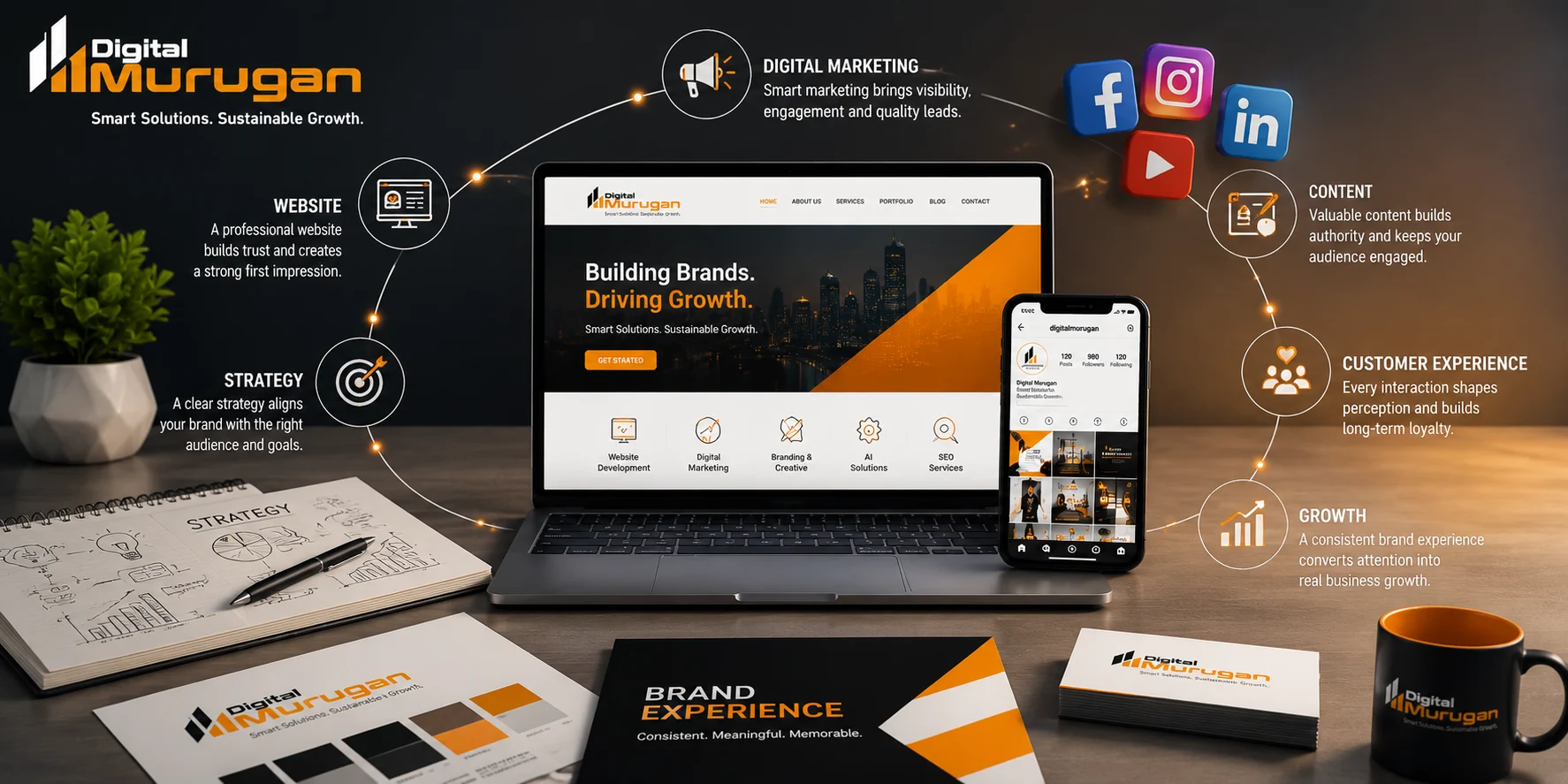
12. A Strong Brand Creates a Complete Experience
The strongest brands do not depend on one element.
They create connections between multiple elements.
A customer might first discover a business through Google.
Then they may visit its website.
Next, they might check its social media.
Later, they may see an advertisement.
Eventually, they may contact the company.
Every stage contributes to the overall perception of the brand.
This is why branding should be considered an ecosystem rather than a single design project.
The Brand-Building Checklist
Before considering your branding complete, ask:
- Is our brand visually consistent?
- Is our message clear?
- Does our website reflect our identity?
- Do our social media channels look and feel connected?
- Does our content demonstrate our expertise?
- Are our marketing campaigns aligned with our brand?
- Is the customer experience consistent with our brand promise?
- Can people recognize our business without immediately seeing the logo?
- Does our brand communicate why we are different?
- Can our brand identity remain consistent as the business grows?
If the answer to most of these questions is yes, you are building something much stronger than a logo.
Final Thoughts
A logo can introduce your brand.
But branding is what makes people remember it.
Your logo, colors, typography, website, content, social media, marketing, customer experience, and communication all contribute to the perception people develop about your business.
The most successful brands understand that branding is not a one-time design exercise. It is an ongoing process of creating a consistent and meaningful experience.
So, when building your brand, don’t stop at the logo.
Build the identity.
Define the message.
Create the experience.
Stay consistent.
And give people a reason to remember you.
Because a great logo can get attention, but great branding gives people something to remember.
 Previous Post
 Next Post