
Google Ads for Small Businesses: A Beginner’s Guide to Getting More Customers
If you run a small business, getting your products or services in front of the right people can be challenging. You may have a great website, strong services, and a valuable offer—but potential customers still need to find you.
This is where Google Ads can help.
Google Ads allows businesses to advertise across Google’s advertising ecosystem and reach people based on their searches, interests, browsing behaviour, and other signals. When used strategically, it can help a small business generate relevant website traffic, leads, phone calls, sales, or other valuable actions.
However, Google Ads is not simply about spending money to appear at the top of search results. Successful campaigns require the right objective, targeting, keywords, advertisements, landing pages, budget, and performance tracking.
In this guide, we’ll explain how Google Ads works and how small businesses can approach it more effectively.
What Is Google Ads?
Google Ads is Google’s online advertising platform that allows businesses to promote their products and services to potential customers.
Depending on the campaign type and objective, advertisements can appear in places such as Google Search, YouTube, websites, apps, and other Google advertising environments.
For example, imagine that you own a web design company in Mumbai.
Someone searches:
“website designer for small business in Mumbai”
A relevant Google Search ad could appear when that person is looking for a service like yours.
This is one of the major advantages of search advertising: you can reach people at the moment they are actively looking for something related to your business.
Google Ads campaigns begin with a business objective, followed by choosing an appropriate campaign type, budget, bidding strategy, targeting, and ad assets.
How Does Google Ads Work?
Google Ads may look simple from the outside, but there is a sophisticated system working behind every advertisement.
When someone performs a relevant search, Google runs an ad auction to determine which eligible ads can appear and in what order.
The auction considers several factors, including the advertiser’s bid and the quality and relevance of the ad and landing page.
This means that simply offering to spend more money does not automatically guarantee the best position.
Google evaluates factors related to ad quality, relevance, landing-page experience, and other signals when determining ad placement.
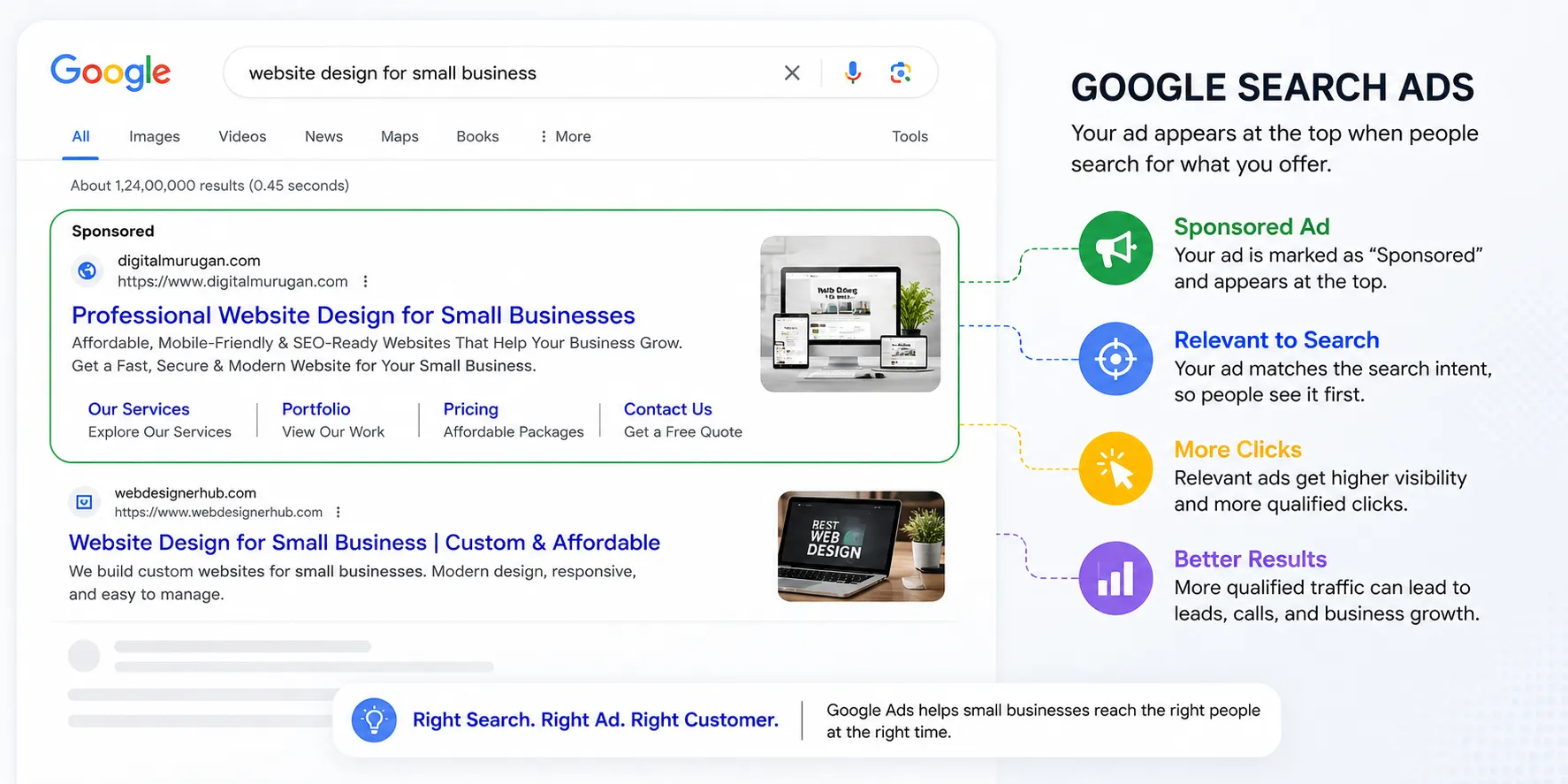
A simplified journey looks like this:
Customer Search → Relevant Keyword/Intent → Ad Auction → Advertisement → Landing Page → Conversion
The goal isn’t just to get someone to click your advertisement.
The goal is to attract the right person and encourage them to take a valuable action.
Why Should Small Businesses Use Google Ads?
Google Ads can be useful for small businesses because it provides a way to reach potential customers who are already searching for products or services.
Some potential benefits include:
Reach people with relevant intent
Someone searching for “accountant near me” has a different level of intent from someone casually scrolling through social media.
Search advertising can help businesses reach people when they are actively looking for a solution.
Control your advertising budget
You can establish campaign budgets and bidding strategies rather than relying entirely on traditional advertising methods.
However, having a small budget doesn’t automatically make a campaign profitable. The quality of targeting, keywords, advertisements, landing pages, and conversion tracking still matters.
Target specific markets
Businesses can structure campaigns around relevant locations, audiences, keywords, and other targeting options.
This can be particularly useful for local businesses that only serve a particular city or region.
Measure results
One of the biggest advantages of digital advertising is the ability to measure what happens after someone interacts with an advertisement.
Google Ads conversion tracking can help businesses measure valuable actions such as purchases, leads, phone calls, sign-ups, and downloads.
Which Google Ads Campaign Type Should You Choose?
Google Ads offers different campaign types designed for different marketing goals.
The right choice depends on what your business is trying to achieve.
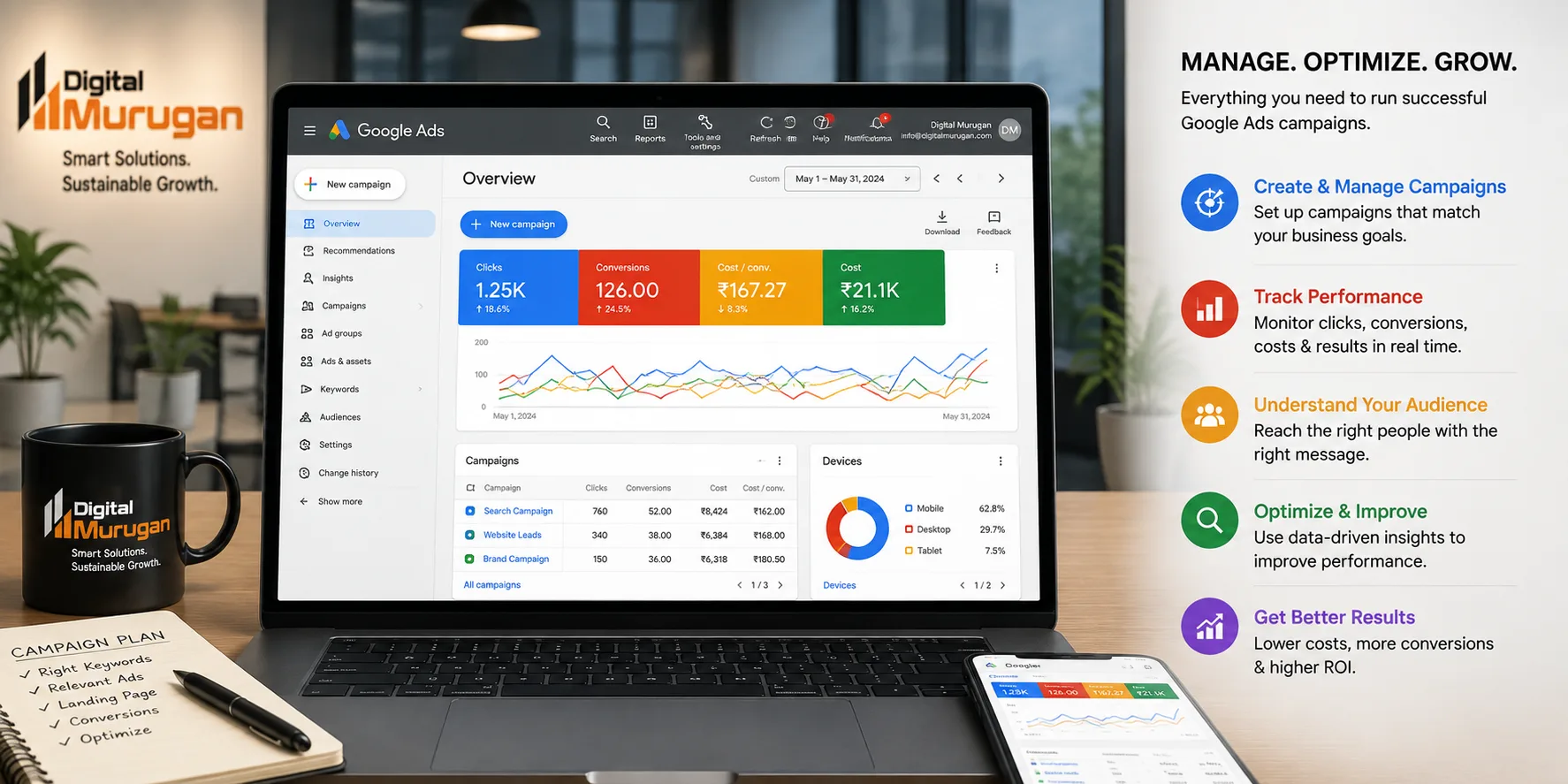
Search Campaigns
Search campaigns are particularly useful when people are actively searching for products or services.
For example:
“best digital marketing agency in Mumbai”
A relevant Search campaign could help a business reach people searching for that service.
Display Campaigns
Display campaigns can use visual advertisements to reach audiences while they browse websites, apps, and other Google advertising environments.
They can be useful for awareness, remarketing, and reaching people beyond traditional search results.
Video Campaigns
Video advertising can help businesses reach audiences through video content and is particularly relevant for businesses using video to build awareness or communicate their brand.
Shopping Campaigns
For eligible ecommerce businesses, Shopping campaigns can help promote products to people searching for products online.
Performance Max
Performance Max is a goal-based campaign type that can access Google’s advertising inventory across multiple channels from a single campaign and uses Google AI to help optimize performance toward specified conversion goals.
Demand Gen
Demand Gen campaigns are designed around visually engaging experiences that can help businesses reach potential customers and create interest in their products or services.
App Campaigns
Businesses promoting mobile applications can use app-focused campaigns to encourage installations and other valuable app actions.
The important lesson is simple:
Don’t choose a campaign type simply because it is popular. Choose it based on your business objective.
How to Choose the Right Keywords
Keywords are an important part of Search advertising.
If you provide website design services, for example, relevant searches might include:
- website design company
- website designer for small business
- professional website design
- business website development
But not every keyword related to your industry will necessarily be valuable.
A person searching for:
“how to design a website for free”
may not be looking for a paid professional service.
This is why search intent matters.
Before adding a keyword, ask:
“What does someone searching for this phrase actually want?”
The closer the search intent is to your offer, the more useful that traffic may be.
Google Ads also provides search-term information that can help advertisers identify relevant searches and discover irrelevant searches that may be added as negative keywords.
Write Ads That Match What People Are Searching For
Your advertisement should clearly communicate what you offer.
If your keyword is:
“website design for small businesses”
your ad should make it obvious that you provide website design services for businesses.
Avoid vague advertising such as:
“We Are The Best. Contact Us Today!”
Instead, communicate something useful and relevant:
“Professional Websites for Small Businesses”
“Mobile-Friendly Business Websites”
“Build a Website That Supports Your Business Growth”
Your advertisement should make it easy for someone to understand why your offer is relevant to their search.
Google recommends making ad messaging relevant to the keywords and user intent.
Don’t Ignore Your Landing Page
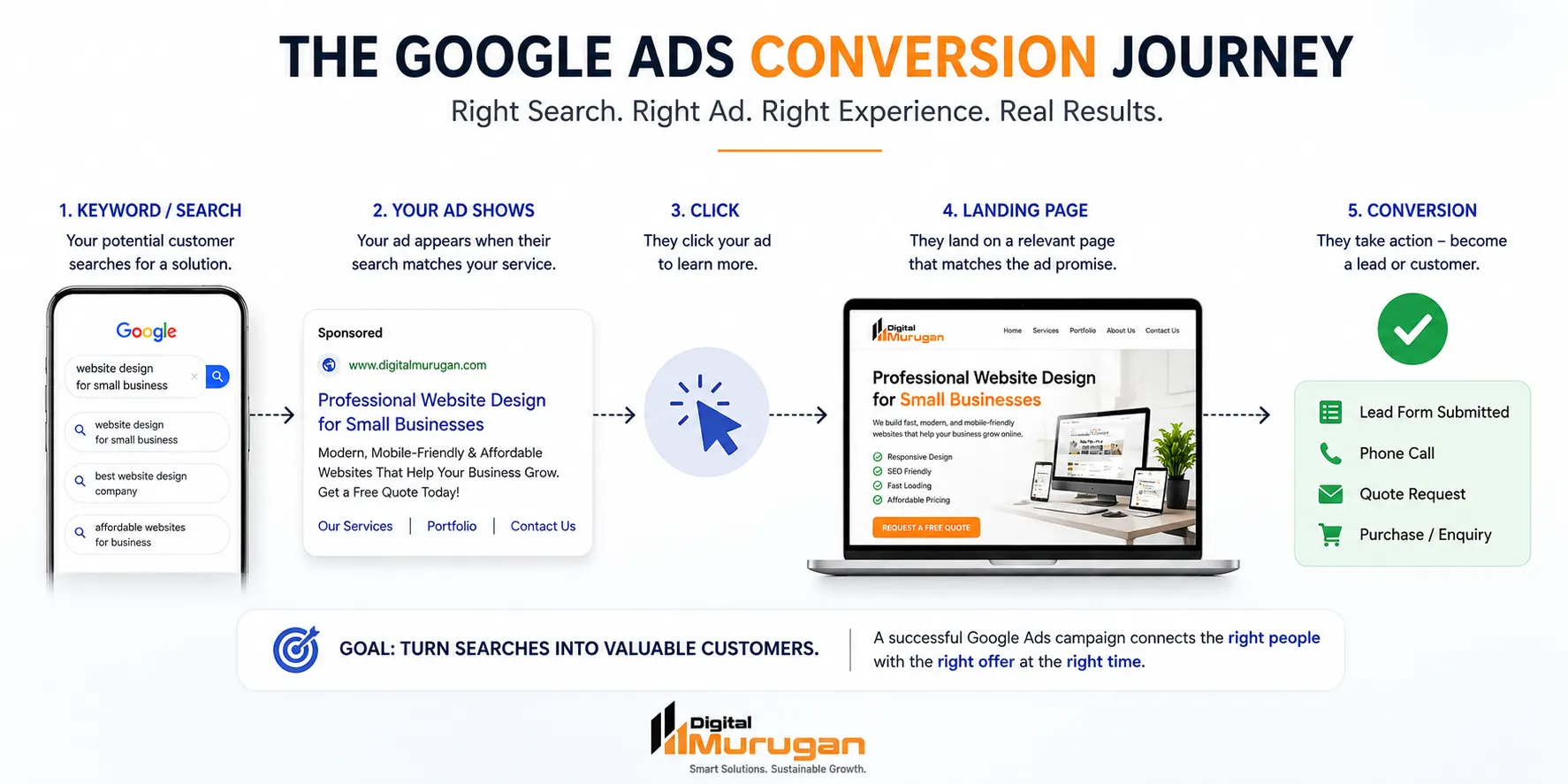
Getting the click is only the beginning.
After someone clicks your advertisement, they should arrive at a page that matches what they expected to see.
For example:
Search: Website Design for Small Businesses
↓
Ad: Professional Small Business Website Design
↓
Landing Page: Small Business Website Design Service
↓
Action: Request a Quote
Sending that visitor to an unrelated homepage can create unnecessary friction.
A good landing page should:
- Match the advertisement
- Clearly explain the offer
- Be easy to navigate
- Work well on mobile devices
- Provide relevant information
- Have a clear next step
- Make it easy for visitors to contact or buy from you
Google identifies landing-page experience as one of the components used in Quality Score, alongside expected clickthrough rate and ad relevance.
How Much Should a Small Business Spend on Google Ads?
There is no universal Google Ads budget that works for every business.
A local service business and a nationwide ecommerce company can have completely different advertising requirements.
Your budget can depend on factors such as:
- Industry
- Location
- Competition
- Average customer value
- Cost per click
- Conversion rate
- Sales cycle
- Available advertising budget
Instead of asking only:
“How much should I spend?”
a better question is:
“What result do I need from my advertising budget?”
For example, if your goal is to generate leads, you should understand how much a qualified lead is worth to your business and how many leads you need to generate.
Start with a realistic testing budget, collect enough data to understand performance, and make decisions based on results rather than assumptions.
Track Conversions, Not Just Clicks
Clicks can look impressive in a report, but clicks alone don’t pay the bills.
Suppose your campaign receives:
1,000 clicks
That sounds good.
But what if only two people contact your business?
The more important question becomes:
What happened after the click?
Depending on your business, a conversion could be:
- A purchase
- A lead form submission
- A phone call
- A newsletter signup
- A booking
- An app download
- Another valuable customer action
Google’s conversion tracking is designed to measure these meaningful actions and help advertisers understand which campaigns, ads, and keywords are contributing to business results.
Important Google Ads Metrics to Watch
Different campaigns can have different priorities, but some commonly useful metrics include:
Impressions
How often your advertisement was shown.
Clicks
How many times people clicked your advertisement.
Clickthrough Rate (CTR)
The percentage of impressions that resulted in clicks.
Conversions
The number of valuable actions attributed to your advertising.
Conversion Rate
The percentage of relevant interactions that resulted in a conversion.
Cost Per Conversion
How much advertising spend is associated with each conversion.
Conversion Value
The business value assigned to conversions where appropriate.
Return on Ad Spend (ROAS)
A way to evaluate the revenue generated relative to advertising spend when revenue tracking is appropriate.
Google recommends using conversion-related metrics and conversion value to better understand the actual business impact of campaigns rather than focusing only on traffic.
What Is Google Ads Quality Score?
If you’ve explored Google Ads, you may have come across Quality Score.
Quality Score is a diagnostic score from 1 to 10 available at the keyword level for Search campaigns.
Google describes three main components:
- Expected clickthrough rate
- Ad relevance
- Landing page experience
A higher Quality Score generally indicates that your ad and landing page are more relevant and useful compared with other advertisers targeting the same keyword.
However, there is an important point to remember:
Don’t treat Quality Score as your main business KPI.
Google describes Quality Score as a diagnostic tool that can help identify areas for improvement—not something advertisers should simply try to maximize.
Your actual business outcomes—such as qualified leads, sales, conversion value, and profitability—matter more.
Common Google Ads Mistakes Small Businesses Should Avoid
1. Targeting overly broad searches
Broad or poorly relevant targeting can attract people who aren’t interested in buying your product or service.
2. Sending every visitor to the homepage
A dedicated landing page can often provide a more relevant experience.
3. Ignoring negative keywords
Some searches may look related to your business but have completely different intent.
Reviewing search terms can help identify irrelevant traffic and opportunities to add negative keywords.
4. Writing generic advertisements
If your advertisement could describe almost any company in your industry, it may not communicate enough value or relevance.
5. Measuring only clicks
A large number of clicks doesn’t necessarily mean a successful campaign.
6. Forgetting conversion tracking
Without proper conversion measurement, it becomes much harder to understand which campaigns and keywords are actually producing valuable results.
7. Changing everything too quickly
Advertising campaigns need meaningful data before you make major decisions.
8. Expecting guaranteed results
Google Ads can create opportunities, but advertising performance depends on many factors—including the market, offer, competition, targeting, ad quality, landing page, and customer demand.
Google Ads vs SEO: Which Is Better?
This is a common question for small businesses.
The answer depends on your goals.
Google Ads
Advantages:
- Paid visibility
- Can reach people actively searching
- Budget and targeting controls
- Measurable advertising activity
- Useful for testing offers and generating targeted traffic
Considerations:
- Requires ongoing advertising spend
- Results depend on campaign quality
- Traffic generally stops when advertising stops
SEO
Advantages:
- Builds organic search visibility
- Can support long-term traffic
- Doesn’t require paying for every organic click
- Can strengthen your website’s overall search presence
Considerations:
- Usually takes time
- Requires consistent content and optimization
- Rankings aren’t guaranteed
For many businesses, the smartest approach isn’t necessarily choosing one over the other.
Google Ads can support immediate paid visibility while SEO works toward long-term organic growth.
A Simple Google Ads Starting Plan for Small Businesses
If you’re new to Google Ads, don’t try to build an enormous campaign immediately.
Start with a focused approach.
Step 1: Define Your Goal
Decide what you actually want:
Sales? Leads? Phone calls? Website traffic?
Google recommends aligning campaign objectives with the outcome you want from your advertising.
Step 2: Choose the Appropriate Campaign
Select the campaign type that fits your goal and audience.
For a business receiving enquiries from people actively searching for its services, Search can be a logical starting point.
Step 3: Research Relevant Searches
Identify keywords and search intent that closely match your products or services.
Don’t focus only on search volume. Relevance matters.
Step 4: Create Relevant Ads and Landing Pages
Make sure the message in your advertisement connects naturally with the page visitors see after clicking.
Step 5: Measure and Improve
Track conversions and review campaign performance.
Then ask:
Which searches are producing valuable results?
Which advertisements are getting relevant engagement?
Which campaigns are generating conversions?
Where is the budget being wasted?
Use those insights to improve the campaign over time.
Final Thoughts
Google Ads can be a powerful advertising channel for small businesses, but success doesn’t come simply from putting money behind an advertisement.
The strongest campaigns begin with a clear business goal and connect every part of the customer journey:
Right Audience → Right Search → Relevant Ad → Useful Landing Page → Valuable Action
Start with a focused campaign, use a realistic budget, measure meaningful results, and improve based on actual data.
Most importantly, remember that more clicks don’t necessarily mean more customers.
The real objective is to attract the right people and turn relevant advertising traffic into meaningful business results.
Frequently Asked Questions
Is Google Ads good for small businesses?
Yes, Google Ads can be useful for small businesses when campaigns are carefully targeted and measured. Its value depends on factors such as the business model, competition, customer value, budget, offer, and campaign execution.
How much money do I need to start Google Ads?
There is no single minimum budget that guarantees results. Your starting budget should depend on your market, expected customer value, competition, and the amount you can realistically spend while gathering useful campaign data.
Is Google Ads better than SEO?
Neither is universally better. Google Ads provides paid visibility, while SEO focuses on organic search visibility. Businesses may benefit from using both depending on their goals and resources.
Can Google Ads guarantee customers?
No. Google Ads can help you reach potential customers, but it cannot guarantee sales or leads. Results depend on factors including demand, targeting, competition, ad relevance, landing-page experience, offer, and conversion process.
Should a small business track conversions?
Yes. Conversion tracking helps businesses understand whether advertising interactions are leading to valuable actions such as purchases, leads, calls, or sign-ups.
 Previous Post
 Next Post