
Beyond Messaging: How WhatsApp Can Strengthen Your Digital Marketing Strategy
For years, digital marketing has been about reaching people wherever they spend their time online. Search engines help people discover brands. Social media creates awareness. Websites provide information. Email keeps audiences connected.
But there is another powerful layer in the customer journey: conversation.
That is where WhatsApp can play an important role.
With billions of users around the world, WhatsApp has become more than a messaging app. For brands and organizations, it can provide a direct way to communicate with customers, answer questions, share useful information and support people as they move from interest to action.
WhatsApp Business describes its solutions around connecting with customers through messaging, improving customer experiences, supporting sales and building longer-term customer relationships.
The real opportunity, however, is not simply sending more messages.
It is using WhatsApp strategically as part of a broader digital marketing ecosystem.
What Is WhatsApp Marketing?
WhatsApp marketing is the use of WhatsApp to communicate with customers and audiences for purposes such as engagement, customer support, product or service communication, lead nurturing and relationship building.
Unlike many traditional advertising channels, WhatsApp creates an environment where communication can feel more direct and conversational.
A person may discover a brand through Google or Instagram, visit its website, and then use WhatsApp to ask a question.
That creates a connected journey:
Discovery → Conversation → Trust → Decision → Support → Loyalty
WhatsApp can become the bridge between marketing and human interaction.
Why WhatsApp Belongs in a Modern Digital Marketing Strategy
A strong digital marketing strategy rarely depends on one channel.
Search can generate discovery. Social media can create awareness. Content can educate an audience. Email can nurture relationships.
WhatsApp can add another important element: direct conversation.
Imagine someone discovering a service through an online search. They have questions before making a decision.
Instead of leaving the website and searching somewhere else, they can start a conversation.
That simple interaction can remove friction.
WhatsApp can therefore support several stages of the customer journey:
- Answering pre-purchase questions
- Sharing relevant information
- Following up with interested customers
- Providing customer support
- Sending important updates
- Maintaining relationships after a purchase
- Encouraging repeat engagement
The goal is not to replace every other marketing channel.
The goal is to make the overall customer journey more connected.
From the First Message to a Long-Term Relationship
One of the biggest mistakes in messaging-based marketing is focusing only on conversion.
A customer relationship does not begin and end with a purchase.
Someone may first contact a brand because they want information. They may need clarification before making a decision. After purchasing, they may need support. Later, they may become interested in another product or service.
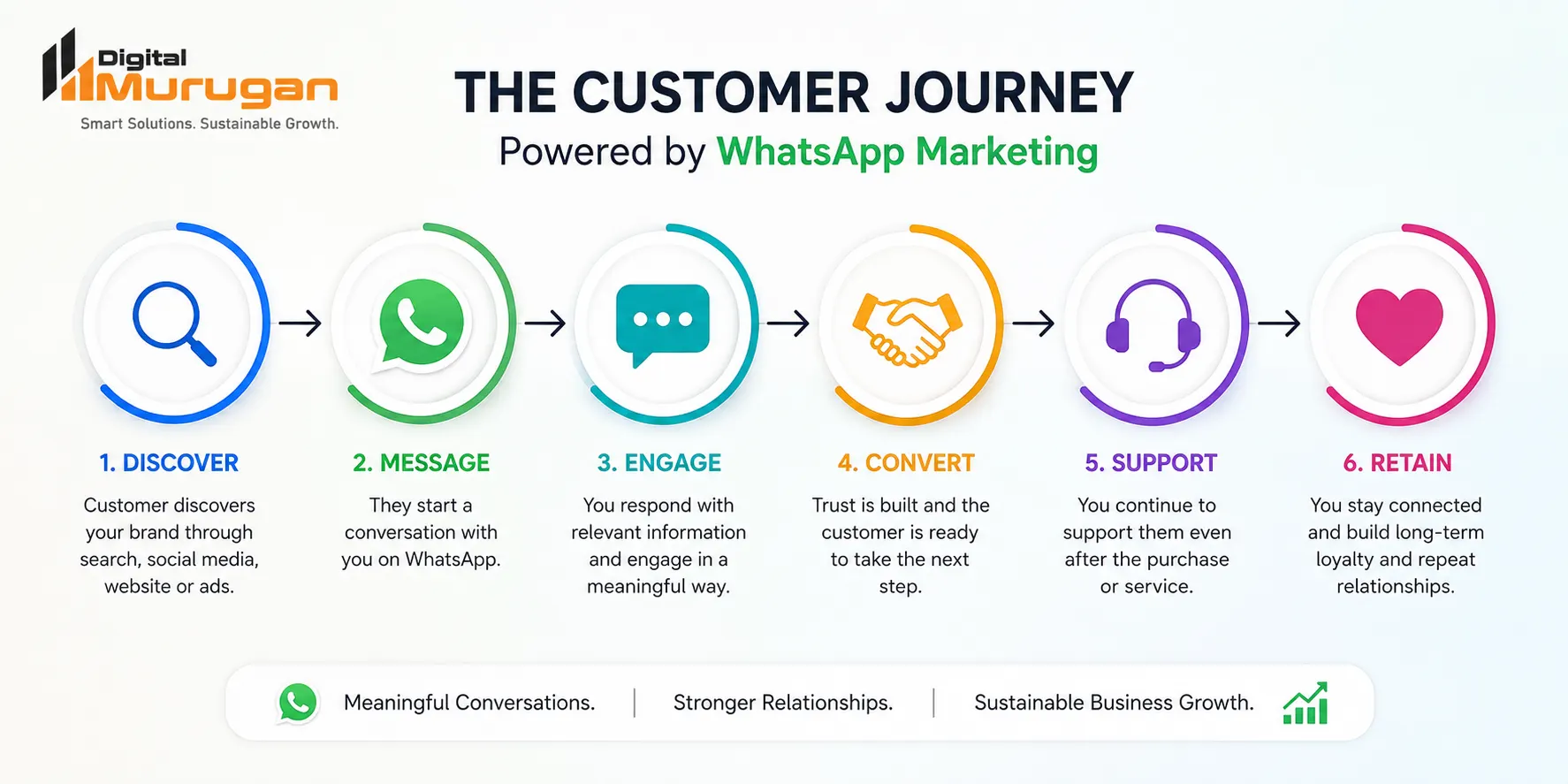
WhatsApp can support these different moments.
1. Discovery
A customer discovers your brand through search, social media, advertising, content or a recommendation.
2. Conversation
They have a question and start a WhatsApp conversation.
3. Trust
Your response provides useful information instead of immediately pushing for a sale.
4. Decision
The customer now has enough confidence to take the next step.
5. Support
After the purchase or interaction, WhatsApp can remain a convenient communication channel.
6. Loyalty
Useful communication over time can help maintain the relationship.
This is why WhatsApp marketing should be viewed as part of the customer experience, not simply another advertising channel.
What Should You Actually Send on WhatsApp?
If every message sounds like an advertisement, people will eventually stop paying attention.
Effective WhatsApp communication should give the recipient a reason to open, read and respond.
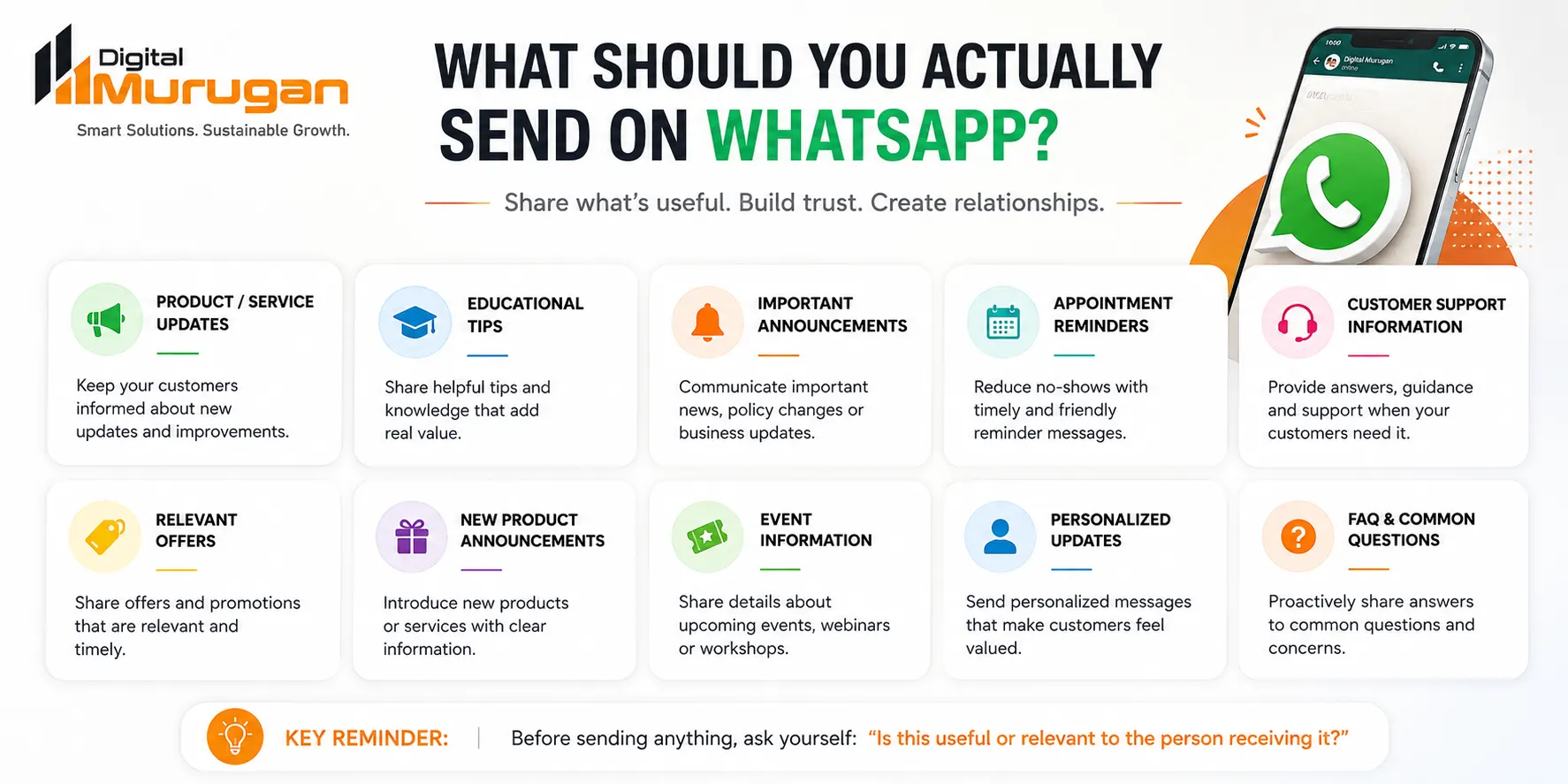
Depending on the nature of the organization, useful messages can include:
- Product or service updates
- Helpful educational tips
- Important announcements
- Appointment reminders
- Customer support information
- Relevant offers
- New product announcements
- Event information
- Personalized updates
- Answers to common customer questions
The key question before sending anything should be:
“Is this useful or relevant to the person receiving it?”
If the answer is no, the message probably does not need to be sent.
WhatsApp Business Can Make Communication More Structured
For organizations managing regular customer conversations, WhatsApp Business provides tools designed to make communication more practical and professional.
Depending on the solution and setup, businesses can use features and capabilities designed around customer conversations, business information, messaging and customer support. WhatsApp positions its business solutions as a way to connect with customers where they already communicate and create more personalized experiences.
The important point is not to use every available feature simply because it exists.
Instead, choose tools that solve real communication problems.
For example:
Quick responses can help teams answer recurring questions more efficiently.
Business information can make it easier for customers to understand who they are communicating with.
Organized conversations can help teams manage customer interactions more effectively.
The technology should support the customer experience—not make communication feel robotic.
Personalization Without Becoming Intrusive
Personalization can make communication more relevant, but there is an important boundary.
There is a difference between:
“We thought this information might be useful to you.”
and
“We are going to send you messages every day because we can.”
The first feels helpful.
The second feels intrusive.
Good WhatsApp marketing respects the customer’s attention.
That means considering:
- Why the person is receiving the message
- Whether the information is relevant
- How frequently communication should happen
- Whether the customer has given appropriate permission
- Whether the message provides genuine value
Trust is difficult to build and easy to lose.
A brand that respects someone’s inbox is more likely to earn long-term attention.
WhatsApp Should Work With Your Other Marketing Channels
WhatsApp becomes even more powerful when it is connected to the rest of a digital marketing strategy.
Consider this journey:
Search → Website → WhatsApp → Conversation → Conversion → Retention
Or:
Social Media → Content → WhatsApp → Customer Support → Loyalty
Each channel has a different job.
Your website can provide detailed information.
Social media can generate awareness.
Search can capture existing intent.
Email can support longer-form communication.
WhatsApp can provide a more direct conversational layer.
This integrated approach is much stronger than treating each platform as an isolated marketing activity.
Common WhatsApp Marketing Mistakes
Sending Too Many Messages
More messages do not automatically mean more engagement.
Quality and relevance matter more than volume.
Making Every Message Promotional
Customers do not want every conversation to become a sales pitch.
Balance promotional communication with useful information and genuine support.
Messaging Without Proper Permission
Respecting communication preferences is essential for maintaining trust and following applicable rules.
Using Generic Messages for Everyone
Different customers have different needs.
Where appropriate, segmenting communication can make messages more relevant.
Responding Too Slowly
If WhatsApp is being presented as a convenient communication channel, customers expect a reasonable response experience.
Ignoring the Customer Journey
A WhatsApp number on a website is not a strategy by itself.
Think about what happens before the customer messages you—and what happens afterward.
Measuring Nothing
Without measurement, it becomes difficult to understand whether your communication is actually helping.
How to Measure WhatsApp Marketing
The right metrics depend on the objective.
If your goal is lead generation, you might look at:
- Conversations started
- Qualified leads
- Response rates
- Conversion rates
If your goal is customer service, useful measures could include:
- Response time
- Resolution time
- Customer satisfaction
- Number of successfully resolved conversations
If your goal is retention, you might examine:
- Repeat interactions
- Repeat purchases
- Customer engagement
- Retention-related outcomes
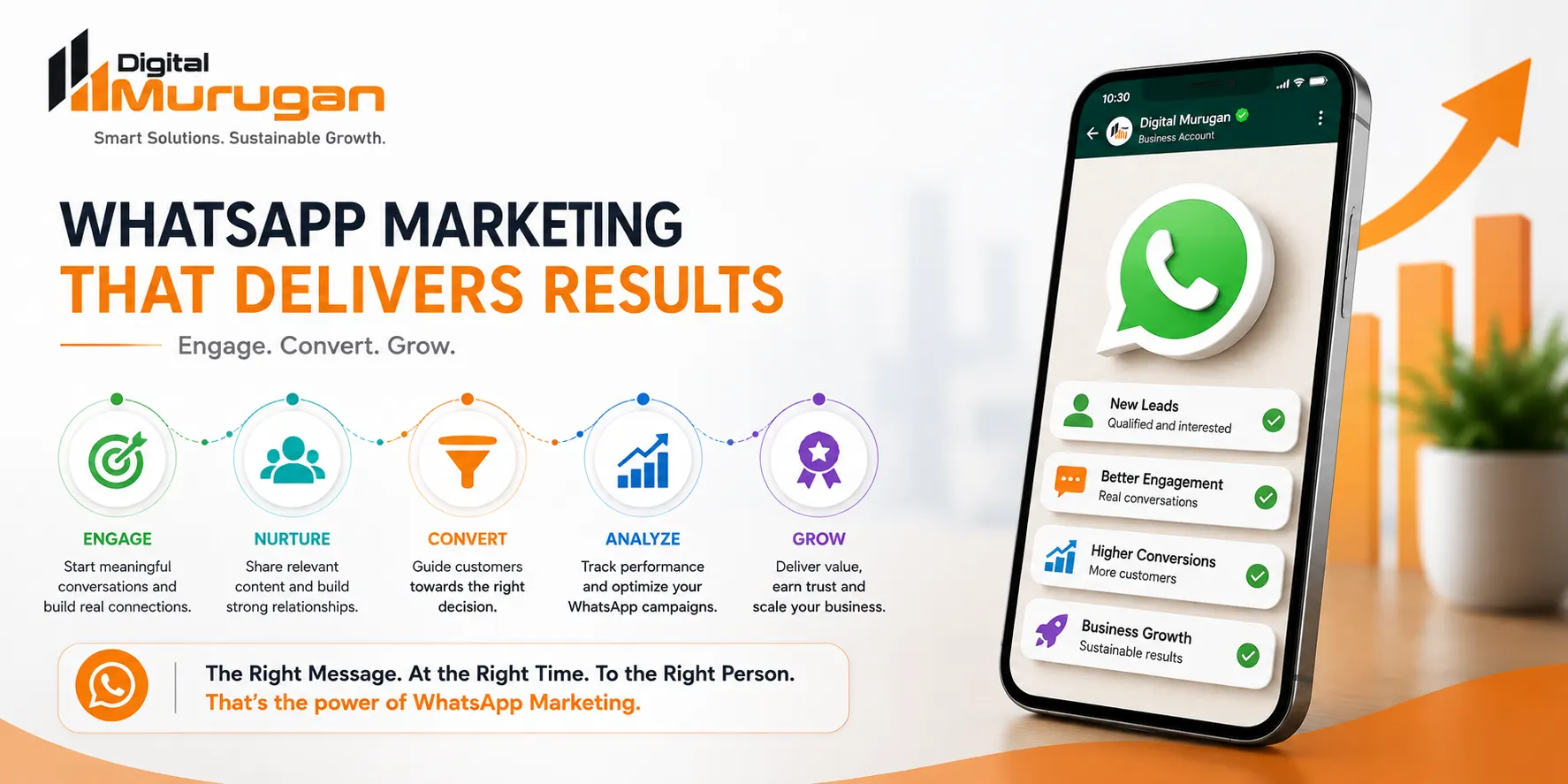
The most important principle is simple:
Measure the outcome, not just the number of messages sent.
A campaign that sends thousands of messages but creates little meaningful engagement is not necessarily successful.
A Simple WhatsApp Marketing Framework
If you are building a WhatsApp strategy from scratch, keep the process simple.
Define
Decide what WhatsApp is supposed to achieve.
Is it for leads, customer support, engagement, sales, retention—or a combination?
Invite
Give people a clear and appropriate reason to start a conversation.
Engage
Respond with useful, relevant information.
Help
Focus on solving problems rather than immediately selling.
Convert
When the customer is ready, make the next step clear and easy.
Retain
Continue providing value after the initial interaction.
Measure
Review performance and improve the strategy over time.
This creates a simple framework:
Define → Invite → Engage → Help → Convert → Retain → Measure
It is flexible enough to work across different industries while keeping the focus on the customer.
The Future of WhatsApp Marketing Is More Conversational
Digital marketing continues to move toward more personalized and interactive experiences.
People do not always want to fill out a long form, wait for an email response or navigate through multiple pages to get a simple answer.
Sometimes, they simply want to ask a question.
That makes conversational channels increasingly valuable.
But the future of WhatsApp marketing should not be about sending more messages.
It should be about creating better conversations.
Businesses that understand this distinction can use WhatsApp not merely as another promotional channel, but as an extension of their customer experience.
Final Thoughts
WhatsApp marketing works best when it feels less like advertising and more like a useful conversation.
The strongest strategy is not to ask:
“How many WhatsApp messages can we send?”
Instead, ask:
“How can WhatsApp make the customer’s journey easier, clearer and more valuable?”
That shift changes everything.
When WhatsApp is connected thoughtfully with search, social media, websites, content, email and customer support, it can become a meaningful part of a modern digital marketing strategy.
The technology may create the channel.
But relevance, trust and useful communication create the relationship.
A Practical Takeaway
Before launching your next WhatsApp campaign, ask yourself these seven questions:
- What is the purpose of this communication?
- Who needs to receive it?
- Why would they find it useful?
- Have they appropriately opted into communication?
- Is the message clear and relevant?
- What happens after they respond?
- How will we measure the result?
If you can answer all seven, you are already thinking beyond messaging—and toward a stronger digital marketing strategy.
 Previous Post
 Next Post