
How Content Marketing Can Build Your Brand and Drive Long-Term Growth
People rarely make decisions based on a single advertisement or social media post. Before choosing a product, service, or company, they often search for information, compare options, read articles, watch videos, explore reviews, and look for answers to their questions.
This is where content marketing becomes valuable.
Instead of constantly asking audiences to buy, content marketing focuses on providing useful information that helps people understand problems, explore solutions, and make better decisions.
When planned strategically, content can help a business increase visibility, attract relevant audiences, build trust, support SEO, generate leads, and create long-term brand value.
What Is Content Marketing?
Content marketing is a marketing approach that involves creating and distributing useful, relevant, and consistent content to attract and engage a specific audience.
Content can take many forms, including:
- Blog articles
- Videos
- Social media posts
- Infographics
- Case studies
- E-books
- Guides
- Podcasts
- Newsletters
- Webinars
- Product education
- Frequently asked questions
The purpose is not simply to produce more content.
Effective content should solve problems, answer questions, educate audiences, or provide useful insights while supporting broader business objectives.
Why Content Marketing Matters
Traditional advertising can help businesses gain immediate visibility, but content can continue delivering value long after it has been published.
A useful article may attract visitors from search engines months or even years after publication. A helpful video can continue generating views. An informative guide can become a resource that customers repeatedly reference.
Content marketing can help businesses:
- Build brand awareness
- Attract organic traffic
- Establish expertise
- Educate potential customers
- Generate leads
- Support sales
- Improve customer relationships
- Strengthen search visibility
- Create reusable marketing assets
The real advantage is that quality content can become a long-term digital asset.
1. Start With Your Target Audience
Effective content begins with understanding the people you want to reach.
Before creating content, consider:
- Who is your audience?
- What problems do they experience?
- What questions do they ask?
- What information are they searching for?
- What challenges influence their decisions?
- Which platforms do they use?
- What type of content do they prefer?
For example, someone researching website development may first search for basic information about website planning. Later, they may compare technologies, pricing models, security requirements, and development options.
Understanding this journey helps businesses create content for different stages of the customer’s decision-making process.
2. Create Content Around Real Problems
One of the easiest ways to improve content quality is to focus on real audience problems.
Instead of asking:
“What can we publish today?”
ask:
“What useful question can we answer today?”
This small change can significantly improve content strategy.
Useful topics can come from:
- Customer questions
- Sales conversations
- Search queries
- Industry discussions
- Product reviews
- Frequently asked questions
- Competitor gaps
- Social media conversations
- Customer feedback
When content addresses genuine problems, it becomes more useful and relevant.
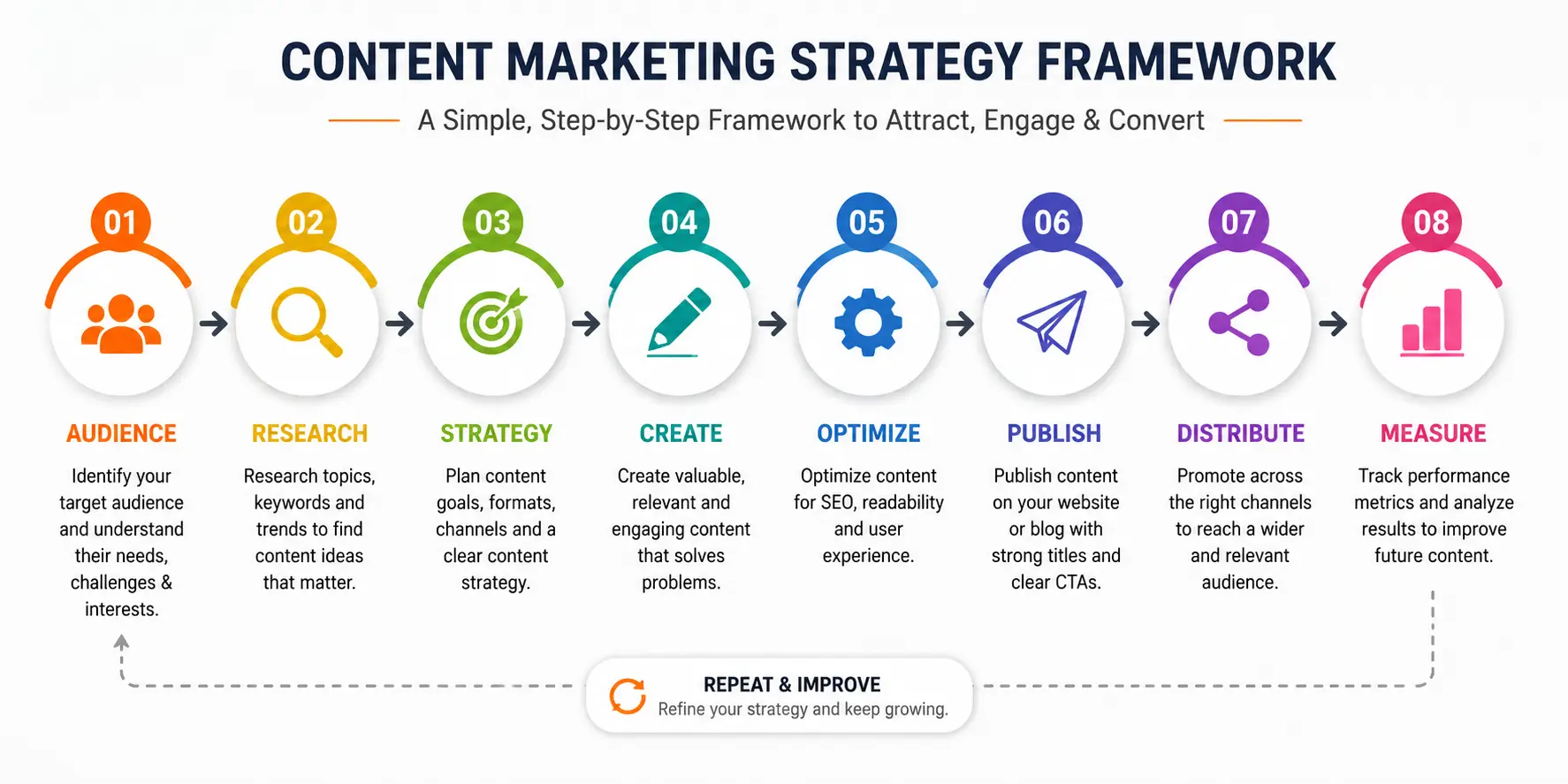
3. Build a Content Strategy
Publishing content without a strategy can quickly become inconsistent.
A content strategy should define:
Goals
What should the content achieve?
Examples include:
- More organic traffic
- Brand awareness
- Lead generation
- Customer education
- Product discovery
- Community engagement
Audience
Who are you trying to reach?
Topics
Which subjects are relevant to that audience?
Formats
Should the content be published as articles, videos, infographics, newsletters, or another format?
Distribution
Where will the content be promoted?
Measurement
Which metrics will determine whether the strategy is working?
A strategy provides direction and makes content creation more intentional.
4. Use Different Content Formats
Not every audience consumes information in the same way.
A strong content strategy can combine multiple formats.
Blog Articles
Useful for detailed educational information and search engine visibility.
Videos
Effective for demonstrations, tutorials, explanations, interviews, and storytelling.
Infographics
Useful for presenting complex information visually.
Social Media Content
Helpful for short-form education, engagement, announcements, and community building.
Case Studies
Useful for showing how a product or service solved a real problem.
E-books and Guides
Suitable for deeper educational content and lead generation.
Email Newsletters
Useful for maintaining relationships with existing audiences.
Using multiple formats allows businesses to communicate the same core ideas in different ways.
5. Make SEO Part of Content Marketing
Search engine optimization and content marketing work closely together.
People use search engines to find answers to questions, research products, compare solutions, and learn about unfamiliar topics.
Content that addresses those searches can attract relevant organic traffic.
Important SEO considerations include:
- Keyword research
- Search intent
- Helpful content
- Clear headings
- Internal linking
- Descriptive URLs
- Optimized images
- Mobile usability
- Page performance
- Structured information
- Strong metadata
However, SEO should not become an excuse for producing content that exists only to target keywords.
The priority should be creating content that genuinely satisfies the reader’s intent.
6. Focus on Search Intent
A keyword alone does not tell the entire story.
Consider someone searching for:
“content marketing strategy”
They may want a definition, a strategy framework, examples, tools, or implementation guidance.
Understanding search intent helps determine what the reader actually expects.
Common search intents include:
- Informational
- Navigational
- Commercial research
- Transactional
Matching content to intent can improve both usefulness and search performance.
7. Build Topic Authority
Publishing one article about a subject is rarely enough to establish strong topical coverage.
Businesses can create a connected group of articles around a broader subject.
For example, a content marketing topic cluster could include:
- What Is Content Marketing?
- How to Build a Content Strategy
- Content Marketing for SEO
- Content Ideas for Businesses
- How to Measure Content Marketing
- Content Distribution Strategies
- Common Content Marketing Mistakes
These articles can be internally linked to create a stronger information structure.
This approach helps readers discover related information while making the website’s content ecosystem more organized.
8. Tell Stories Instead of Just Listing Features
People remember stories more easily than isolated facts.
Businesses can use storytelling to explain:
- Customer challenges
- Product development
- Brand journeys
- Business transformations
- Lessons learned
- Industry experiences
For example, instead of simply listing the features of a service, a business could explain a customer’s problem, the process used to address it, and the outcome.
Storytelling makes content more relatable and can create a stronger emotional connection.
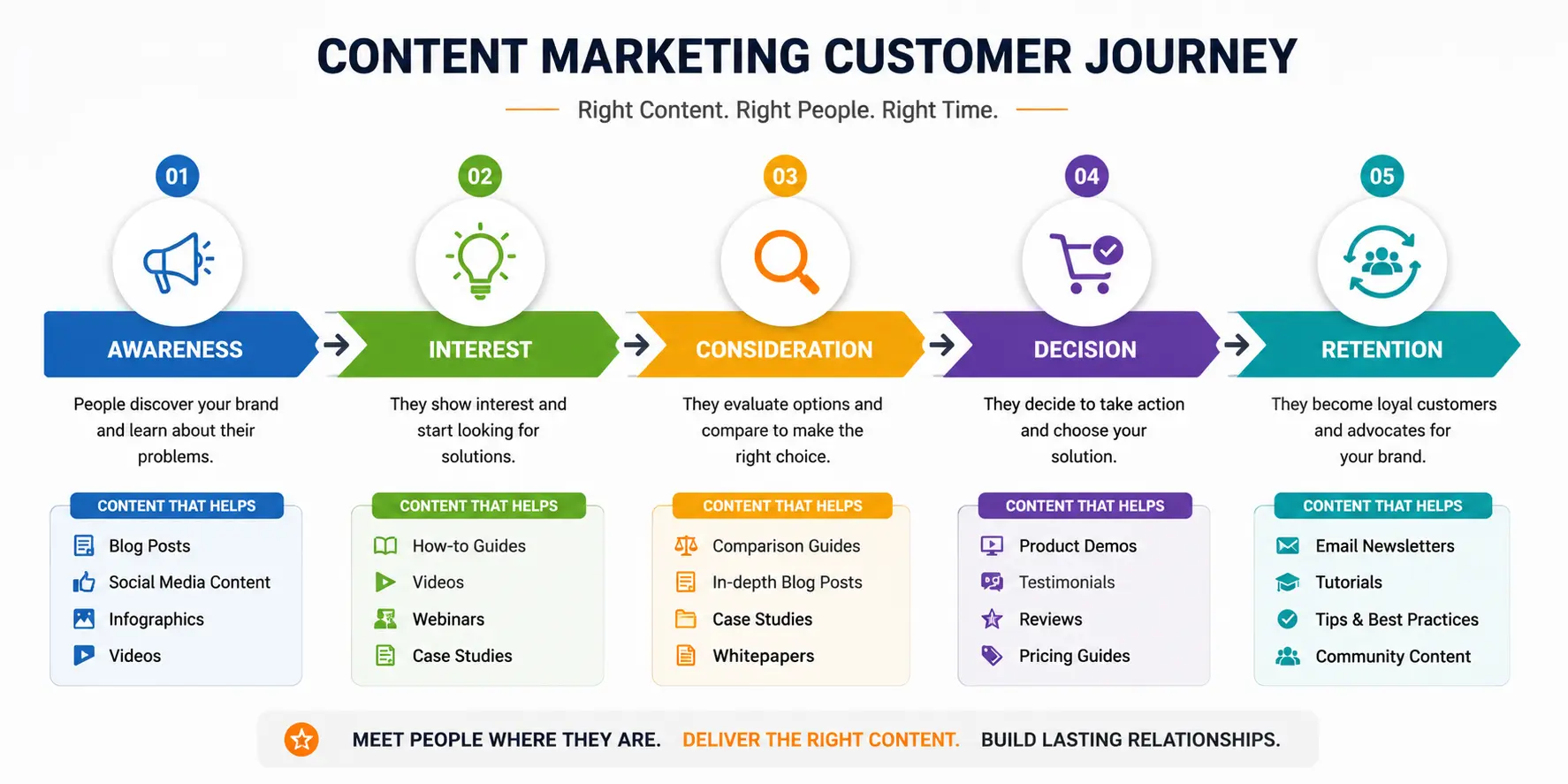
9. Create Content for Different Stages of the Customer Journey
Not everyone who encounters your content is ready to buy.
Content should support different stages of the customer journey.
Awareness
The audience is discovering a problem or learning about a topic.
Useful content:
- Educational articles
- Videos
- Infographics
- Beginner guides
Consideration
The audience is exploring possible solutions.
Useful content:
- Comparisons
- Case studies
- Detailed guides
- Expert insights
Decision
The audience is closer to taking action.
Useful content:
- Product demonstrations
- Testimonials
- FAQs
- Service pages
- Detailed case studies
Retention
Existing customers need continued support and value.
Useful content:
- Tutorials
- Knowledge bases
- Email education
- Product updates
- Advanced guides
This creates a content ecosystem that supports customers beyond the initial discovery stage.
10. Distribution Is as Important as Creation
Creating excellent content does not guarantee that people will discover it.
Content needs an effective distribution strategy.
Depending on the audience, businesses can distribute content through:
- Search engines
- Social media
- Email newsletters
- Online communities
- Industry publications
- Partnerships
- Influencer collaborations
- Paid promotion
One article can also be repurposed into several smaller assets.
For example:
One blog article → social posts → infographic → short video → email newsletter → presentation
This allows businesses to get more value from each piece of high-quality content.
11. Consistency Matters More Than Volume
A common misconception is that successful content marketing requires publishing as much content as possible.
Quantity alone does not create value.
Publishing one useful article regularly can be more effective than producing many low-quality pieces that provide little value.
Consistency helps businesses:
- Build audience expectations
- Maintain search visibility
- Develop content libraries
- Strengthen brand recognition
- Improve editorial processes
The objective should be sustainable content production rather than content overload.
12. Measure Content Marketing Performance
Content marketing should be measured against meaningful business objectives.
Useful metrics can include:
Traffic
How many people are discovering the content?
Engagement
Are visitors reading, watching, sharing, or interacting with the content?
Search Performance
Are important pages gaining visibility for relevant searches?
Leads
Is content generating potential customers?
Conversions
Are visitors taking meaningful actions?
Returning Visitors
Are people coming back for more information?
Revenue Influence
Does content contribute to sales or customer acquisition?
Different content types may have different goals, so not every article needs to generate an immediate sale.
13. Update Existing Content
Content marketing is not only about publishing new articles.
Older content can often be improved by:
- Updating outdated information
- Adding new examples
- Improving readability
- Expanding useful sections
- Updating statistics
- Improving internal links
- Replacing outdated images
- Improving search intent alignment
A strong content library should evolve over time.
Regular content maintenance can help preserve its usefulness and relevance.
14. Avoid Common Content Marketing Mistakes
Creating Content Without an Audience
Content should have a clearly defined reader.
Publishing Only Promotional Content
Constantly selling can reduce audience trust.
Ignoring Quality
More content does not compensate for poor information.
Chasing Every Trend
Not every trend is relevant to every brand.
Neglecting Distribution
Good content still needs to reach the right audience.
Ignoring Analytics
Without measurement, it becomes difficult to understand what works.
Giving Up Too Quickly
Content marketing often produces results gradually rather than immediately.
15. The Role of AI in Content Marketing
Artificial intelligence is changing how content teams research, create, organize, and distribute content.
AI tools can assist with:
- Topic research
- Content ideation
- Outlining
- Drafting
- Content repurposing
- Search analysis
- Personalization
- Image creation
- Performance analysis
- Workflow automation
However, AI-generated content still requires human oversight.
Accuracy, originality, brand voice, audience understanding, fact-checking, and strategic judgment remain important.
The most effective approach is often to use AI to improve efficiency while keeping human expertise at the center of the strategy.
How to Build a Sustainable Content Marketing Strategy
A practical content marketing workflow can look like this:
Step 1: Define your business objectives.
Step 2: Identify your target audience.
Step 3: Research their questions and problems.
Step 4: Identify relevant topics and search intent.
Step 5: Create a content calendar.
Step 6: Produce useful, original content.
Step 7: Optimize content for search and usability.
Step 8: Publish and distribute the content.
Step 9: Repurpose high-performing content.
Step 10: Measure results.
Step 11: Improve existing content.
Step 12: Repeat the process consistently.
Content Marketing Is a Long-Term Investment
Unlike a short-term promotional campaign, content can continue creating value after publication.
A strong article can attract organic visitors. A helpful video can continue generating views. A detailed guide can become a reference point for customers. A well-designed case study can support future purchasing decisions.
Over time, these individual assets can become a valuable digital library.
The businesses that benefit most from content marketing are usually those that approach it as a long-term investment rather than expecting immediate results from every publication.
Conclusion
Content marketing is more than publishing blog posts or social media updates.
It is a strategic approach to helping audiences discover useful information, understand their challenges, evaluate solutions, and build confidence in a brand.
A successful content marketing strategy combines audience research, valuable content, SEO, storytelling, distribution, measurement, and consistency.
The goal is not simply to create more content.
The goal is to create content that people genuinely want to find, read, watch, share, and return to.
When businesses consistently provide useful information and connect that content with broader marketing objectives, content can become one of their most valuable long-term digital assets.
Frequently Asked Questions
What is content marketing?
Content marketing is a strategy that uses useful and relevant content to attract, educate, engage, and retain a specific audience while supporting broader business objectives.
Why is content marketing important?
Content marketing can help businesses increase brand awareness, attract organic traffic, build authority, educate customers, generate leads, and support long-term relationships.
What types of content can businesses create?
Businesses can create blog articles, videos, infographics, case studies, guides, e-books, podcasts, newsletters, webinars, social media posts, and educational resources.
How does content marketing support SEO?
High-quality content can target relevant search queries, answer user questions, build topical coverage, support internal linking, and attract organic search traffic.
How long does content marketing take to produce results?
Results vary depending on the industry, competition, content quality, distribution, and existing website authority. Content marketing generally works best as a long-term strategy rather than an instant promotional tactic.
Can AI be used for content marketing?
Yes. AI can assist with research, ideation, drafting, repurposing, personalization, analysis, and automation. Human review remains important for accuracy, originality, quality, and strategic direction.
How often should a business publish content?
There is no universal publishing frequency. A sustainable schedule that consistently produces useful, high-quality content is generally more valuable than publishing large amounts of low-quality material.
 Previous Post
 Next Post