
Google 360° Virtual Tours: Let Customers Explore Your Business Before They Visit
Imagine a potential customer searching for a restaurant, hotel, showroom, clinic, salon or office online.
They find your business.
They see your name, address, opening hours, reviews and a few photographs.
Everything looks fine.
But then they have another question:
“What does this place actually look like?”
A few carefully selected photographs can answer part of that question.
A Google 360° Virtual Tour can take the experience much further.
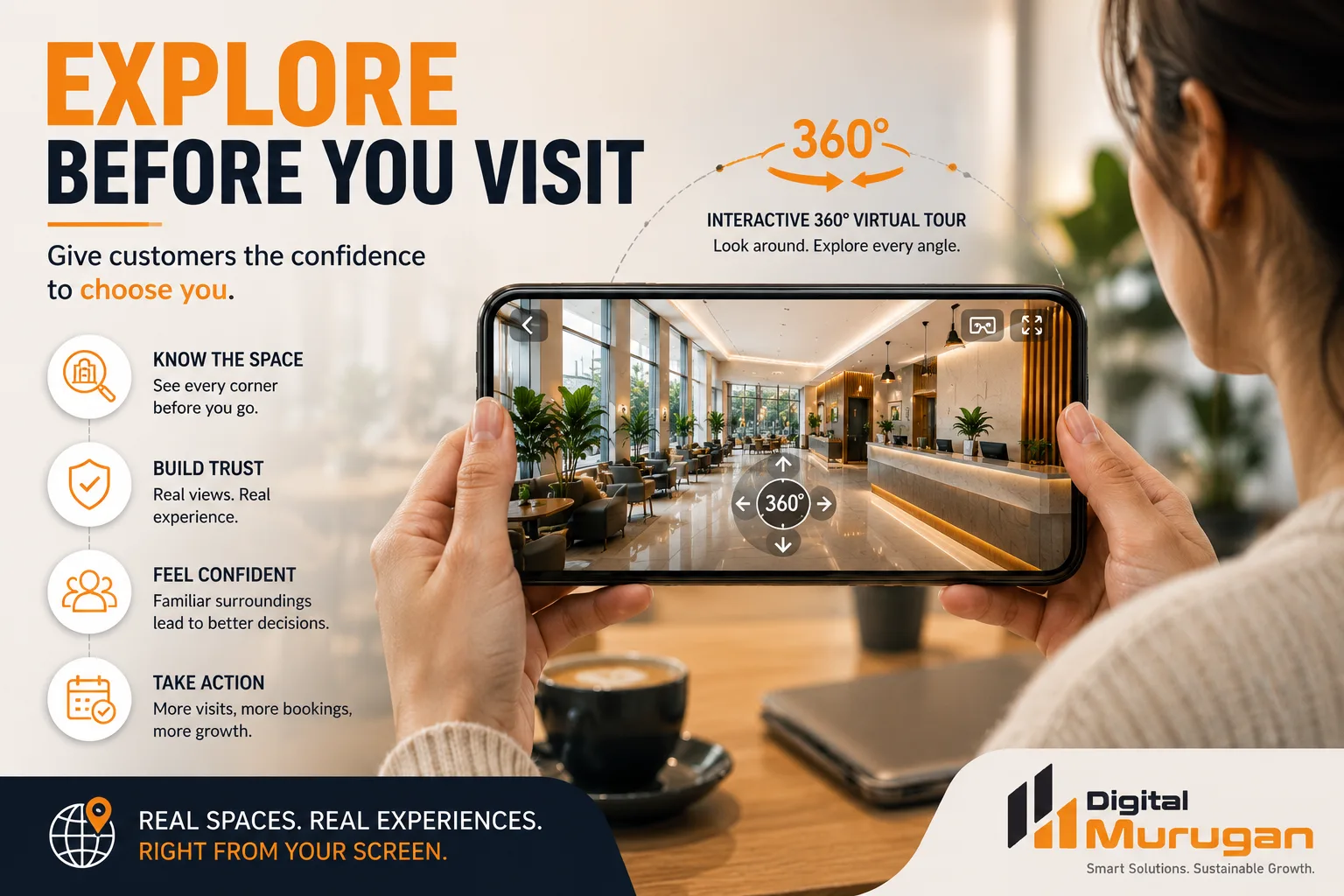
Instead of simply looking at individual photographs, potential customers can explore a space from different viewpoints and get a better sense of what it feels like to be there.
They can look around.
They can understand the layout.
They can see the environment.
And they can become more familiar with the business before physically visiting it.
That is what makes 360° virtual experiences so interesting for modern businesses.
They are not simply another type of photograph.
They can turn an online business listing into a more immersive first impression.
What Is a Google 360° Virtual Tour?
A Google 360° Virtual Tour is an interactive experience built from 360-degree imagery that allows viewers to look around a location and, when multiple viewpoints are connected, move through different areas of the space.
Instead of seeing one fixed image, the viewer can explore the surroundings.
Think about the difference between these two experiences:
Traditional photo:
“Here is what our reception area looks like.”
360° experience:
“Come inside and look around.”
That difference is important.
A potential customer is no longer limited to viewing the exact angle chosen by the photographer. They can interact with the environment and explore the available viewpoint themselves.
For businesses with attractive interiors, distinctive spaces or customer-facing environments, this can create a much richer digital introduction.
Why Let Customers Explore Before They Visit?
People naturally want to know what they are getting into before making a decision.
Before visiting a restaurant, someone may want to see the atmosphere.
Before booking a hotel, they may want to understand the property.
Before visiting a clinic, they may want to feel comfortable with the environment.
Before visiting a showroom, they may want to see how products are displayed.
Before attending an event venue, they may want to understand the space.
A 360° virtual tour can help answer these questions visually.
It gives potential customers more context.
And more context can make an unfamiliar business feel more familiar.
That matters because the first impression of a business increasingly happens online.
Your Google Business Profile Is More Than a Listing
A Google Business Profile is an important part of how an eligible business presents itself on Google Search and Google Maps.
Businesses can manage information such as their hours, website, phone number and location, while also adding photos and videos and interacting with customer reviews.
For customers, this means the profile can become an important part of the discovery process.
The more accurately and professionally your business is represented online, the easier it can be for potential customers to understand what you offer.
A 360° experience can complement this visual presence by giving people a more immersive way to explore the environment.
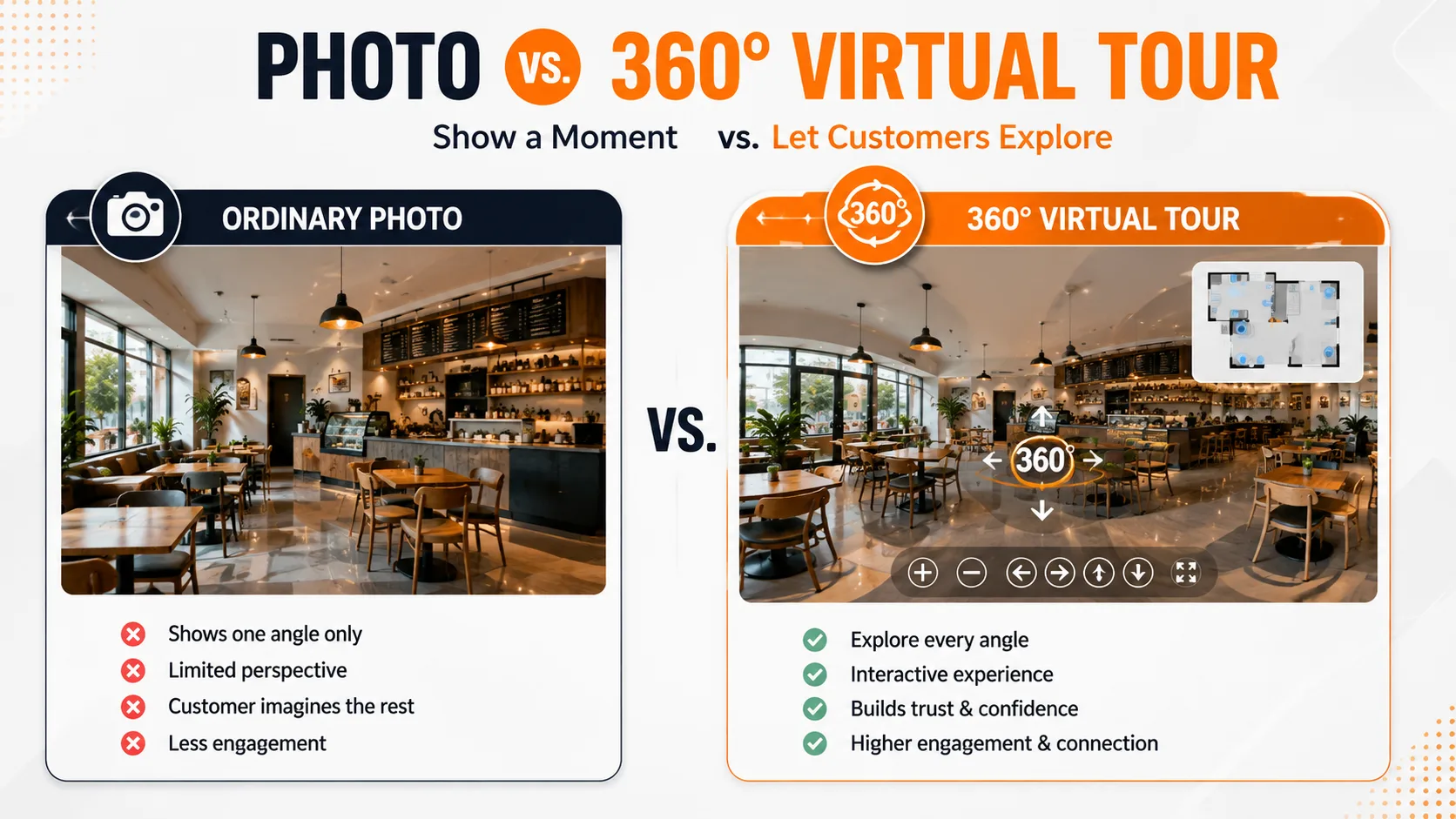
A Photo Shows a Moment. A 360° Tour Can Show a Space.
This is one of the easiest ways to understand the difference.
A normal photograph captures one perspective.
A 360° image captures the surrounding environment.
That means a viewer can look in different directions instead of being restricted to one composition.
For a business with an attractive physical environment, this can be particularly useful.
Imagine a customer looking for:
- A premium restaurant
- A boutique hotel
- A modern office
- A luxury salon
- A fitness studio
- A medical clinic
- A furniture showroom
- A car dealership
- An event venue
- A retail store
A collection of conventional photographs may show several parts of the location.
A connected 360° experience can make those areas feel more like one continuous environment.
The Psychology of “See Before You Visit”
There is a simple psychological benefit to showing people what they can expect.
Familiarity reduces uncertainty.
When someone has never visited a location, they may have questions:
Where is the entrance?
What does the interior look like?
Is the environment professional?
Is it spacious?
Does it match the photographs?
Will I feel comfortable there?
A good visual experience cannot answer every question, but it can remove some uncertainty.
That can be particularly valuable for businesses where the physical environment is part of the customer experience.
A restaurant is not just its menu.
A hotel is not just its room rate.
A salon is not just its service list.
A clinic is not just its appointment information.
A showroom is not just its products.
The environment itself can influence the decision.
Who Can Benefit From a Google 360° Virtual Tour?
Almost any business with a physical location that customers care about seeing can potentially benefit from immersive visual content.
Restaurants and Cafés
Show the dining atmosphere, seating areas, entrance and overall ambience.
Customers can get a better idea of the environment before deciding where to eat.
Hotels and Hospitality Businesses
Help potential guests explore common areas and understand the property’s atmosphere before booking.
Retail Stores
Show customers the store environment, layout and product presentation.
Salons and Spas
Visual presentation can communicate cleanliness, design and atmosphere before a customer arrives.
Clinics and Healthcare Facilities
A professional, accurate visual presentation can help new visitors become familiar with the environment.
Gyms and Fitness Studios
Show equipment, training areas and the overall space.
Showrooms
Let potential customers explore the environment where products are displayed.
Offices
A virtual experience can help introduce a company environment to clients, partners and prospective employees.
Event Venues
Wedding venues, conference spaces and event halls can use immersive visuals to help potential customers understand the layout and atmosphere.
Educational Institutions
Schools, training centres and other educational facilities can provide prospective students and parents with a better sense of the environment.
Automotive Businesses
Dealerships and showrooms can provide an additional way for potential customers to explore the physical location.
The key question is not:
“Can my business have a 360° tour?”
A better question is:
“Would seeing my physical space help a potential customer make a decision?”
If the answer is yes, immersive visual content deserves serious consideration.
Google 360° Virtual Tour vs. Ordinary Business Photos
Both are valuable.
They simply serve different purposes.
| Ordinary Business Photos | 360° Virtual Tour |
|---|---|
| Shows selected views | Allows interactive exploration |
| Fixed perspective | Viewer can look around |
| Best for specific details | Best for understanding a space |
| Easy to scan quickly | More immersive experience |
| Multiple individual images | Can connect multiple viewpoints |
| Strong for products and highlights | Strong for environments and locations |
The best strategy does not necessarily mean choosing one over the other.
A strong Business Profile can use high-quality conventional photographs alongside immersive 360° imagery.
Photos can highlight important details.
A virtual tour can help people understand the overall environment.
Together, they can create a stronger visual representation of the business.
What Makes a Great 360° Virtual Tour?
Having a 360° tour is one thing.
Creating a professional one is another.
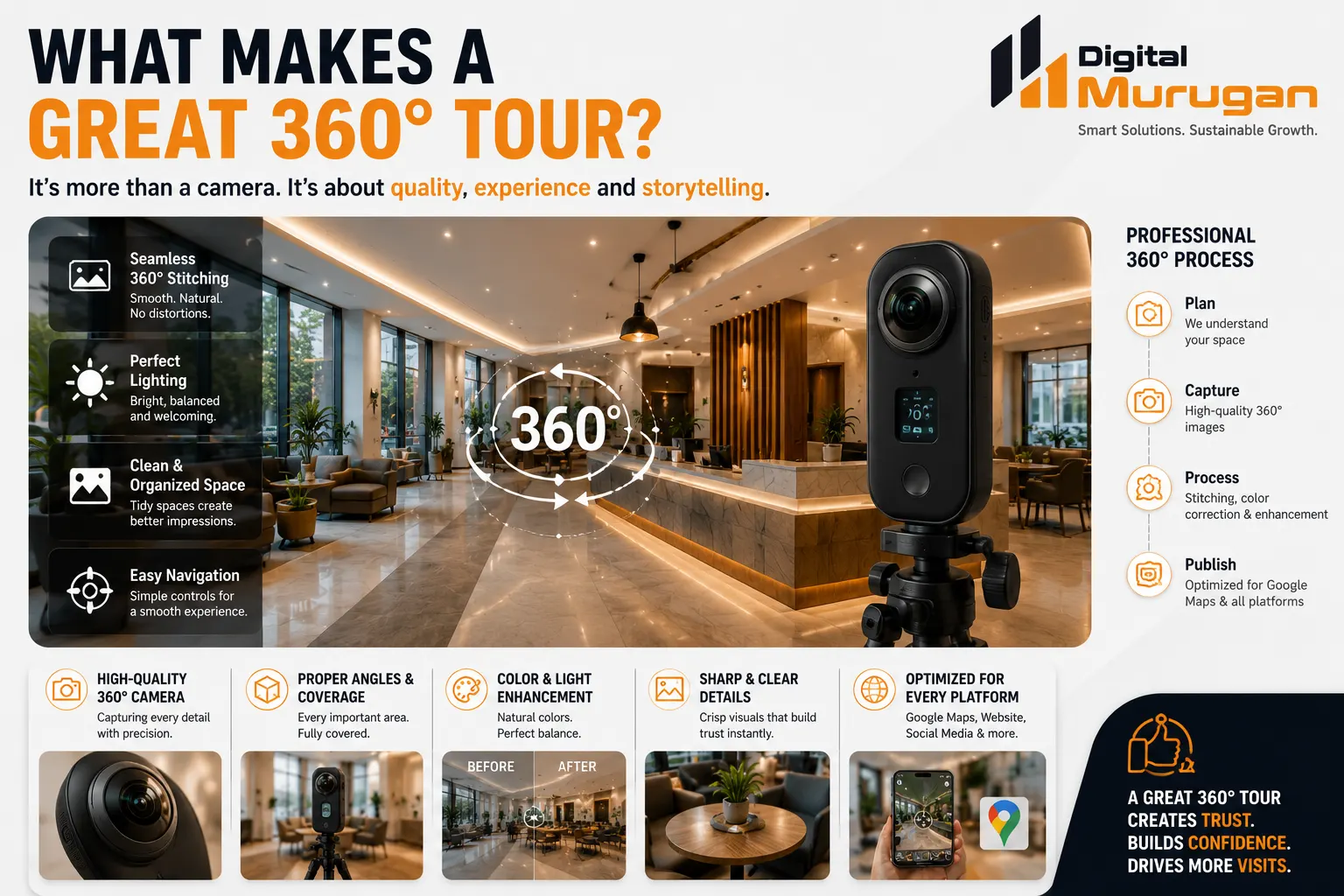
High-Quality Imagery
The environment should look sharp and realistic.
Poor image quality can make even a beautiful location appear unprofessional.
Good Lighting
Lighting has a major effect on how a space appears.
Dark corners, blown-out windows or inconsistent exposure can reduce the quality of the experience.
Accurate Representation
The objective should be to represent the real business honestly.
A virtual tour should not make a space look dramatically different from what a customer will actually experience.
Clean Environment
Before photography begins, the space should be prepared.
Remove unnecessary clutter.
Organize visible areas.
Clean surfaces.
Hide distracting objects.
Make the environment presentation-ready.
Smooth Navigation
If multiple viewpoints are connected, the movement between them should make sense.
The customer should feel like they are exploring a real space rather than jumping randomly between disconnected photographs.
Strategic Viewpoints
Not every corner necessarily needs to be captured.
Choose viewpoints that help customers understand the most important areas.
For example:
Entrance → Reception → Main Area → Key Feature → Additional Area
The sequence should tell a story.
Plan the Tour Like a Customer Journey
This is where professional planning becomes important.
Don’t simply walk around the location and capture random points.
Think like a first-time visitor.
Step 1 — Arrival
What does the customer see first?
Step 2 — Entrance
Is the entrance easy to understand?
Step 3 — First Impression
What should the customer notice immediately?
Step 4 — Main Experience
Which area best represents the business?
Step 5 — Supporting Areas
What additional spaces are important?
Step 6 — Exit or Next Action
Where should the visual journey naturally end?
This approach transforms a collection of 360° images into a guided visual experience.
A 360° Tour Can Strengthen Your First Impression
Consider two businesses competing for the same customer.
Business A has:
- Basic listing
- Few photographs
- Limited visual information
Business B has:
- Complete business information
- High-quality photographs
- Strong reviews
- Professional branding
- An immersive visual experience
The second business may simply feel more transparent and easier to understand.
That does not mean a virtual tour guarantees a customer or a higher Google ranking.
It means the business is providing more information and a richer digital experience to someone who is already considering it.
And sometimes that extra context can matter.
Your Website Can Benefit Too
A Google-based 360° experience does not have to be the only place where immersive content is useful.
Businesses can also use virtual-tour content as part of their broader digital presence.
For example, a business website can feature an immersive experience on a:
- Homepage
- About page
- Location page
- Contact page
- Venue page
- Product showroom page
- Hotel page
- Office page
Imagine a potential customer reading about your business and then seeing:
“Explore Our Location in 360°.”
Instead of relying entirely on written descriptions, they can experience the space visually.
That creates another opportunity to turn information into engagement.
Use 360° Experiences Across Your Marketing
The value of creating immersive content increases when you use it beyond one location.
A business can promote its visual experience through:
Website
Add a clear link or embedded experience where appropriate.
Social Media
Use short clips, screenshots or previews to encourage people to explore the full experience.
QR Codes
Place a QR code on brochures, signage, menus, flyers or promotional materials where appropriate.
Presentations
Show the environment during sales presentations or business meetings.
Event Promotion
Event venues can use immersive visuals when presenting their space to prospective clients.
Sales Conversations
A sales representative can share the virtual experience with prospects who are unable to visit immediately.
The goal is simple:
Create the experience once and make it useful across multiple customer touchpoints.
How to Prepare Your Business for a 360° Shoot
A little preparation can make a major difference.
Clean the Space
Remove clutter and unnecessary items.
Organize Visible Areas
Arrange furniture, displays and products properly.
Check Lighting
Turn on appropriate lights and make sure important areas are well illuminated.
Hide Temporary Items
Move boxes, cleaning supplies, loose cables and other distracting objects out of sight.
Prepare Signage
Make sure your important branding and signage are clean and presentable.
Check Mirrors and Reflective Surfaces
Reflective surfaces can require additional planning during 360° photography.
Plan the Viewpoints
Decide which areas should be captured and how they connect.
Keep the Business Representative
Do not create an unrealistic environment purely for photography.
The objective is to show customers what they can genuinely expect.
Google’s own guidance emphasizes that business imagery should be well lit, in focus and representative of reality rather than excessively altered. That principle is especially important for immersive experiences because customers can explore the environment from multiple directions.
Common 360° Virtual Tour Mistakes
Poor Image Quality
A technically weak tour can hurt rather than help the visual presentation.
Bad Lighting
Dark interiors make it difficult for customers to understand the environment.
Cluttered Spaces
A messy environment communicates the wrong impression.
Incorrect or Outdated Information
If the business has changed significantly, old visual content can create confusion.
Too Few Viewpoints
One 360° image may not adequately represent a larger business.
Too Many Unnecessary Viewpoints
More does not always mean better.
The journey should remain logical.
Poor Stitching
Visible stitching errors can make the experience feel artificial.
Misleading Presentation
The tour should accurately represent the actual environment.
Ignoring the Customer Journey
A collection of images is not automatically a good virtual experience.
The customer should be able to understand the space.
Does a 360° Virtual Tour Guarantee Better Google Rankings?
No responsible marketing professional should promise that.
A 360° virtual tour should not be sold as a guaranteed shortcut to the top of Google Search.
Google’s Business Profile system involves many aspects of how businesses are represented and discovered, and rankings are not something a virtual tour alone can guarantee.
The better way to understand the value is:
Better visual information → Better customer understanding → Stronger digital presentation → Potentially better-informed decisions
A 360° experience should therefore be part of a broader digital presence rather than treated as a magic SEO button.
That approach is more realistic—and more useful for businesses.
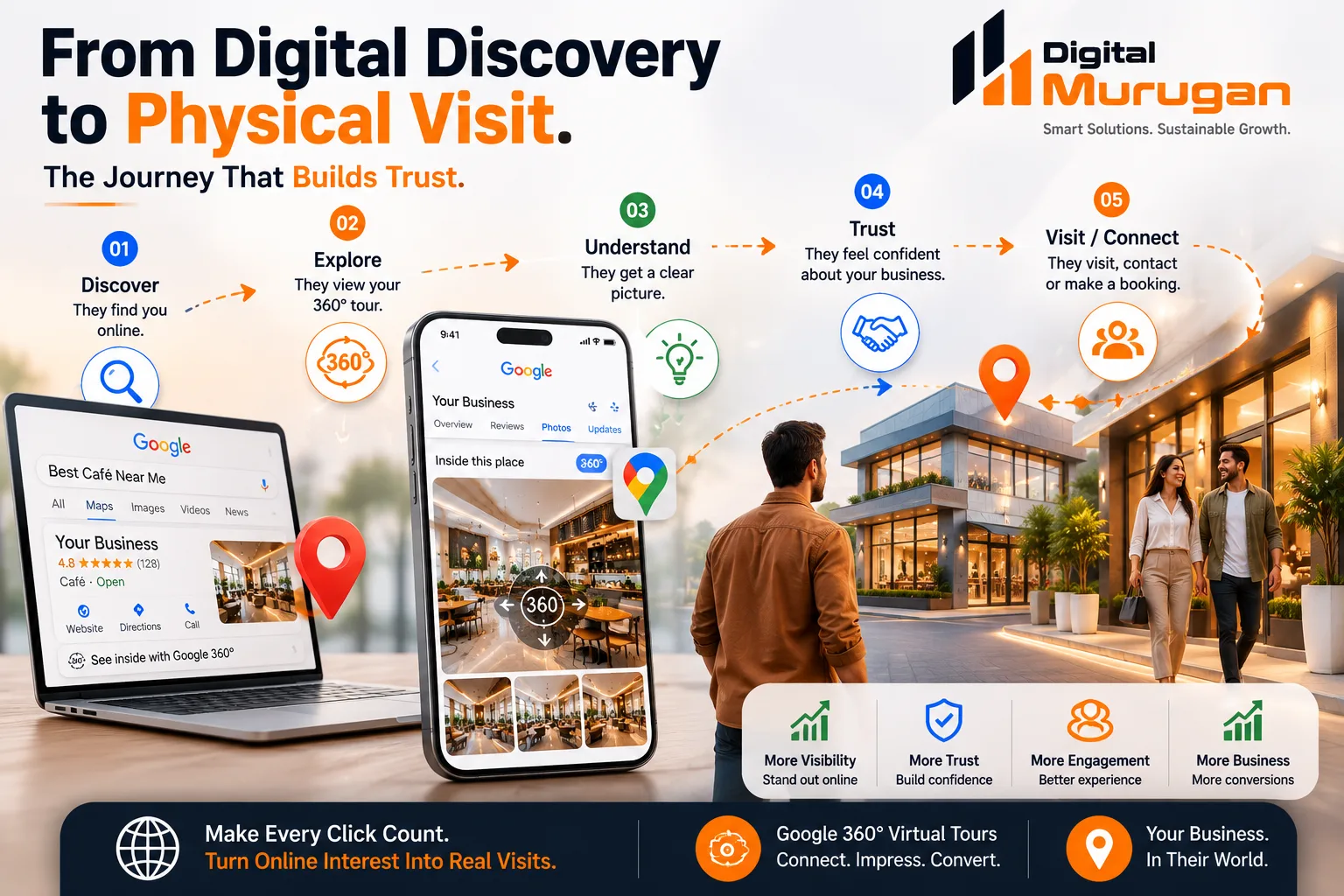
How a 360° Tour Fits Into a Strong Digital Presence
Think about your online customer journey.
Google Search
↓
Google Business Profile
↓
Photos + Reviews + Business Information
↓
360° Virtual Experience
↓
Website
↓
Enquiry / Booking / Visit
↓
Customer Relationship
Each element has a different job.
Your Business Profile helps people discover and understand the business.
Photos communicate visual highlights.
Reviews provide social proof.
A 360° experience helps people explore the environment.
Your website provides deeper information.
Your contact or booking system gives them the next step.
The result is a more complete digital journey.
The Real Value Is Not the Technology
It is easy to become fascinated by the technology behind 360° photography.
But customers do not care about the camera.
They care about the experience.
They want to know:
What will this place feel like?
What can I expect when I arrive?
Does this business look professional?
Can I trust what I am seeing?
Is this the right place for me?
Technology is simply the tool.
The real value comes from using that tool to reduce uncertainty and communicate the physical experience of a business more effectively.
Why 360° Virtual Tours Can Be a Smart Marketing Asset
A strong virtual tour can continue working after the photography session is finished.
It can help introduce the business to someone who has never visited.
It can support website content.
It can become part of sales presentations.
It can be shared with prospects.
It can complement conventional business photography.
And it can give potential customers another reason to spend time exploring the business digitally.
That makes it more than a one-time promotional image.
It becomes a reusable visual marketing asset.
Final Thoughts
The customer journey increasingly begins before someone walks through your door.
They may discover your business on Google.
They may compare several options.
They may look at photographs.
They may read reviews.
They may visit your website.
And they may try to understand what your business feels like before deciding whether to visit.
A Google 360° Virtual Tour gives you an opportunity to answer that last question visually.
Instead of simply telling people:
“Come visit us.”
You can give them a way to experience more of your space before they arrive.
For businesses where the environment matters, that can be a powerful addition to a modern digital marketing strategy.
Because sometimes the best way to build confidence is not to describe the experience.
It is to let people see it for themselves.
Give Customers a Reason to Step Inside Before They Arrive
Your physical location is part of your brand.
Let customers experience it digitally before they make the journey.
Digital Murugan creates professional Google 360° Virtual Tour experiences designed to help businesses present their physical spaces in a more immersive, engaging and professional way.
From planning the viewpoints to creating the visual experience, the goal is simple:
Make your business easier to explore. Make the first impression more powerful.
Explore Google 360° Virtual Tour Solutions by Digital Murugan
 Previous Post
 Next Post