
Digital Business Cards: The Smarter Way to Share Your Professional Identity
Imagine meeting a potential client at a conference.
You introduce yourself, have a great conversation, and they ask for your contact details. You hand them a traditional business card. A few days later, that card may be sitting in a drawer, buried under dozens of other cards, or simply forgotten.
Now imagine a different experience.
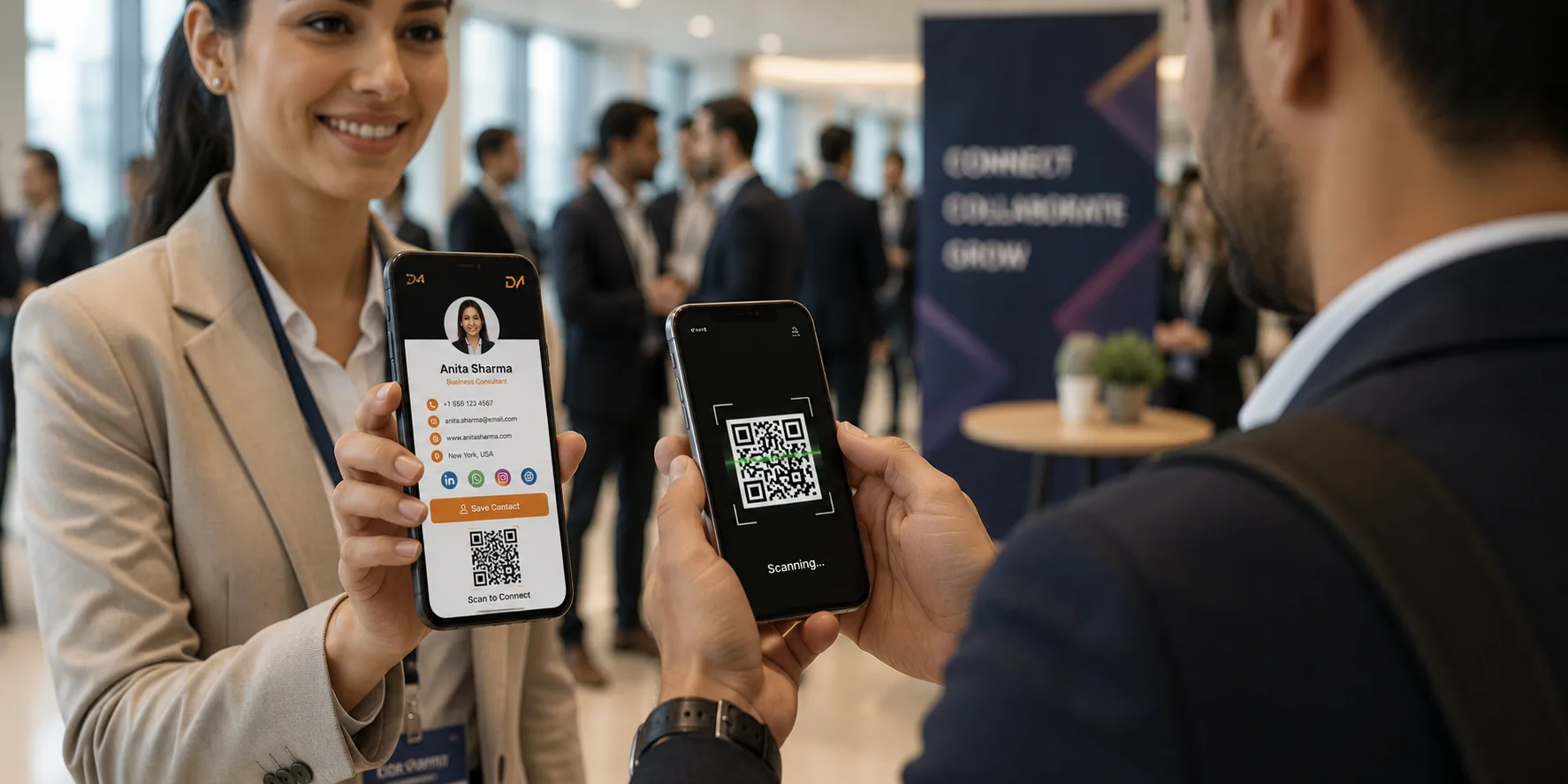
You show a QR code. They scan it. Your name, profile photo, company, phone number, email address, website, social media profiles, portfolio, location, and other important information appear instantly on their smartphone.
They can save your contact, visit your website, connect with you on LinkedIn, send you a WhatsApp message, or explore your work—all from one digital profile.
That is the power of a digital business card.
A digital business card is no longer simply a paper business card converted into a web page. When designed properly, it can become a compact digital identity, networking tool, personal branding asset, and gateway to your wider online presence.
And as professional networking becomes increasingly digital, the way people exchange contact information is evolving with it.
What Is a Digital Business Card?
A digital business card is an online professional profile that allows you to share your business and contact information electronically.
Instead of printing your details on paper, your information is stored on a digital profile that can be accessed through a QR code, direct link, NFC tap, email, messaging app, social media profile, or other digital channels.
A typical digital business card can include:
- Your name
- Professional title
- Company name
- Profile photograph or company logo
- Phone number
- Email address
- Website
- LinkedIn profile
- Instagram or other social profiles
- Business location
- Portfolio
- Services
- Product information
- Appointment or booking links
- Call-to-action buttons
- QR code
- Contact-saving functionality
Unlike a traditional paper card, the digital version can act as a living professional profile. Information can be updated without having to print and distribute a completely new batch of cards.
That simple difference changes the role of the business card completely.
Why Are Digital Business Cards Becoming More Important?
The way we communicate professionally has changed dramatically.
People work across countries and time zones. Meetings happen through video calls. Prospects discover companies through Google and social media. Professionals communicate through WhatsApp, email and LinkedIn. Conferences bring together people from different industries and countries.
Yet the basic business card has remained almost unchanged.
A small piece of paper still tries to represent an entire professional identity.
The problem is that modern professionals have far more to share than just a phone number and email address.
Your website may show your portfolio.
Your LinkedIn profile may demonstrate your professional experience.
Your Instagram profile may show your creative work.
Your WhatsApp account may be the fastest way to communicate.
Your booking page may allow prospects to schedule a meeting.
Your business card should help connect all of these assets.
This is where the digital business card becomes powerful.
It doesn’t simply replace the paper card. It connects your professional identity.
Digital Business Card vs. Traditional Business Card
Traditional business cards still have their place. They can be useful in certain situations, especially when a physical exchange is preferred.
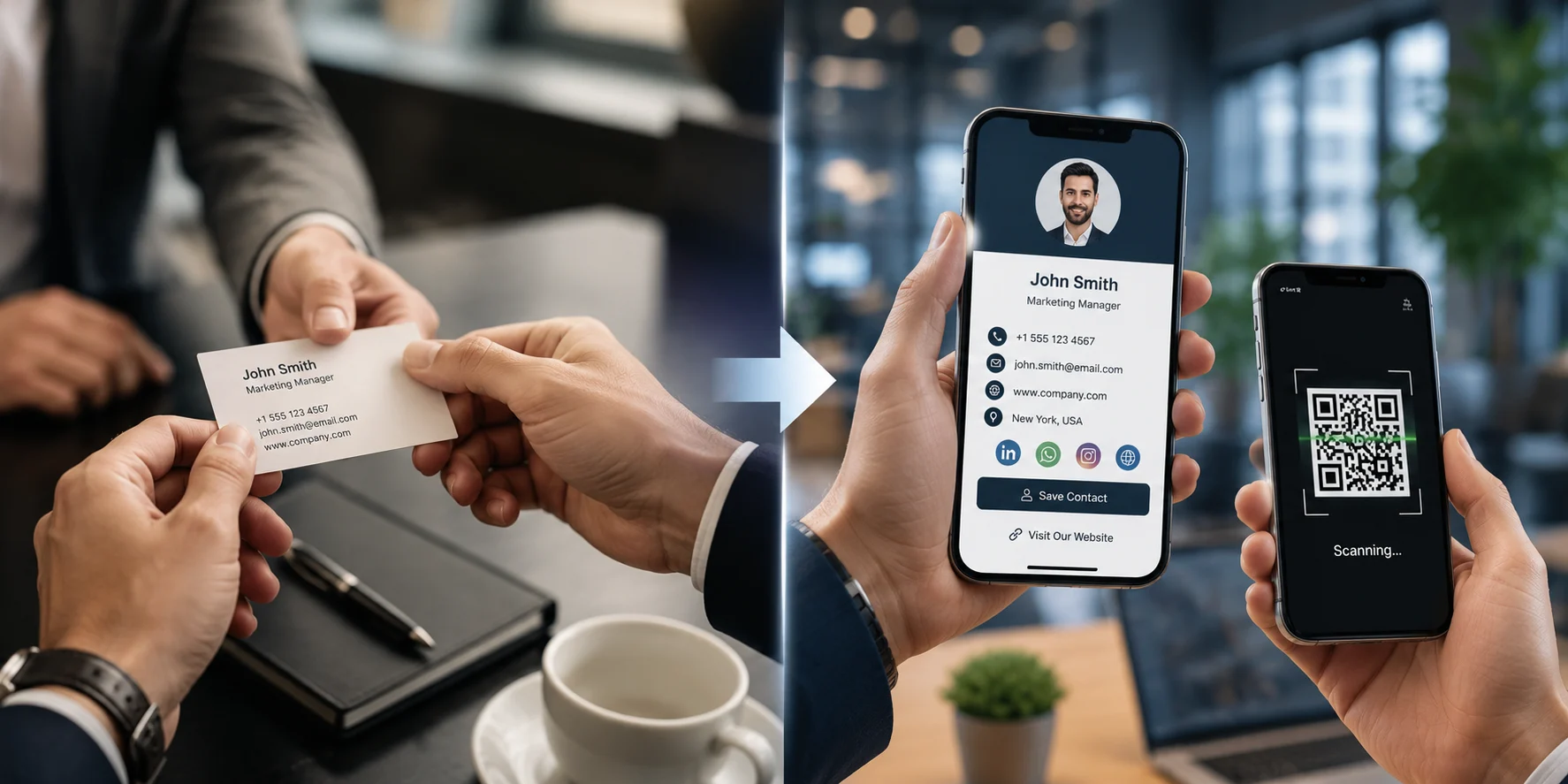
But digital cards offer capabilities that paper simply cannot provide.
| Traditional Business Card | Digital Business Card |
|---|---|
| Printed on paper | Available online |
| Limited space | Can contain multiple sections and links |
| Difficult to update | Information can be updated |
| Must be physically carried | Can be shared from a smartphone |
| Usually contains basic details | Can connect to websites, social profiles and portfolios |
| Can be misplaced | Accessible through a digital link or QR code |
| Requires manual typing | Can allow quick contact saving |
| Limited interaction | Can include buttons and calls to action |
| No built-in digital journey | Can direct visitors to specific actions |
The biggest difference is not paper versus technology.
The biggest difference is static information versus an interactive professional experience.
Your Digital Business Card Is More Than a Contact Card
One of the biggest mistakes is treating a digital business card as nothing more than an electronic phonebook entry.
A strong digital business card can function more like a mini landing page for your professional identity.
Someone who scans your card should be able to understand three things quickly:
Who are you?
What do you do?
What should they do next?
For example, a consultant might use the card to introduce their expertise and invite prospects to schedule a consultation.
A designer could showcase selected portfolio projects.
A real estate professional could display property listings and contact options.
A sales executive could connect prospects to a product presentation.
A freelancer could combine their portfolio, services, testimonials and communication channels.
A business owner could connect customers to their website, location, WhatsApp and social media.
This transforms the card from a simple contact-sharing tool into a digital first impression.
QR Codes Make Networking Faster
One of the most practical ways to share a digital business card is through a QR code.
Instead of asking someone to type your phone number, search your company name, remember your website address, or manually enter an email address, you can provide one simple action:
Scan.
The QR code can open your digital profile directly on the recipient’s smartphone.
QR codes can also bridge physical and digital marketing. They can be displayed on:
- Presentations
- Brochures
- Posters
- Event booths
- Packaging
- Office displays
- Name badges
- Printed business cards
- Resumes
- Marketing materials
- Conference screens
The important point, however, is that a QR code is only as useful as the destination behind it.
A beautiful QR code leading to a confusing or outdated page creates a poor experience. The destination should load quickly, work well on mobile devices and make the next action obvious.
A Digital Business Card Should Strengthen Your Brand
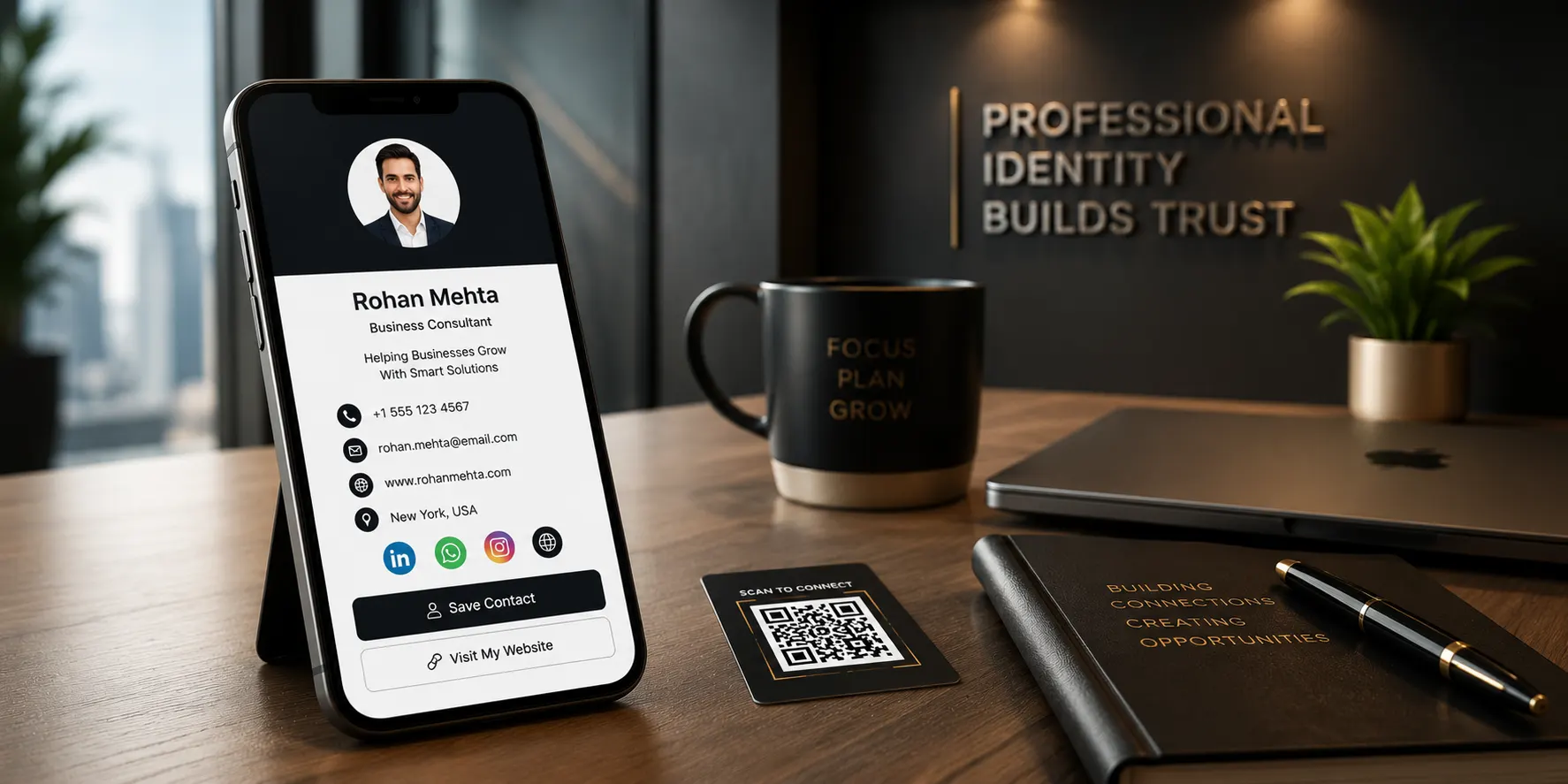
Your business card is often one of the first branded assets another professional sees.
That makes design important.
A professional digital business card should not look like a random collection of links.
It should feel like an extension of your brand.
Your:
- Logo
- Brand colors
- Typography
- Profile photograph
- Visual style
- Tone of communication
- Professional title
- Brand message
should work together.
For individuals, the card should communicate personal professionalism.
For companies, it should reinforce corporate identity.
For creative professionals, it can become an opportunity to demonstrate visual personality.
The best design is not necessarily the most complicated design.
In many cases, clarity, hierarchy and consistency create a stronger impression than excessive decoration.
What Should You Put on a Digital Business Card?
A digital business card should contain enough information to be useful without overwhelming the visitor.
A strong basic structure could include:
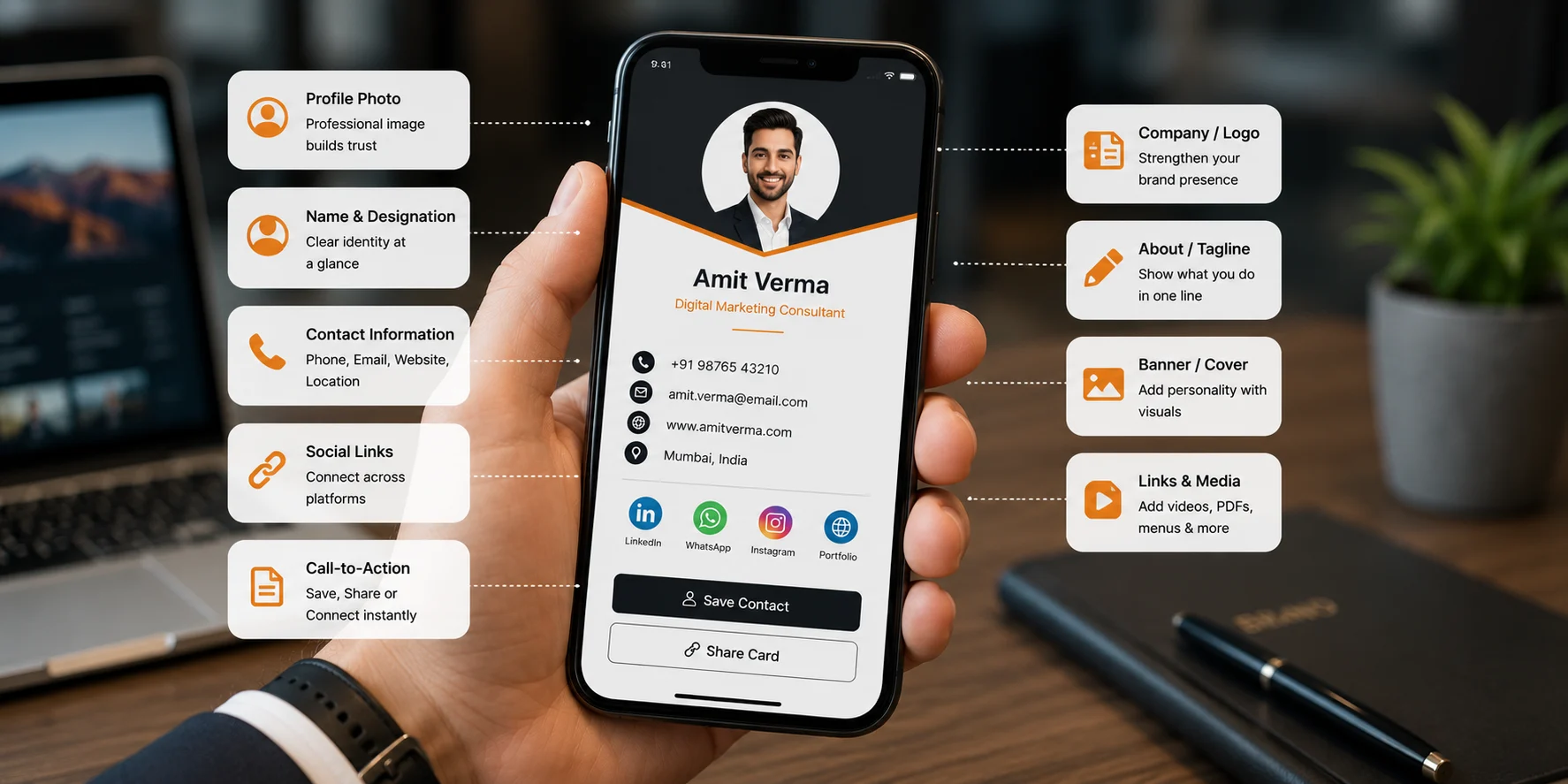
1. Name and Professional Title
Make it immediately clear who the visitor is looking at.
For example:
Alex Morgan
Creative Director | Brand Strategist
2. Professional Photograph or Logo
A quality photograph can make an individual card more personal, while a company logo can reinforce corporate identity.
3. Short Introduction
A concise description can explain what you do and who you help.
Avoid turning this section into a long biography.
4. Contact Information
Include the most relevant communication options:
- Phone
- Website
5. Professional Profiles
Connect relevant platforms such as LinkedIn, Instagram, YouTube or other professional channels.
6. Portfolio or Work
If your work can demonstrate your expertise, make it easy to access.
7. Clear Call to Action
This is one of the most important elements.
Instead of simply giving people information, tell them what they can do next.
Examples include:
Save My Contact
Visit My Website
View My Portfolio
Book a Meeting
Message Me on WhatsApp
Connect on LinkedIn
A clear call to action turns passive information into an opportunity for engagement.
Digital Business Cards Can Support Personal Branding
Personal branding is no longer limited to celebrities, influencers or corporate executives.
Freelancers, consultants, designers, developers, sales professionals, entrepreneurs, coaches, recruiters, photographers, agents and many other professionals compete on reputation and visibility.
Your digital business card can become another piece of that personal brand ecosystem.
Think about the journey:
Someone meets you.
They scan your card.
They see your professional identity.
They see what you do.
They discover your website.
They view your portfolio.
They connect with you on LinkedIn.
They contact you later.
That is considerably more powerful than someone simply receiving your phone number.
A well-designed digital card can therefore help make your professional identity easier to remember, easier to access and easier to continue exploring.
Digital Business Cards Are Useful Beyond Networking Events
You do not have to wait for a conference to use one.
A digital business card can be shared virtually or in person.
During Client Meetings
At the end of a meeting, share your card so the client has all your details in one place.
At Conferences
Display your QR code on your phone, presentation screen, badge or booth.
Through WhatsApp
Send your card link directly to prospects, clients and professional contacts.
Through Email
Include the digital card link in your email signature.
On Social Media
Add it to your profile or bio where appropriate.
During Presentations
Place the QR code on your final slide so interested viewers can connect immediately.
On Your Website
Use it as another way for visitors to access your contact information.
On Printed Materials
A QR code can connect physical marketing materials to your digital identity.
This makes the digital card useful both online and offline.
Digital Business Cards Can Help Sales Teams
The opportunity becomes even more interesting when digital business cards are used by teams.
Imagine a company with 20 sales representatives.
Instead of every employee using a different format, outdated information or inconsistent branding, the organization can establish a standard professional identity.
Every representative can have their own details while following the company’s branding system.
This can help create consistency across:
- Sales teams
- Business development teams
- Customer-facing employees
- Consultants
- Real estate teams
- Recruitment teams
- Event representatives
- Corporate executives
For larger organizations, digital card solutions may also support team management, analytics and integrations, depending on the platform being used.
This is where a simple networking tool can become part of a broader digital sales and branding system.
The Real Value Is What Happens After the Scan
A scan itself is not the goal.
A saved contact is not the final goal either.
The real objective is to continue the relationship.
Suppose someone meets you at an industry event.
They scan your card.
They visit your profile.
They see your portfolio.
They save your contact.
Then you follow up with a personalized message referencing the conversation you had.
Now the digital card has helped create a professional journey.
This is why follow-up matters.
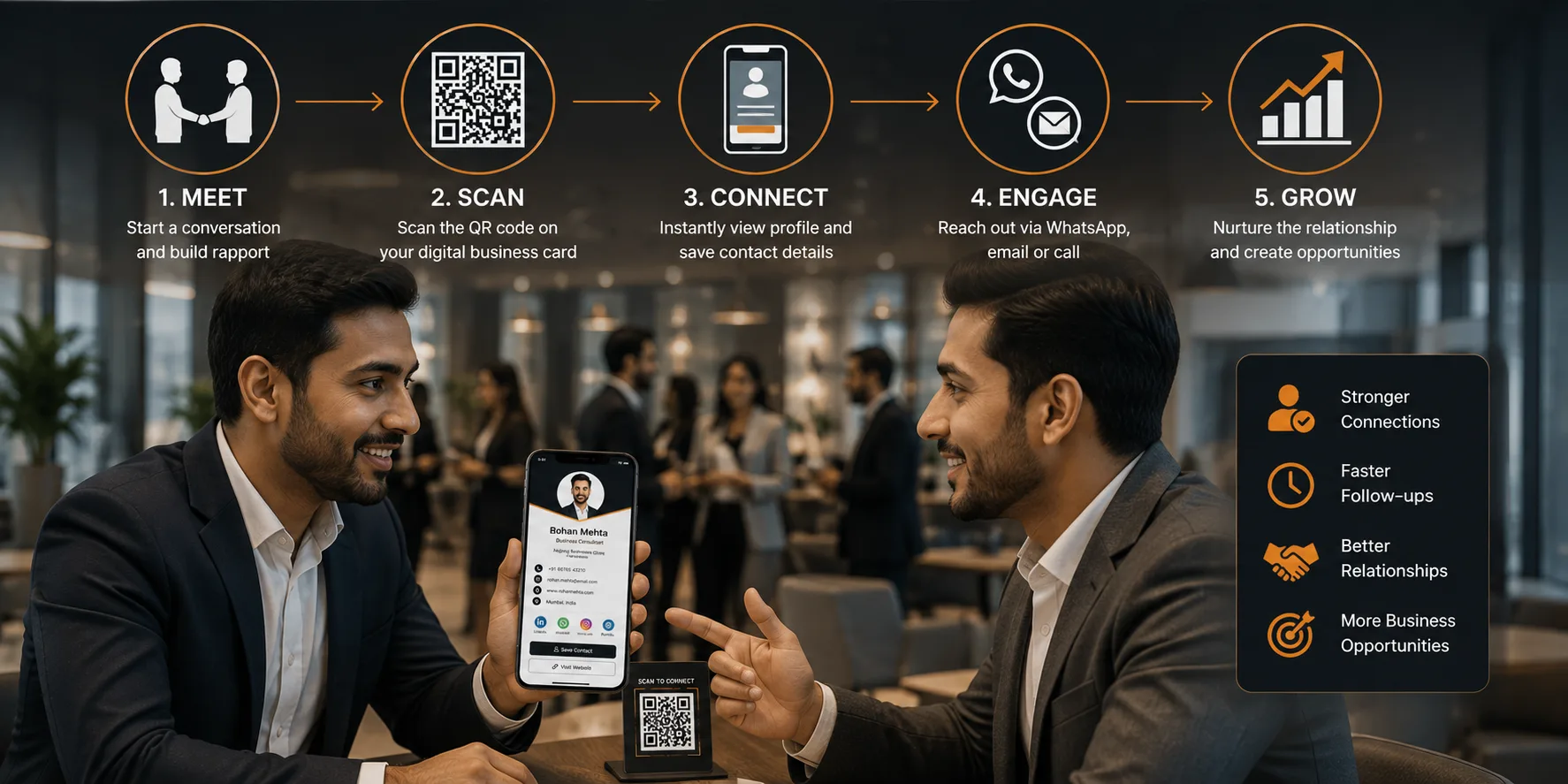
The best digital business card strategy is not:
Share → Forget
It is:
Meet → Share → Connect → Follow Up → Build Relationship
Recent guidance on digital networking similarly emphasizes that sharing the card is only the beginning; timely, personalized follow-up is what turns a new contact into a meaningful professional relationship.
What Makes a Digital Business Card Professional?
Not every digital card provides the same experience.
Before creating one, consider these questions:
Is it mobile-friendly?
Most people will open your card on a smartphone. The experience should be easy to navigate on a small screen.
Is it fast?
A visitor should not have to wait unnecessarily for the page to load.
Is the information clear?
The most important details should be easy to find.
Does it look like your brand?
Your card should feel consistent with your professional identity.
Is sharing easy?
QR codes, direct links and other sharing options should reduce friction.
Can the information be updated?
Your professional details will change over time. Your digital identity should be able to evolve with you.
Is there a clear next step?
The visitor should know what you want them to do after viewing the card.
Does it create trust?
Professional photography, accurate information, consistent branding and a clean design can make a significant difference.
Common Digital Business Card Mistakes to Avoid
A digital card can look modern and still perform poorly.
Here are some common mistakes.
Too Much Information
More information does not automatically mean more value.
If everything is given equal importance, nothing stands out.
Poor Mobile Design
A card designed primarily for desktop viewing may become frustrating on a smartphone.
Weak Branding
Using random colors, inconsistent fonts or low-quality images can make the card look unprofessional.
No Clear CTA
If visitors don’t know what to do next, many will simply leave.
Outdated Information
An old phone number, expired offer or incorrect job title can damage credibility.
Broken Links
Every button should be tested regularly.
An Unclear QR Code
QR codes should be displayed clearly and tested before being used publicly.
Sharing Too Early
Networking is about relationships, not simply distributing links. A digital card works best when it follows a meaningful interaction rather than replacing one.
Digital Business Cards and the Future of Networking
The future of professional networking is not necessarily about eliminating every physical interaction.
It is about making those interactions more connected.
A handshake can still matter.
A face-to-face conversation can still matter.
A physical event can still matter.
But the information exchange that follows those interactions is increasingly digital.
That creates an interesting shift.
The business card is no longer just something you hand someone.
It can become something that opens a digital relationship.
The card can lead to your website.
Your website can lead to your portfolio.
Your portfolio can lead to a conversation.
That conversation can lead to a client.
And that client relationship can lead to referrals, repeat business and long-term opportunities.
The technology is simple.
The strategic value can be much greater.
Who Should Consider a Digital Business Card?
Almost any professional who regularly needs to introduce themselves or their business can benefit from having one.
It can be particularly useful for:
- Entrepreneurs
- Business owners
- Freelancers
- Consultants
- Sales professionals
- Marketing professionals
- Designers
- Developers
- Real estate professionals
- Financial professionals
- Coaches
- Recruiters
- Photographers
- Content creators
- Agency owners
- Corporate executives
- Startup founders
- Event professionals
- Service providers
For professionals who attend meetings, conferences, exhibitions, networking events or client appointments, a digital business card can become a practical addition to their everyday toolkit.
The Business Card Is Evolving
For decades, the business card had one primary purpose:
Give someone your contact information.
Today, professional networking demands much more.
People want to discover who you are, what you do, what you have created, how they can contact you and where they can learn more.
A digital business card brings those elements together.
It can be your introduction.
Your contact point.
Your mini portfolio.
Your professional profile.
Your brand touchpoint.
And your next step toward a business relationship.
That is why the most useful way to think about a digital business card is not as a replacement for a piece of paper.
Think of it as your professional identity in a shareable digital format.
Final Thoughts
Your first impression may happen in seconds.
What happens after that impression can determine whether a professional connection disappears or develops into something valuable.
A traditional business card gives someone your details.
A well-designed digital business card can give them a way to experience your professional identity.
With a simple scan, tap or link, someone can discover your business, save your contact information, explore your work and choose how they want to connect with you.
That makes digital business cards particularly relevant in a world where networking is increasingly mobile, connected and global.
The goal is not simply to have a digital card.
The goal is to create a digital card that represents you, your expertise and your brand professionally—and makes the next step easy.
Because modern networking is no longer just about exchanging contact details.
It is about creating connections that continue after the conversation ends.
Ready to Build Your Digital Professional Identity?
If you want a digital business card that is professionally designed around your personal or business brand, Digital Murugan can help you create a modern digital identity that is easy to share and built for today’s connected way of networking.
One card. One digital identity. Countless opportunities to connect.
 Previous Post
 Next Post