
How Website Analytics Help Businesses Make Smarter Decisions
Introduction
A business website is more than an online presence. It is a valuable source of information that helps businesses understand their visitors, evaluate marketing performance, and identify opportunities for growth. However, simply having a website is not enough. Businesses also need to understand how people interact with it.
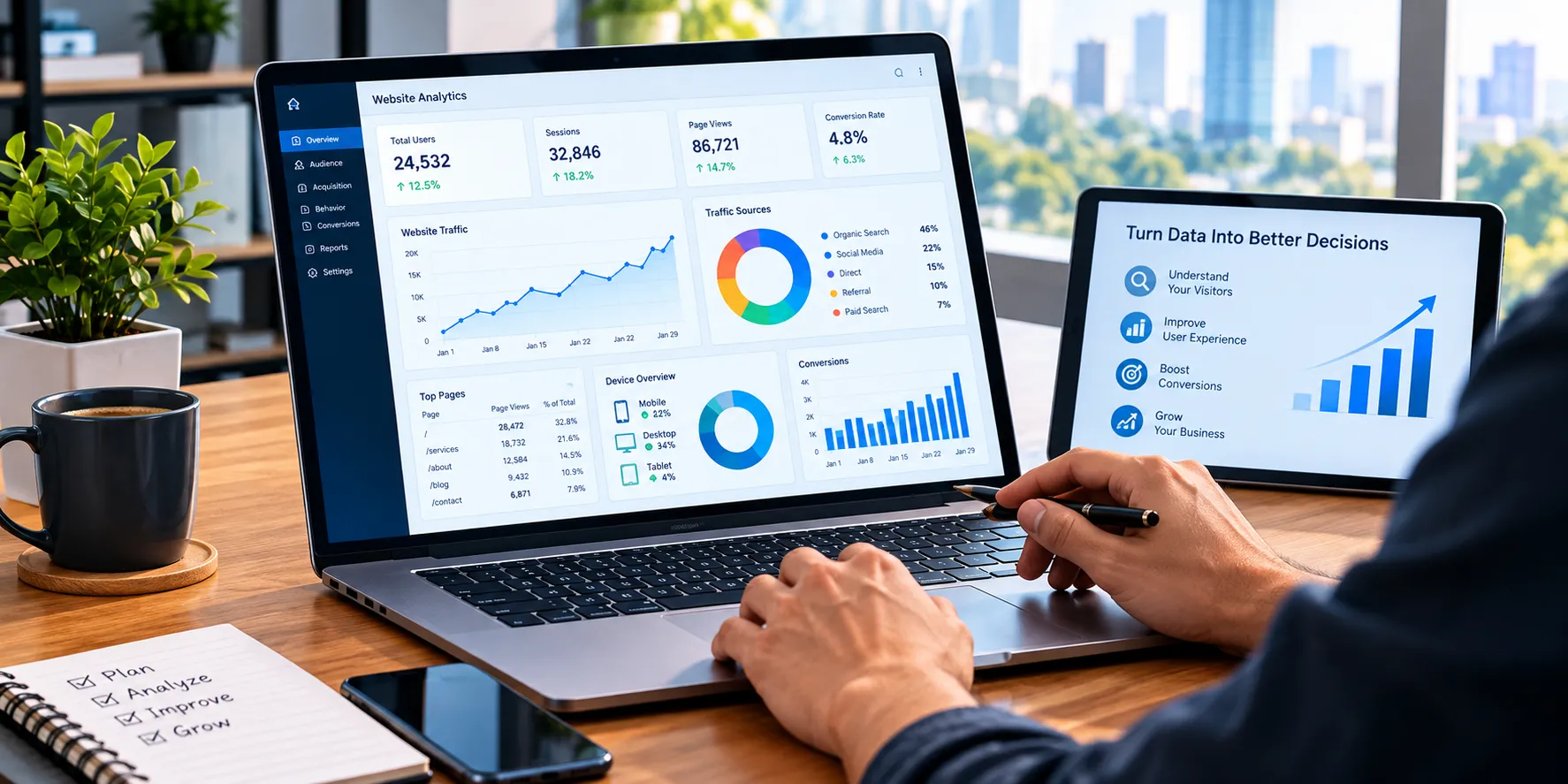
This is where website analytics becomes important. Website analytics helps businesses collect and analyze information about website traffic, visitor behavior, popular pages, and conversions. By understanding these insights, businesses can make informed decisions instead of relying entirely on assumptions.
In this article, we will explore what website analytics is, why it matters, and how businesses can use it to improve their online performance.
What Is Website Analytics?
Website analytics is the process of collecting, measuring, and analyzing data about how visitors use a website. It provides insights into where visitors come from, which pages they explore, how they navigate the website, and whether they complete important actions.
For example, a business can use website analytics to discover whether visitors arrive through search engines, social media, online advertisements, or direct website visits.
Tools such as Google Analytics can help businesses monitor website performance and understand visitor interactions. These insights allow business owners and marketing teams to identify what works well and what needs improvement.
Why Is Website Analytics Important for Businesses?
Website analytics helps businesses make decisions based on measurable information rather than guesswork. It provides a clearer understanding of customer interests, marketing effectiveness, and website performance.
1. Understand Visitor Behaviour
Understanding visitor behaviour is essential for creating a better online experience. Website analytics helps businesses identify popular pages, common navigation paths, and areas where visitors may leave the website.
For example, if visitors frequently view a service page but rarely submit an enquiry, the business can review the page’s content, contact options, and calls to action.
These insights help businesses improve their websites to better meet visitor expectations.
2. Measure Marketing Performance
Businesses invest in different marketing activities, including search engine optimisation, social media campaigns, email marketing, and paid advertising.
Website analytics helps measure how these activities contribute to website traffic and business goals. By comparing traffic sources and conversions, businesses can identify which channels bring valuable visitors.
This information supports better marketing decisions and helps businesses use their budgets more effectively.
3. Improve Website Conversion Rates
A website conversion occurs when a visitor completes a desired action, such as submitting a contact form, requesting a quotation, booking an appointment, or purchasing a product.
Analytics can help businesses understand how visitors move through the conversion process and where they encounter difficulties.
For example, if many visitors abandon a form before completing it, simplifying the form or improving its usability may help increase enquiries.
Tracking conversions makes it easier to evaluate whether website improvements are producing meaningful results.
4. Identify Popular Products and Services
Website analytics can reveal which products, services, and informational pages attract the most attention.
Businesses can use this information to understand customer interests and prioritise relevant content. An online store, for example, may discover that certain product categories receive more visits than others.
These insights can support decisions about product presentation, content development, promotional campaigns, and website navigation.
However, page views alone do not guarantee customer interest or sales. Businesses should also examine engagement and conversion data.
5. Enhance the Mobile User Experience
Many people browse websites using smartphones and tablets. A website that performs poorly on mobile devices may create frustration and discourage visitors from taking action.
By examining device categories, page performance, and relevant user interactions, businesses can identify opportunities to improve their mobile experience.
Possible improvements include making navigation simpler, improving page loading speed, using readable text, and ensuring that buttons and forms work properly on smaller screens.
A smoother mobile experience can make it easier for visitors to explore products and contact a business.
Important Website Analytics Metrics to Track
Businesses do not need to monitor every available metric. Instead, they should focus on measurements that align with their objectives.
Website Traffic
Website traffic shows how many visits or users a website receives over a selected period. Monitoring traffic trends can help businesses evaluate their online visibility and identify changes in visitor activity.
Traffic Sources
Traffic sources indicate how visitors arrive at a website, such as through organic search, paid advertising, social media, referrals, or direct visits.
Understanding these sources helps businesses evaluate their marketing channels.
Engagement
Engagement measurements help businesses understand how visitors interact with website content. Depending on the analytics tool, these measurements may include engaged sessions, engagement rate, and interactions with important elements.
Conversion Rate
Conversion rate measures the proportion of visitors or sessions that complete a defined action, depending on how the metric is configured.
Tracking conversion rates helps businesses assess whether their website effectively supports their goals.
Landing Page Performance
Landing pages are often the first pages visitors see when arriving at a website. Evaluating their traffic, engagement, and conversion performance helps businesses determine which pages are effective and which may need improvement.
How Businesses Can Use Website Analytics Effectively
Collecting data is only the first step. Businesses need a consistent process for turning that information into useful action.
Step 1: Define Clear Business Goals
Before tracking metrics, decide what the website should achieve. Goals might include generating enquiries, increasing online sales, encouraging appointment bookings, or attracting relevant visitors.
Clear goals help determine which metrics deserve attention.
Step 2: Set Up Analytics Tools Correctly
Choose an appropriate analytics platform and configure it to measure relevant activity. For example, Google Analytics can help businesses monitor website traffic, engagement, and configured events or conversions.
Check that tracking works correctly and that important actions are recorded consistently.
Step 3: Review Data Regularly
Review website performance at a consistent interval, such as weekly or monthly. Compare results over time and consider factors such as seasonal demand, campaign activity, and website changes.
Avoid making major decisions based on a single unusual day or a small amount of data.
Step 4: Identify Areas for Improvement
Look for patterns that may indicate opportunities. These might include pages with declining traffic, forms with low completion rates, or marketing channels that attract visitors who rarely convert.
Investigate the possible causes before deciding what to change.
Step 5: Test and Measure Improvements
Make focused improvements and measure their results. For example, a business could test a clearer call-to-action button or simplify a contact form.
Where practical, use structured experiments rather than assuming that every change will improve performance.
Over time, this process helps businesses develop a more effective and user-friendly website.
Common Website Analytics Mistakes to Avoid
Although analytics offers valuable insights, businesses should use it carefully.
Tracking too many metrics: Focusing on too many numbers can make it difficult to identify meaningful trends. Prioritise metrics that relate directly to business goals.
Ignoring data quality: Incorrect tracking or duplicate events can produce misleading reports. Review analytics configuration regularly.
Focusing only on traffic: More visitors do not necessarily mean more customers. Consider engagement, lead quality, and conversions alongside traffic.
Making decisions too quickly: Short-term fluctuations may not represent long-term trends. Consider sufficient data and relevant external factors.
Overlooking privacy: Businesses should handle visitor information responsibly, follow applicable privacy laws, and configure consent and data collection practices appropriately.
The Role of Professional Website Development
A well-designed website and reliable analytics work together. While analytics helps businesses understand website performance, professional website development helps turn those insights into practical improvements.
A clear structure, responsive design, fast-loading pages, useful content, and effective calls to action can make a website easier to use. Analytics can then help businesses evaluate how visitors respond to these improvements.
By combining thoughtful website design with data-driven decisions, businesses can build a stronger digital presence and create better experiences for their customers.
Conclusion
Website analytics gives businesses a clearer understanding of how their websites perform and how visitors interact with their online content. From identifying traffic sources to improving conversion rates, analytics supports smarter marketing decisions and more effective website development.
The key is to focus on meaningful business goals, collect reliable data, and use the findings to make continuous improvements.
Businesses that combine a user-friendly website with consistent performance analysis are better equipped to recognise opportunities, respond to customer needs, and strengthen their online presence.
Build a Smarter Digital Presence with Digital Murugan
Want to improve your business website and make better use of your online presence? Digital Murugan can help your business explore professional website solutions designed around your digital goals.
Contact Digital Murugan today to discuss your website requirements and discover opportunities to strengthen your business online.
 Previous Post