
Online Advertising: How to Reach the Right Audience and Grow Your Business
Imagine having an excellent product, a professional website and a service that genuinely solves a customer problem—but very few people know that your business exists.
That is one of the biggest challenges businesses face today.
Building something valuable is only part of the journey. You also need a reliable way to put that product or service in front of people who are most likely to need it.
This is where online advertising becomes powerful.
Instead of relying only on people discovering your business organically, online advertising allows you to actively place your products, services or brand in front of relevant audiences across search engines, websites, social platforms, video platforms, apps and other digital channels.
More importantly, effective advertising is not simply about getting more views.
It is about reaching the right people, with the right message, at the right moment—and giving them a clear reason to take action.
What Is Online Advertising?
Online advertising is the practice of promoting products, services, brands or offers through digital channels.
Depending on your objective, online advertising can be used to:
- Build brand awareness
- Generate website traffic
- Generate leads
- Increase enquiries
- Promote products
- Drive online purchases
- Generate phone calls
- Encourage app installations
- Promote events
- Reach new markets
- Reconnect with previous visitors or customers
Google describes online advertising as a way to reach people who are likely to be interested in a product or service and measure actions such as clicks and conversions.
The important word here is relevance.
An advertisement shown to 100 highly relevant prospects can be more valuable than an advertisement shown to thousands of people who have no interest in what you sell.
Why Online Advertising Matters for Business Growth
Traditional advertising often depends heavily on broad exposure.
Digital advertising can make the process more targeted and measurable.
For example, a business may want to reach:
- People searching for a specific product
- Professionals in a particular industry
- Customers in a specific city or country
- People interested in a particular category
- Visitors who previously visited its website
- People who interacted with its digital content
- Potential customers showing signs of purchase intent
Modern advertising platforms provide different targeting options based on factors such as location, interests, search behaviour, audience characteristics and previous interactions.
This gives businesses an opportunity to move from:
“Let’s advertise to everyone.”
to:
“Let’s reach the people most likely to care.”
That shift can make advertising considerably more strategic.
Online Advertising Is Not the Same as Simply Boosting a Post
One common misconception is that online advertising means putting money behind a social media post and waiting for results.
Effective advertising requires much more thought.
Before launching a campaign, you should understand:
Who are you trying to reach?
What problem are you solving?
What action do you want people to take?
Where are those people most likely to discover you?
What message will make them stop and pay attention?
What happens after they click?
How will you measure whether the campaign worked?
Without these answers, even a visually attractive advertisement can waste money.
Advertising should be treated as a business system rather than an isolated promotional activity.
Start With the Goal, Not the Advertisement
One of the most important decisions is determining what you actually want your campaign to achieve.
Different objectives require different approaches.
Brand Awareness
If your business is new or entering a new market, your initial objective may be to increase awareness.
The goal is not necessarily an immediate sale.
You may want more relevant people to recognize your brand and understand what you offer.
Website Traffic
You may want potential customers to visit a website, landing page, portfolio or product page.
In traffic-focused campaigns, metrics such as clicks and click-through rate can help you evaluate how effectively your advertising attracts visitors.
Lead Generation
For service businesses, the primary objective may be generating enquiries.
That could mean:
- Contact form submissions
- Phone calls
- WhatsApp enquiries
- Consultation requests
- Appointment bookings
- Quote requests
Sales
For an e-commerce business, the objective may be online purchases.
The advertising strategy should therefore be designed around the customer journey from discovery to purchase.
App Installs
Businesses promoting mobile applications may focus on getting qualified users to install and engage with the app.
The key lesson is simple:
Choose the destination before choosing the road.
If you do not know what success looks like, it becomes difficult to determine whether your advertising is actually working.
Know Your Audience Before Spending Money
The quality of your targeting can have a major impact on campaign performance.
Start by defining your ideal customer.
Consider:
- Age range
- Location
- Language
- Profession
- Industry
- Interests
- Problems
- Buying behaviour
- Budget
- Search intent
- Stage in the buying journey
But demographics alone are not enough.
Ask a more important question:
What is this person trying to accomplish?
For example, someone searching for:
“best accounting software”
may be researching options.
Someone searching for:
“accounting software pricing”
may be closer to making a decision.
Someone searching for:
“buy accounting software for small business”
may have even stronger commercial intent.
The words people use can reveal what they need and where they are in their decision-making process.
Google Ads, for example, provides keyword and search-term information that can help advertisers understand what searches are triggering their ads and refine their campaigns accordingly.
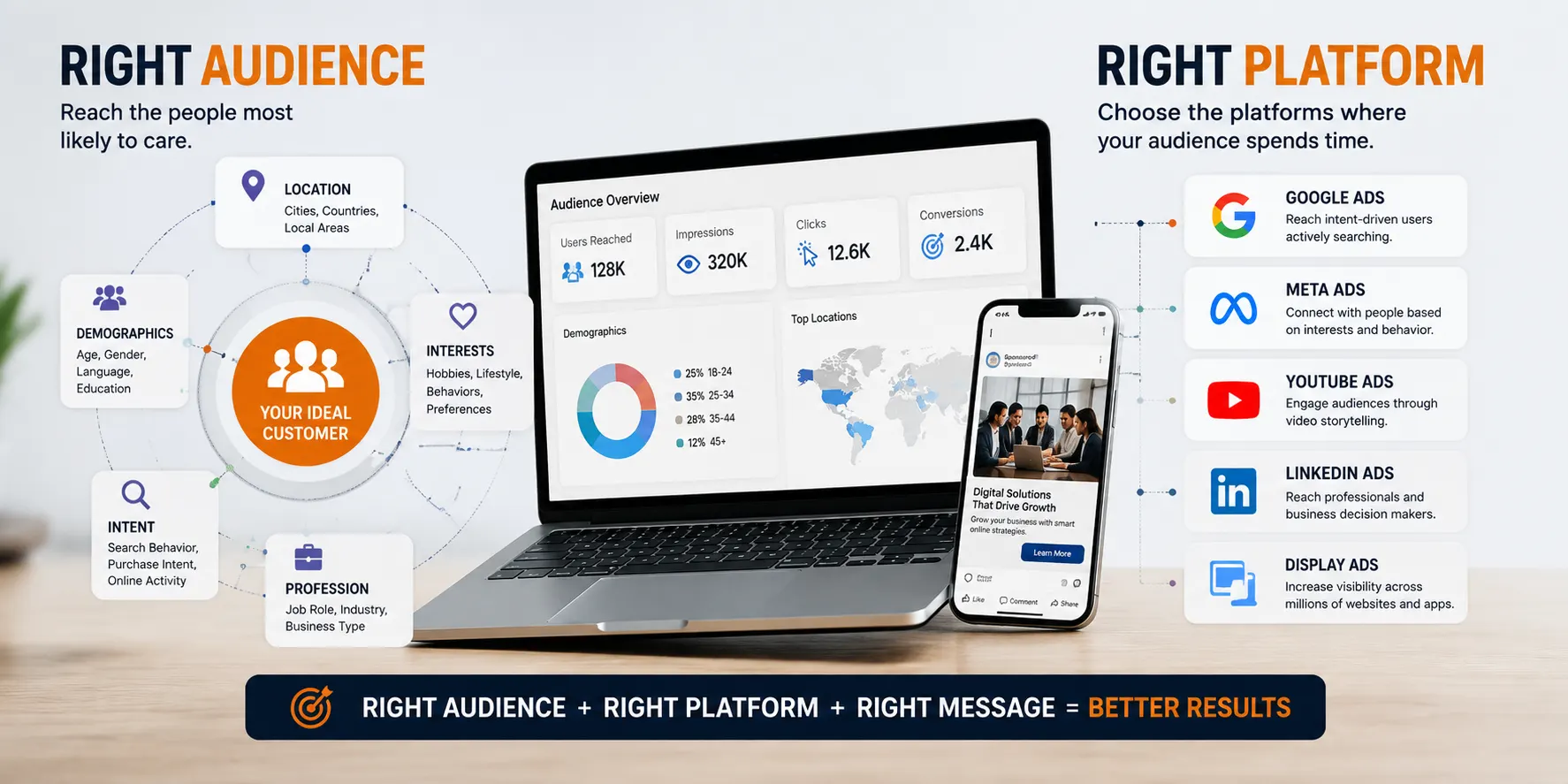
Choose the Right Advertising Platform
There is no universal “best” advertising platform.
The right platform depends on your audience and objective.
Search Advertising
Search advertising can be particularly useful when people are actively looking for a solution.
For example:
- Web design services
- Accounting services
- Digital marketing agencies
- Hotels
- Software
- Professional services
- Local businesses
The advantage is intent.
The person is already searching.
Social Media Advertising
Social platforms can be useful when visual storytelling, audience discovery and brand engagement are important.
They can work particularly well for:
- Consumer products
- Fashion
- Food
- Lifestyle brands
- Creators
- Events
- Local services
- Visual businesses
Video Advertising
Video can communicate emotion, demonstrations, stories and product experiences more effectively than static formats in many situations.
Video advertising can therefore be useful for:
- Product demonstrations
- Brand stories
- Tutorials
- Testimonials
- Explainer content
- Product launches
Display Advertising
Display advertising can help businesses reach audiences across websites and apps.
It can also be useful for remarketing and maintaining brand visibility among people who have previously interacted with a business.
Professional and Industry Platforms
For B2B businesses, professional networks can be useful when the audience is defined by job role, industry, company type or professional interests.
The right platform is the one where your potential customers actually spend attention.
Your Advertisement Has Only a Few Seconds to Earn Attention
Once you identify the audience and platform, the next challenge is your creative.
A successful advertisement needs to communicate value quickly.
A strong ad usually answers three questions:
What is this?
The viewer should understand what you are offering.
Why should I care?
The advertisement should connect with a need, problem, desire or opportunity.
What should I do next?
The next step should be clear.
For example:
Weak:
“Welcome to our digital marketing agency.”
Stronger:
“Turn More Website Visitors Into Qualified Leads.”
The second message immediately focuses on a business outcome.
Sell the Outcome, Not Just the Feature
Features describe what your product does.
Benefits explain why the customer should care.
Suppose you are advertising a website development service.
A feature might be:
Responsive website development.
A benefit-oriented message could be:
Give customers a faster, easier way to discover your business on every device.
The second message connects the service to a result.
This does not mean every advertisement needs an exaggerated promise.
In fact, credible advertising is usually stronger when it clearly communicates a realistic benefit rather than making impossible claims.
Your Landing Page Is Part of the Advertisement
One of the biggest advertising mistakes is focusing heavily on the advertisement while ignoring what happens after the click.
Imagine an ad promising:
“Launch Your Professional Business Website.”
A user clicks.
Instead of finding a relevant landing page, they arrive on a generic homepage with dozens of unrelated services.
The connection is broken.
The landing page should continue the conversation started by the advertisement.
If the ad promotes one specific service, the destination should make that service easy to understand.
A strong landing page should generally provide:
- Clear headline
- Relevant offer
- Benefits
- Supporting information
- Trust signals
- Visual proof
- Clear CTA
- Easy contact or purchase process
The journey should feel continuous:
Advertisement → Landing Page → Action
Not:
Advertisement → Confusion → Exit
Google’s advertising guidance also emphasizes the relevance between ads, keywords and landing pages when improving campaign performance.
Set a Budget Based on Learning, Not Guesswork
A common question is:
“How much should I spend on online advertising?”
There is no universal answer.
Your budget depends on:
- Industry
- Competition
- Customer value
- Geographic market
- Advertising platform
- Campaign objective
- Conversion rate
- Sales cycle
- Available resources
Instead of asking only:
“How little can I spend?”
ask:
“How much do I need to learn?”
A controlled initial campaign can help you discover:
- Which audience responds
- Which message attracts attention
- Which creative performs better
- Which locations work
- Which keywords produce relevant traffic
- Which landing pages convert
- Which customers are most valuable
Advertising becomes more intelligent as you gather useful data.
Understand the Numbers Behind Your Campaign
You do not need to become a data scientist to understand online advertising.
But you should know the basic metrics.
Impressions
How many times your advertisement was shown.
Reach
How many people were estimated to have seen your advertisement.
Clicks
How many times people clicked.
CTR — Click-Through Rate
The percentage of impressions that resulted in clicks.
CPC — Cost Per Click
How much you paid, on average, for a click.
Conversions
The valuable action you defined for your campaign.
Conversion Rate
The percentage of visitors who completed the desired action.
CPA — Cost Per Acquisition
How much it costs, on average, to generate a desired acquisition or conversion.
ROAS — Return on Ad Spend
Revenue generated relative to advertising spend.
These numbers should not be evaluated in isolation.
A campaign with a low CPC is not automatically successful if the traffic does not convert.
Similarly, a campaign with a higher CPC may still be valuable if it produces high-quality customers.
The real question is:
Is the advertising generating valuable business outcomes?
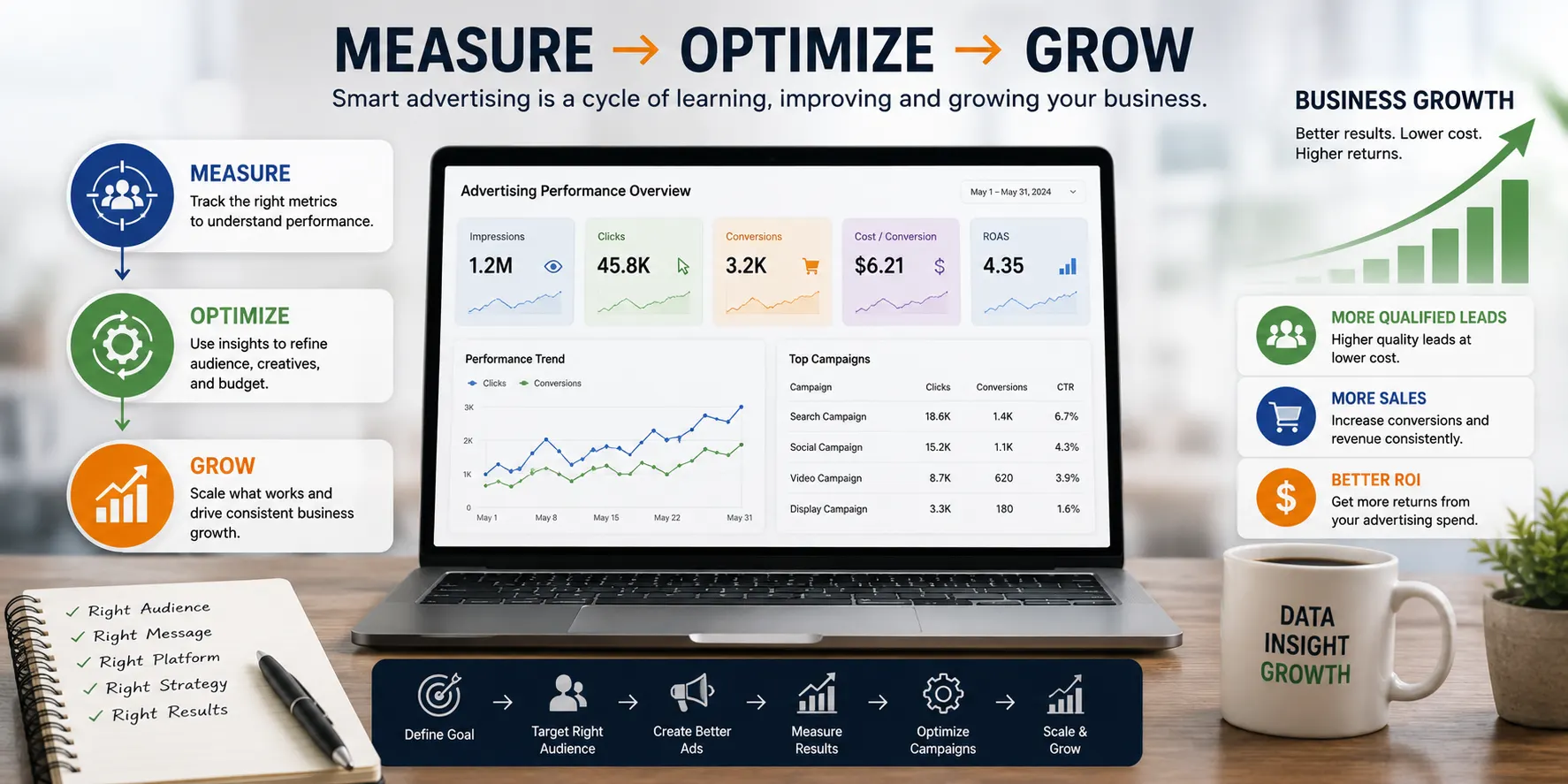
Do Not Optimize for Vanity Metrics
Likes can be encouraging.
Views can look impressive.
Reach can look exciting.
But none of these automatically means your business is growing.
If your objective is lead generation, you need to know how many qualified leads you generated.
If your objective is sales, you need to know how many purchases resulted.
If your objective is phone enquiries, you need to know whether the advertising generated relevant calls.
The closer a metric is to your actual business objective, the more useful it becomes.
Retargeting Can Reconnect With Interested People
Not everyone who visits your website will buy immediately.
Someone may:
- Browse your service
- Read your offer
- Compare competitors
- Leave to think about it
- Return later
- Forget about the business
Remarketing or retargeting can help businesses reconnect with people who have previously interacted with their website, app or other digital assets, depending on the platform and available audience setup.
This can be particularly useful for longer buying journeys.
For example:
First interaction: Discover the brand.
Second interaction: Learn about the service.
Third interaction: Compare options.
Fourth interaction: Make an enquiry.
The objective is not to annoy people with endless advertisements.
The objective is to remain relevant while they are still considering the solution.
Test Different Messages
You rarely know the perfect advertisement before launching it.
That is why testing matters.
You can test:
- Headlines
- Images
- Videos
- Offers
- Calls to action
- Landing pages
- Audience segments
- Locations
- Ad formats
For example:
Version A:
“Build a Better Online Presence.”
Version B:
“Turn Your Online Presence Into a Growth Engine.”
Both communicate a similar idea, but the second focuses more strongly on business outcomes.
The data can tell you which message resonates better with your audience.
Testing does not mean randomly changing everything at once.
It means making deliberate improvements and learning from the results.
Common Online Advertising Mistakes
1. Targeting Everyone
Trying to reach everyone often means your message connects deeply with no one.
2. Starting Without a Clear Objective
If you don’t know what you want the campaign to achieve, measurement becomes difficult.
3. Focusing Only on Cheap Clicks
Cheap traffic is not necessarily valuable traffic.
4. Sending Everyone to the Homepage
Different campaigns often deserve different landing experiences.
5. Using Weak Creative
If the advertisement does not earn attention, targeting alone cannot save it.
6. Making Unrealistic Promises
Aggressive claims may generate curiosity but can damage trust.
7. Ignoring Mobile Users
Many customers encounter advertisements on smartphones, so the complete journey—from ad to landing page—should work well on mobile devices.
8. Stopping Too Early
Some campaigns need enough data before meaningful conclusions can be made.
9. Never Reviewing Search Terms or Audience Data
Campaign data can reveal what people are actually responding to. Regular review can uncover opportunities and irrelevant traffic.
10. Treating Advertising as a One-Time Activity
Online advertising works best as a continuous process of testing, measuring and improving.
A Simple Online Advertising Framework
If you are starting from scratch, use this framework:
Step 1 — Define the Goal
Choose one primary objective.
Awareness? Leads? Sales? App installs? Enquiries?
Step 2 — Define the Customer
Identify who is most likely to value your offer.
Step 3 — Choose the Platform
Go where your potential customers are most likely to discover or search for your solution.
Step 4 — Create the Message
Communicate the problem, benefit or opportunity clearly.
Step 5 — Build the Creative
Use an image, video or text format that suits the platform.
Step 6 — Create the Destination
Send users to a relevant landing page or action.
Step 7 — Measure
Track meaningful results.
Step 8 — Learn
Identify what worked and what did not.
Step 9 — Improve
Adjust targeting, creative, messaging, landing pages or budget allocation.
Step 10 — Scale Carefully
When you identify a repeatable combination of audience, message and conversion, gradually increase investment rather than blindly increasing spending.
This creates a simple cycle:
Plan → Launch → Measure → Learn → Improve → Scale
Online Advertising Should Work With Your Other Marketing
Advertising should not operate in isolation.
It becomes more powerful when connected with your broader digital presence.
For example:
Online Advertising
↓
Website / Landing Page
↓
Content & Social Proof
↓
Enquiry / Purchase
↓
Follow-Up
↓
Customer Relationship
↓
Repeat Business & Referrals
Your website, branding, social media, content, email marketing, WhatsApp communication and customer experience all influence what happens after someone sees your advertisement.
That is why a beautiful ad cannot compensate for a weak overall digital presence.
The Future of Online Advertising Is More About Relevance
Technology will continue to change.
Platforms will introduce new formats.
Targeting capabilities will evolve.
Artificial intelligence will influence campaign creation and optimization.
Customer behaviour will continue to shift.
But one principle is unlikely to change:
People respond to relevant messages.
A customer does not care that your business spent money on advertising.
They care whether your message is relevant to their problem.
They care whether your product can help.
They care whether they trust your business.
And they care whether taking the next step feels worthwhile.
The strongest advertisers therefore focus less on simply buying attention and more on earning meaningful attention.
Final Thoughts
Online advertising can give businesses something traditional advertising often struggles to provide at the same level: the ability to target, measure, learn and improve.
But successful advertising is not about spending the most money.
It is about using your budget intelligently.
Find the right audience.
Understand what they need.
Choose the right platform.
Create a compelling and credible message.
Send people to a relevant destination.
Measure what happens.
Learn from the data.
Improve the campaign.
Then scale what works.
That is how online advertising can move from being simply an expense on a marketing budget to becoming a measurable part of a business growth strategy.
The goal is not to reach everyone.
The goal is to reach the people who matter.
And when the right audience sees the right message at the right moment, an advertisement can become much more than an impression or a click.
It can become a customer, a conversation, a sale—and eventually a long-term business relationship.
Ready to Turn Your Advertising Into a Growth Strategy?
Digital Murugan helps businesses build stronger digital visibility through strategic digital marketing, creative advertising and online growth solutions.
If your business is ready to reach the right audience and turn digital attention into meaningful opportunities, a well-planned online advertising strategy can be the next step.
Advertise Smarter. Reach Better. Grow Stronger.
 Previous Post
 Next Post