
How Influencer Marketing Can Help Your Business Grow
People increasingly discover products, services, and brands through individuals they already follow and trust. From social media creators and industry experts to niche content publishers, influencers can play an important role in how audiences discover and evaluate businesses.
This has made influencer marketing an increasingly useful part of modern digital marketing strategies.
However, successful influencer marketing is not simply about paying someone with a large following to promote a product. The most effective campaigns focus on relevance, credibility, audience fit, creative storytelling, and measurable business objectives.
When planned strategically, influencer marketing can help businesses increase awareness, reach new audiences, build trust, generate engagement, and support long-term growth.
What Is Influencer Marketing?
Influencer marketing is a marketing approach in which a business collaborates with a creator or influential individual to communicate its products, services, or brand to their audience.
Influencers can operate across platforms such as:
- YouTube
- TikTok
- Podcasts
- Blogs
- Online communities
The right influencer is not necessarily the person with the largest audience.
A creator with a smaller but highly relevant and engaged audience can sometimes be more valuable than a celebrity whose followers have little connection with the product or service.
Why Influencer Marketing Matters for Business Growth
Traditional advertising often places a brand’s message directly in front of an audience.
Influencer marketing works differently.
Instead of communicating only through the brand itself, the message can be introduced through a creator who has already developed a relationship with their audience.
This can help businesses:
- Reach new potential customers
- Increase brand awareness
- Build social proof
- Generate content
- Improve product discovery
- Strengthen credibility
- Drive website traffic
- Support sales and conversions
The effectiveness depends heavily on choosing the right creator and designing the campaign around a clear objective.
1. Start With a Clear Business Objective
Before searching for influencers, determine what the campaign is supposed to achieve.
Possible objectives include:
- Increasing brand awareness
- Launching a new product
- Generating website traffic
- Growing social media visibility
- Increasing leads
- Driving sales
- Collecting user-generated content
- Reaching a new market
Different objectives require different campaign structures.
For example, an awareness campaign may prioritize reach and visibility, while a conversion-focused campaign may use trackable links, discount codes, landing pages, or affiliate arrangements.
A clear objective makes it easier to select influencers and measure results.
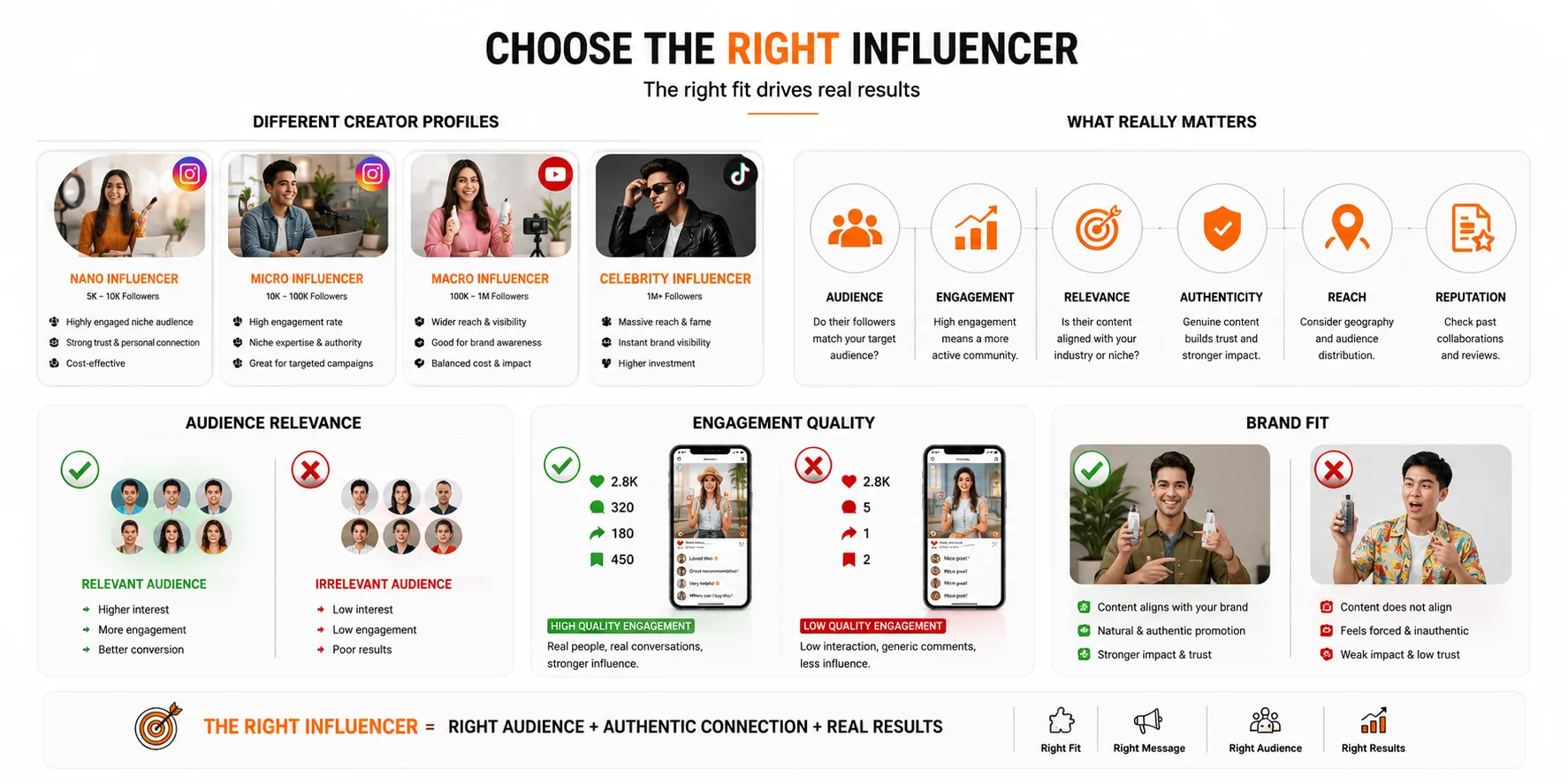
2. Choose Influencers Based on Relevance
Follower count should not be the first thing you look at.
Instead, consider whether the influencer’s audience is relevant to your business.
Look at:
- Content niche
- Audience demographics
- Geographic reach
- Engagement quality
- Content style
- Audience interests
- Previous brand collaborations
- Overall reputation
A technology creator may be highly effective for a software product but completely unsuitable for a luxury fashion campaign.
Relevance often matters more than raw audience size.
3. Understand Different Types of Influencers
Influencers are often grouped according to audience size.
Nano Influencers
These creators typically have smaller, highly focused communities.
They can be useful for niche products, local campaigns, and highly targeted audiences.
Micro Influencers
Micro influencers often have a stronger connection with specific communities and may generate meaningful engagement within their niche.
Macro Influencers
These creators reach larger audiences and can be useful when broad awareness is an important campaign objective.
Celebrity Influencers
Celebrities can provide substantial visibility, but they may also involve significantly higher costs and may not always provide the audience relevance required for a particular product.
The best choice depends on your campaign objective rather than simply selecting the largest account.
4. Evaluate Engagement, Not Just Followers
A large follower count does not automatically mean strong influence.
A creator with hundreds of thousands of followers may receive relatively little meaningful interaction, while a smaller creator may have a highly active community.
Look at indicators such as:
- Comments
- Shares
- Saves
- Views
- Clicks
- Audience responses
- Repeat engagement
- Content quality
More importantly, examine whether the engagement appears genuine.
Sudden spikes in followers or unusually repetitive comments can be warning signs that require further investigation.
5. Give Influencers Creative Freedom
One of the strengths of influencer marketing is that creators understand how their audience prefers to consume content.
Giving them a rigid script can make promotional content feel unnatural.
Instead, businesses should provide:
- Campaign objectives
- Key product information
- Important brand guidelines
- Required disclosures
- Mandatory talking points
- Content restrictions
Then allow the creator to communicate the message in their own authentic style.
The balance is important: the brand should control its identity and requirements while allowing the creator to control the storytelling style.
6. Create Different Types of Influencer Campaigns
Influencer marketing can take many forms.
Product Reviews
Creators test a product and share their experience with their audience.
Tutorials
The influencer demonstrates how a product or service works.
Sponsored Content
A creator publishes paid content featuring the brand or product.
Product Launches
Influencers introduce a new product to their audience during a launch campaign.
Giveaways
Brands collaborate with creators to generate awareness and participation.
Affiliate Marketing
Creators receive a commission for generating sales through trackable links or codes.
User-Generated Content
Creators produce visual content that businesses can potentially reuse across their own marketing channels, subject to agreed usage rights.
Choosing the right format depends on the campaign objective.
7. Build Long-Term Creator Relationships
One-off collaborations can generate short-term attention, but long-term creator partnerships can create stronger brand familiarity.
When the same creator works with a brand over time, their audience may become more familiar with the product and its positioning.
Long-term partnerships can include:
- Recurring sponsored content
- Product education
- Ambassador programs
- Affiliate partnerships
- Product launches
- Exclusive campaigns
- Event participation
The relationship should feel credible rather than repetitive.
8. Measure the Right Metrics
Influencer marketing should be measurable.
Useful metrics include:
Reach
How many people saw the campaign?
Engagement
How many people interacted with the content?
Website Traffic
How much traffic came from the influencer?
Leads
How many potential customers were generated?
Conversions
How many people completed the desired action?
Sales
How much revenue was directly or indirectly generated?
Return on Investment
How does the campaign’s business outcome compare with its total cost?
Using unique links, landing pages, promotional codes, affiliate tracking, and platform analytics can make campaign measurement more effective.
9. Consider Content Quality and Reusability
Influencer campaigns can produce valuable marketing assets beyond the original post.
Depending on the agreement, businesses may be able to use creator-generated content for:
- Social media
- Advertisements
- Website content
- Product pages
- Email campaigns
- Marketing presentations
However, content usage rights should be clearly agreed upon before the campaign begins.
This can make an influencer partnership more valuable because one collaboration may generate multiple pieces of useful content.
10. Make Authenticity a Priority
Audiences are increasingly exposed to sponsored content.
If every creator promotes the same type of product using identical language, audiences may become less responsive.
Authenticity can be strengthened when:
- The product genuinely fits the creator
- The creator understands the product
- The content matches their normal style
- The campaign provides useful information
- Sponsored relationships are clearly disclosed
The objective should not be to make paid content look like something it is not.
Instead, the goal should be to make the partnership genuinely useful and relevant to the audience.
11. Avoid Common Influencer Marketing Mistakes
Several mistakes can reduce campaign effectiveness.
Choosing Influencers Only by Follower Count
Large audiences are not automatically relevant audiences.
Ignoring Audience Quality
A creator’s audience should be examined for relevance, geography, demographics, and authenticity.
Over-Controlling the Content
Excessive scripting can make the content feel unnatural.
Having No Clear Objective
Without a defined goal, it becomes difficult to measure success.
Ignoring Disclosure Requirements
Paid partnerships and sponsored content should follow applicable advertising and disclosure requirements.
Failing to Track Results
Without measurable data, it is difficult to understand whether the campaign created meaningful business value.
12. Influencer Marketing and the Customer Journey
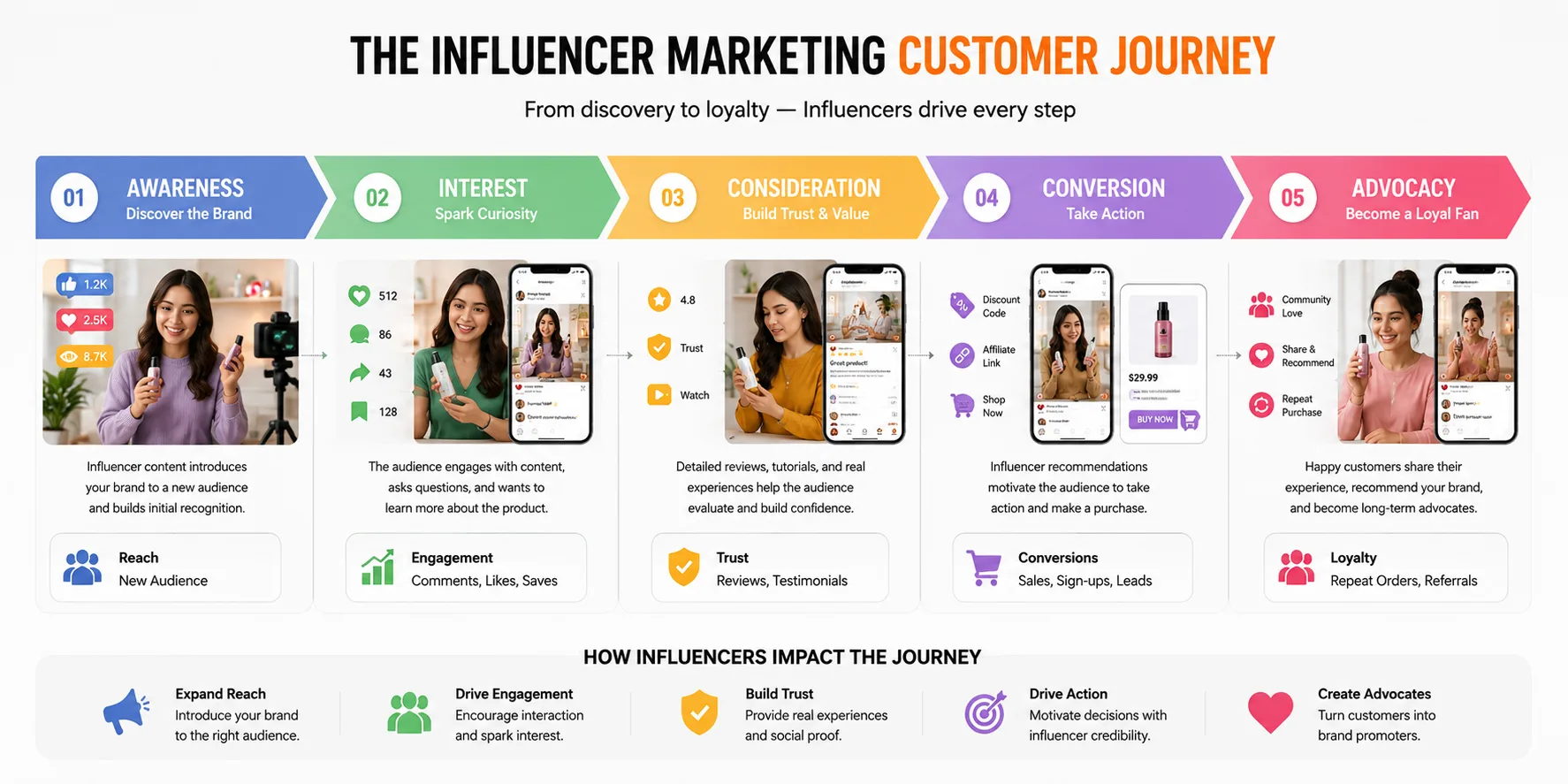
Influencer marketing can contribute to different stages of the customer journey.
Awareness
A creator introduces the brand to a new audience.
↓
Interest
The audience explores the product or service.
↓
Consideration
Reviews, demonstrations, comparisons, and educational content help people evaluate the offering.
↓
Conversion
A promotional code, affiliate link, landing page, or direct purchase opportunity encourages action.
↓
Advocacy
Satisfied customers may later create their own content or recommend the product.
This is why influencer marketing should be viewed as part of a broader marketing system rather than an isolated social media activity.
13. Combine Influencer Marketing With Other Channels
Influencer campaigns can become more effective when integrated with other digital marketing activities.
For example:
Influencer Content + Social Media + SEO + Email Marketing + Paid Advertising
A creator’s content can generate awareness, while the business website provides detailed information, search engines capture ongoing demand, email supports follow-up communication, and paid advertising can extend the reach of high-performing content.
This creates a more connected customer journey.
14. The Role of AI in Influencer Marketing
AI is also changing how businesses manage influencer campaigns.
AI-powered tools can assist with:
- Creator discovery
- Audience analysis
- Content research
- Campaign planning
- Performance analysis
- Trend identification
- Content repurposing
- Reporting
However, technology should support decision-making rather than replace human judgment.
A creator’s personality, credibility, audience relationship, and brand fit still require careful evaluation.
How to Build a Successful Influencer Marketing Strategy
A practical approach can be summarized in these steps:
Step 1: Define the business objective.
Step 2: Identify the target audience.
Step 3: Determine the right platforms.
Step 4: Research relevant creators.
Step 5: Evaluate audience quality and engagement.
Step 6: Select the appropriate campaign format.
Step 7: Establish clear expectations and usage rights.
Step 8: Give creators enough creative freedom.
Step 9: Track campaign performance.
Step 10: Analyze results and improve future campaigns.
Conclusion
Influencer marketing can be a powerful component of a modern business growth strategy, but success depends on much more than finding someone with a large following.
The strongest campaigns are built around relevance, authenticity, clear objectives, creative collaboration, measurable results, and long-term relationships.
Businesses that carefully select the right creators and connect influencer activity with their broader marketing strategy can turn social influence into meaningful brand awareness, customer engagement, and business growth.
The goal should not simply be to reach more people.
It should be to reach the right people with the right message through a voice they already trust.
Frequently Asked Questions
What is influencer marketing?
Influencer marketing is a strategy in which businesses collaborate with creators or influential individuals to promote products, services, or brands to their audiences.
Is influencer marketing suitable for every business?
Not necessarily. Its effectiveness depends on the target audience, product, industry, platform, campaign objective, and availability of relevant creators.
How do I choose the right influencer?
Look at relevance, audience demographics, engagement quality, content style, reputation, geographic reach, and previous partnerships rather than focusing only on follower count.
Are micro influencers effective?
Micro influencers can be highly effective when their audience closely matches a brand’s target market. Their smaller communities can sometimes provide strong engagement and niche relevance.
How can influencer marketing generate sales?
Businesses can use trackable links, landing pages, promotional codes, affiliate programs, and conversion tracking to measure and support sales generated through influencer campaigns.
How should influencer marketing success be measured?
Depending on the objective, businesses can measure reach, engagement, website traffic, leads, conversions, sales, content performance, and return on investment.
Can AI help with influencer marketing?
Yes. AI can assist with creator discovery, audience analysis, campaign research, reporting, trend analysis, and content workflows, while human judgment remains important for evaluating authenticity and brand fit.
 Previous Post